
The wild duck
Henrik Ibsen
THE CLASSIC COLLECTION · 1908
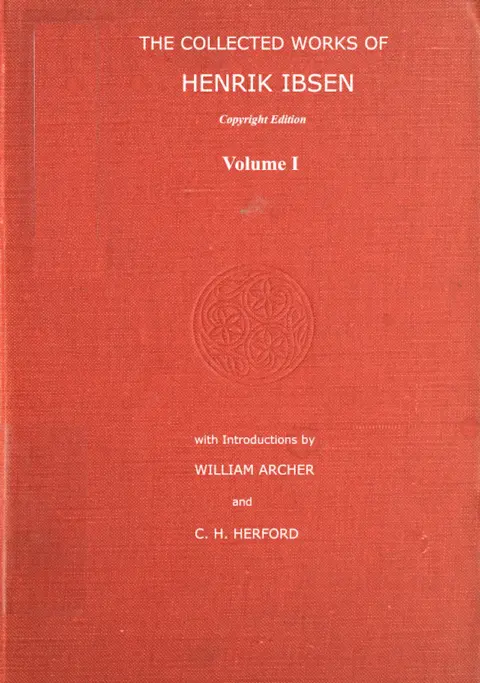
"The Collected Works of Henrik Ibsen, Vol. 01 (of 11)" by Henrik Ibsen is a collection of dramatic works written in the late 19th century. This volume includes three plays: "Lady Inger of Östråt," "The Feast at Solhoug," and "Love's Comedy." These works explore intricate themes of power dynamics, societal norms, and personal struggles, with characters that navigate the complexities of love, ambition, and familial duty. At the start of "Lady Inger of Östråt," the stage is set in the dramatic backdrop of Norway in 1528, where Lady Inger is at the center of an impending conflict. We find her receiving guests and grappling with a sense of national degradation under Danish rule, exemplified through the discussions among her servants and peasants about rising against their oppressors. The opening introduces tensions surrounding Lady Inger’s ambitions for her family and her struggles with the looming threats posed by the political landscape. The scene is charged with emotions as Elina, her daughter, reflects on the weight of their heritage and the sacrifices made for power, setting the foundation for the intricate relationships and moral dilemmas that will unfold throughout the play.
Introduction adapted from the source catalogue; source summaries may be automatically generated.
Free to read · English · 81,990 words · No account needed
MAKE TIME FOR A GOOD BOOK
On by default. Untick to stop anonymous reading totals. Each page counts after 10 seconds in view. How this works.
Anonymous counting is on unless you have switched it off.
Pay is the first condition of a priest In Asia, Africa, America, Or where you will. Ah yes, if he were free, My dear young friend, I willingly agree, The thing might pass; but, being pledged and bound, He’ll scarcely find the venture very sound. Reflect, he’s young and vigorous, sure to found A little family in time; assume his will To be the very best on earth—but still The means, my friend—? ‘Build not upon the sand,’ Says Scripture. If, upon the other hand, The Offering—
That’s no trifle, I’m aware.
Ah, come—that wholly alters the affair.
When men are zealous in their Offering,
And liberal—
There he far surpasses most.
“He” say you? How? In virtue of his post
The Offering is not what he has to bring
But what he has to get.
MRS. STRAWMAN [looking towards the background].
They’re sitting there.
FALK [after staring a moment in amazement, suddenly understands and bursts out laughing].
Hurrah for Offerings—the ones that caper
And strut—on Holy-days—in bulging paper!
All the year round the curb and bit we bear, But Whitsuntide and Christmas make things square.
FALK [gaily].
Why then, provided only there’s enough of it, Even family-founders will obey their Calls.
Of course; a man assured the quantum suff of it Will preach the Gospel to the cannibals.
[Sotto voce.
Now I must see if she cannot be led,
[To one of the little girls.
My little Mattie, fetch me out my head—
My pipe-head I should say, my little dear—
[Feels in his coat-tail pocket.
Nay, wait a moment tho’: I have it here.
[Goes across and fills his pipe, followed by his
wife and children.
GULDSTAD [approaching].
You seem to play the part of serpent in
This paradise of lovers.
O, the pips
Upon the tree of knowledge are too green
To be a lure for anybody’s lips.
[To LIND, who comes in from the right.
Ha, Lind!
In heaven’s name, who’s been ravaging Our sanctum? There the lamp lies dashed To pieces, curtain dragged to floor, pen smashed, And on the mantelpiece the ink pot splashed—
FALK [clapping him on the shoulder].
This wreck’s the first announcement of my spring;
No more behind drawn curtains I will sit,
Making pen poetry with lamp alit;
My dull domestic poetising’s done,
I’ll walk by day, and glory in the sun:
My spring is come, my soul has broken free,
Action henceforth shall be my poetry.
Your reading position is saved on this browser. Take it to another device with a library code. Reading pages adapt to text, rather than matching a printed edition.
BEHIND THE BOOK
This eBook is for the use of anyone anywhere in the United States and most other parts of the world at no cost and with almost no restrictions whatsoever. You may copy it, give it away or re-use it under the terms of the Project Gutenberg License included with this eBook or online at www.gutenberg.org. If you are not located in the United States, you will have to check the laws of the country where you are located before using this eBook. Read the source licence.
The original source file, including credits and licence, is retained by this library. Request an original-format copy at no charge. Please include the book title and Project Gutenberg identifier #66060.
KEEP YOUR CURIOSITY GOING
Maurice Baring
W. B. (William Butler) Yeats
Edward Martyn

John Brougham & Charlotte Brontë
Marguerite Merington
Leonid Andreyev


