
The wild duck
Henrik Ibsen
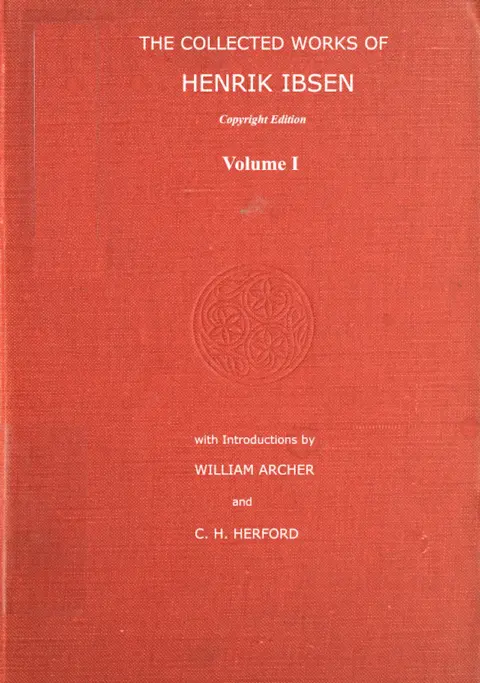
THE CLASSIC COLLECTION · 1908
"The Collected Works of Henrik Ibsen, Vol. 01 (of 11)" by Henrik Ibsen is a collection of dramatic works written in the late 19th century. This volume includes three plays: "Lady Inger of Östråt," "The Feast at Solhoug," and "Love's Comedy." These works explore intricate themes of power dynamics, societal norms, and personal struggles, with characters that navigate the complexities of love, ambition, and familial duty. At the start of "Lady Inger of Östråt," the stage is set in the dramatic backdrop of Norway in 1528, where Lady Inger is at the center of an impending conflict. We find her receiving guests and grappling with a sense of national degradation under Danish rule, exemplified through the discussions among her servants and peasants about rising against their oppressors. The opening introduces tensions surrounding Lady Inger’s ambitions for her family and her struggles with the looming threats posed by the political landscape. The scene is charged with emotions as Elina, her daughter, reflects on the weight of their heritage and the sacrifices made for power, setting the foundation for the intricate relationships and moral dilemmas that will unfold throughout the play.
Introduction adapted from the source catalogue; source summaries may be automatically generated.
Free to read · English · 81,990 words · No account needed
MAKE TIME FOR A GOOD BOOK
On by default. Untick to stop anonymous reading totals. Each page counts after 10 seconds in view. How this works.
Anonymous counting is on unless you have switched it off.
Valkyrias find no market in this land! When the faith lately was assailed in Syria, Did you go out with the crusader-band? No, but on paper you were warm and willing,— And sent the “Clerical Gazette” a shilling.
[Pause. FALK is about to retort, but checks himself, and goes into the garden.
[After watching him a moment, approaches him and
asks gently:
Falk, are you angry?
No, I only brood,—
SVANHILD [with thoughtful sympathy].
You seem to be two natures, still at feud,—
Unreconciled—
I know it well.
SVANHILD [impetuously].
But why?
FALK [losing self-control].
Why, why? Because I hate to go about With soul bared boldly to the vulgar eye, As Jock and Jennie hang their passions out; To wear my glowing heart upon my sleeve, Like women in low dresses. You, alone, Svanhild, you only,—you, I did believe,— Well, it is past, that dream, for ever flown.—
[She goes to the summer-house and looks out; he
follows.
You listen—?
To another voice, that sings. Hark! every evening when the sun’s at rest, A little bird floats hither on beating wings,— See there—it darted from its leafy nest— And, do you know, it is my faith,—as oft As God makes any songless soul, He sends A little bird to be her friend of friends, And sing for ever in her garden-croft.
FALK [picking up a stone].
Then must the owner and the bird be near, Or its song’s squandered on a stranger’s ear.
Yes, that is true; but I’ve discovered mine. Of speech and song I am denied the power, But when it warbles in its leafy bower, Poems flow in upon my brain like wine— Ah, yes,—they fleet—they are not to be won—
[FALK throws the stone. SVANHILD screams.
O God, you’ve hit it! Ah, what have you done!
[She hurries out to the right and then quickly
returns.
O pity! pity!
FALK [in passionate agitation].
No,—but eye for eye,
Svanhild, and tooth for tooth. Now you’ll attend
No further greetings from your garden-friend,
No guerdon from the land of melody.
That is my vengeance: as you slew, I slay.
I slew?
You slew. Until this very day,
A clear-voiced song-bird warbled in my soul;
See,—now one passing bell for both may toll—
You’ve killed it!
Have I?
Yes, for you have slain
My young, high-hearted, joyous exultation—
[Contemptuously.
By your betrothal!
How! But pray, explain—!
O, it’s in full accord with expectation;
He gets his licence, enters orders, speeds to
A post,—as missionary in the West—
Your reading position is saved on this browser. Take it to another device with a library code. Reading pages adapt to text, rather than matching a printed edition.
BEHIND THE BOOK
This eBook is for the use of anyone anywhere in the United States and most other parts of the world at no cost and with almost no restrictions whatsoever. You may copy it, give it away or re-use it under the terms of the Project Gutenberg License included with this eBook or online at www.gutenberg.org. If you are not located in the United States, you will have to check the laws of the country where you are located before using this eBook. Read the source licence.
The original source file, including credits and licence, is retained by this library. Request an original-format copy at no charge. Please include the book title and Project Gutenberg identifier #66060.
KEEP YOUR CURIOSITY GOING
Maurice Baring
W. B. (William Butler) Yeats
Edward Martyn

John Brougham & Charlotte Brontë
Marguerite Merington
Leonid Andreyev


