
The wild duck
Henrik Ibsen
THE CLASSIC COLLECTION · 1908
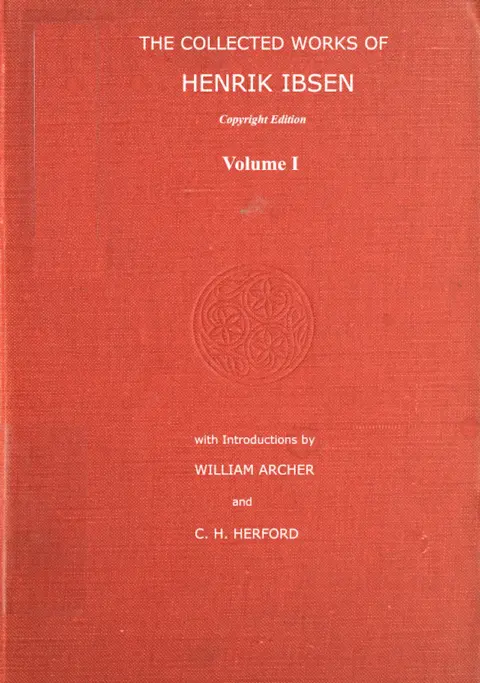
"The Collected Works of Henrik Ibsen, Vol. 01 (of 11)" by Henrik Ibsen is a collection of dramatic works written in the late 19th century. This volume includes three plays: "Lady Inger of Östråt," "The Feast at Solhoug," and "Love's Comedy." These works explore intricate themes of power dynamics, societal norms, and personal struggles, with characters that navigate the complexities of love, ambition, and familial duty. At the start of "Lady Inger of Östråt," the stage is set in the dramatic backdrop of Norway in 1528, where Lady Inger is at the center of an impending conflict. We find her receiving guests and grappling with a sense of national degradation under Danish rule, exemplified through the discussions among her servants and peasants about rising against their oppressors. The opening introduces tensions surrounding Lady Inger’s ambitions for her family and her struggles with the looming threats posed by the political landscape. The scene is charged with emotions as Elina, her daughter, reflects on the weight of their heritage and the sacrifices made for power, setting the foundation for the intricate relationships and moral dilemmas that will unfold throughout the play.
Introduction adapted from the source catalogue; source summaries may be automatically generated.
Free to read · English · 81,990 words · No account needed
MAKE TIME FOR A GOOD BOOK
On by default. Untick to stop anonymous reading totals. Each page counts after 10 seconds in view. How this works.
Anonymous counting is on unless you have switched it off.
Presently, my dear.
GULDSTAD [to FALK].
One thing at least to me is very clear;— And that is that you cannot but allow Some forethought indispensable. For see, Suppose that you to-day should write a sonnet, And, scorning forethought, you should lavish on it Your last reserve, your all, of poetry, So that, to-morrow, when you set about Your next song, you should find yourself cleaned out, Heavens! how your friends the critics then would crow!
D’you think they’d notice I was bankrupt? No! Once beggared of ideas, I and they Would saunter arm in arm the selfsame way— [Breaking off. But Lind! why, what’s the matter with you, pray? You sit there dumb and dreaming—I suspect you’re Deep in the mysteries of architecture.
LIND [collecting himself].
I? What should make you think so?
I observe. Your eyes are glued to the verandah yonder— You’re studying, mayhap, its arches’ curve, Or can it be its pillars’ strength you ponder, The door perhaps, with hammered iron hinges? The window blinds, and their artistic fringes? From something there your glances never wander.
No, you are wrong—I’m just absorbed in being— Drunk with the hour—naught craving, naught foreseeing. I feel as though I stood, my life complete, With all earth’s riches scattered at my feet. Thanks for your song of happiness and spring— From out my inmost heart it seemed to spring.
[Lifts his glass and exchanges a glance,
unobserved, with ANNA.
Here’s to the blossom in its fragrant pride!
What reck we of the fruit of autumn-tide?
[Empties his glass.
FALK [looks at him with surprise and emotion, but assumes a light tone].
Behold, fair ladies! though you scorn me quite, Here I have made an easy proselyte. His hymn-book yesterday was all he cared for— To-day e’en dithyrambics he’s prepared for! We poets must be born, cries every judge; But prose-folks, now and then, like Strasburg geese, Gorge themselves so inhumanly obese On rhyming balderdash and rhythmic fudge, That, when cleaned out, their very souls are thick With lyric lard and greasy rhetoric.
[To LIND.
Your praise, however, I shall not forget;
We’ll sweep the lyre henceforward in duet.
You, Mr. Falk, are hard at work, no doubt, Here in these rural solitudes delightful, Where at your own sweet will you roam about—
MRS. HALM [smiling].
Oh, no, his laziness is something frightful.
What! here at Mrs. Halm’s! that’s most surprising— Surely it’s just the place for poetising—
[Pointing to the right.
Your reading position is saved on this browser. Take it to another device with a library code. Reading pages adapt to text, rather than matching a printed edition.
BEHIND THE BOOK
This eBook is for the use of anyone anywhere in the United States and most other parts of the world at no cost and with almost no restrictions whatsoever. You may copy it, give it away or re-use it under the terms of the Project Gutenberg License included with this eBook or online at www.gutenberg.org. If you are not located in the United States, you will have to check the laws of the country where you are located before using this eBook. Read the source licence.
The original source file, including credits and licence, is retained by this library. Request an original-format copy at no charge. Please include the book title and Project Gutenberg identifier #66060.
KEEP YOUR CURIOSITY GOING
Maurice Baring
W. B. (William Butler) Yeats
Edward Martyn

John Brougham & Charlotte Brontë
Marguerite Merington
Leonid Andreyev


