
The wild duck
Henrik Ibsen
THE CLASSIC COLLECTION · 1908
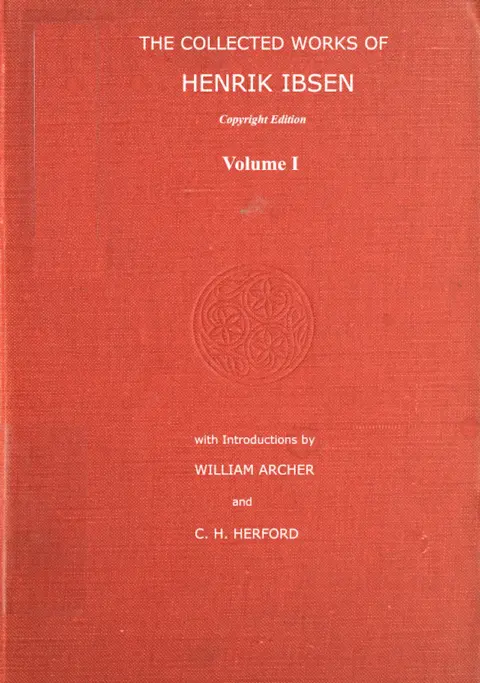
"The Collected Works of Henrik Ibsen, Vol. 01 (of 11)" by Henrik Ibsen is a collection of dramatic works written in the late 19th century. This volume includes three plays: "Lady Inger of Östråt," "The Feast at Solhoug," and "Love's Comedy." These works explore intricate themes of power dynamics, societal norms, and personal struggles, with characters that navigate the complexities of love, ambition, and familial duty. At the start of "Lady Inger of Östråt," the stage is set in the dramatic backdrop of Norway in 1528, where Lady Inger is at the center of an impending conflict. We find her receiving guests and grappling with a sense of national degradation under Danish rule, exemplified through the discussions among her servants and peasants about rising against their oppressors. The opening introduces tensions surrounding Lady Inger’s ambitions for her family and her struggles with the looming threats posed by the political landscape. The scene is charged with emotions as Elina, her daughter, reflects on the weight of their heritage and the sacrifices made for power, setting the foundation for the intricate relationships and moral dilemmas that will unfold throughout the play.
Introduction adapted from the source catalogue; source summaries may be automatically generated.
Free to read · English · 81,990 words · No account needed
MAKE TIME FOR A GOOD BOOK
On by default. Untick to stop anonymous reading totals. Each page counts after 10 seconds in view. How this works.
Anonymous counting is on unless you have switched it off.
But, Mr. Falk, I thought the lyric’s ending
Was not so rich in—well, in poetry,
As others of the stanzas seemed to be.
Why yes, and I am sure it could not tax
Your powers to get a little more inserted—
FALK [clinking glasses with him].
You cram it in, like putty into cracks,
Till lean is into streaky fat converted.
STIVER [unruffled].
Yes, nothing easier—I, too, in my day
Could do the trick.
Dear me! Were you a poet?
My Stiver! Yes!
Oh, in a humble way.
MISS JAY [to the ladies].
His nature is romantic.
Yes, we know it.
Not now; it’s ages since I turned a rhyme.
Yes, varnish and romance go off with time.
But in the old days—?
Well, you see, ’twas when
I was in love.
Is that time over, then?
Have you slept off the sweet intoxication?
I’m now engaged—I hold official station— That’s better than in love, I apprehend!
Quite so! You’re in the right, my good old friend. The worst is past—vous voilà bien avancé— Promoted from mere lover to fiancé.
STIVER [with a smile of complacent recollection].
It’s strange to think of it—upon my word,
I half suspect my memory of lying—
[Turns to FALK.
But seven years ago—it sounds absurd!—
I wasted office hours in versifying.
What! Office hours—!
Yes, such were my transgressions.
GULDSTAD [ringing on his glass].
Silence for our solicitor’s confessions!
But chiefly after five, when I was free,
I’d rattle off whole reams of poetry—
Ten—fifteen folios ere I went to bed—
I see—you gave your Pegasus his head,
And off he tore—
On stamped or unstamped paper— ’Twas all the same to him—he’d prance and caper—
The spring of poetry flowed no less flush? But how, pray, did you teach it first to gush?
By aid of love’s divining-rod, my friend!
Miss Jay it was that taught me where to bore,
My fiancée—she became so in the end—
For then she was—
Your love and nothing more.
STIVER [continuing].
’Twas a strange time; I could not read a bit;
I tuned my pen instead of pointing it;
And when along the foolscap sheet it raced,
It twangled music to the words I traced;—
At last by letter I declared my flame
To her—to her—
Whose fiancé you became.
In course of post her answer came to hand—
The motion granted—judgment in my favour!
Your reading position is saved on this browser. Take it to another device with a library code. Reading pages adapt to text, rather than matching a printed edition.
BEHIND THE BOOK
This eBook is for the use of anyone anywhere in the United States and most other parts of the world at no cost and with almost no restrictions whatsoever. You may copy it, give it away or re-use it under the terms of the Project Gutenberg License included with this eBook or online at www.gutenberg.org. If you are not located in the United States, you will have to check the laws of the country where you are located before using this eBook. Read the source licence.
The original source file, including credits and licence, is retained by this library. Request an original-format copy at no charge. Please include the book title and Project Gutenberg identifier #66060.
KEEP YOUR CURIOSITY GOING
Maurice Baring
W. B. (William Butler) Yeats
Edward Martyn

John Brougham & Charlotte Brontë
Marguerite Merington
Leonid Andreyev


