
The wild duck
Henrik Ibsen
THE CLASSIC COLLECTION · 1908
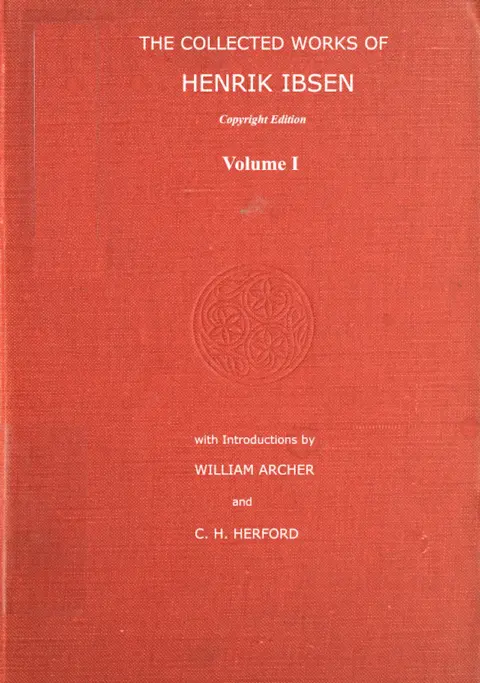
"The Collected Works of Henrik Ibsen, Vol. 01 (of 11)" by Henrik Ibsen is a collection of dramatic works written in the late 19th century. This volume includes three plays: "Lady Inger of Östråt," "The Feast at Solhoug," and "Love's Comedy." These works explore intricate themes of power dynamics, societal norms, and personal struggles, with characters that navigate the complexities of love, ambition, and familial duty. At the start of "Lady Inger of Östråt," the stage is set in the dramatic backdrop of Norway in 1528, where Lady Inger is at the center of an impending conflict. We find her receiving guests and grappling with a sense of national degradation under Danish rule, exemplified through the discussions among her servants and peasants about rising against their oppressors. The opening introduces tensions surrounding Lady Inger’s ambitions for her family and her struggles with the looming threats posed by the political landscape. The scene is charged with emotions as Elina, her daughter, reflects on the weight of their heritage and the sacrifices made for power, setting the foundation for the intricate relationships and moral dilemmas that will unfold throughout the play.
Introduction adapted from the source catalogue; source summaries may be automatically generated.
Free to read · English · 81,990 words · No account needed
MAKE TIME FOR A GOOD BOOK
On by default. Untick to stop anonymous reading totals. Each page counts after 10 seconds in view. How this works.
Anonymous counting is on unless you have switched it off.
[Following him-with her eyes.] How fair and manlike he is! [With a sigh.] There is little likeness ’twixt him and—[Begins putting things in order on the table, but presently stops.] “You then were free,” he said. Yes, then! [A short pause.] ’Twas a strange tale, that of the Princess who—She held another dear, and then—Aye, those women of far-off lands—I have heard it before—they are not weak as we are; they do not fear to pass from thought to deed. [Takes up a goblet which stands on the table.] ’Twas in this beaker that Gudman and I, when he went away, drank to his happy return. ’Tis well-nigh the only heirloom I brought with me to Solhoug. [Putting the goblet away in a cupboard.] How soft is this summer day; and how light it is in here! So sweetly has the sun not shone for three long years.
[SIGNË, and after her GUDMUND, enters from the
left.
SIGNË.
[Runs laughing up to MARGIT.]
Ha, ha, ha! He will not believe that ’tis I!
MARGIT.
[Smiling, to GUDMUND.]
You see: while in far-off lands you strayed,
She, too, has altered, the little maid.
Aye truly! But that she should be—Why,
’Tis a marvel in very deed.
[Takes both SIGNË’S hands and looks at her.
Yet, when I look in these eyes so blue, The innocent child-mind I still can read— Yes, Signë, I know that ’tis you! I needs must laugh when I think how oft I have thought of you perched on my shoulder aloft As you used to ride. You were then a child; Now you are a nixie, spell-weaving, wild.
SIGNË.
[Threatening with her finger.]
Beware! If the nixie’s ire you awaken,
Soon in her nets you will find yourself taken.
GUDMUND.
[To himself.]
I am snared already, it seems to me.
But, Gudmund, wait—you have still to see How I’ve shielded your harp from the dust and the rust.
[As she goes out to the left.
You shall teach me all of your songs! You must!
GUDMUND.
[Softly, as he follows her with his eyes.]
She has flushed to the loveliest rose of May, That was yet but a bud in the morning’s ray.
SIGNË.
[Returning with the harp.]
Behold!
GUDMUND.
[Taking it.]
My harp! As bright as of yore!
[Striking one or two chords.
Still the old chords ring sweet and clear— On the wall, untouched, thou shalt hang no more.
MARGIT.
[Looking out at the back.]
Our guests are coming.
[While GUDMUND preludes his song.]
Hush—hush! Oh, hear!
GUDMUND.
[Sings.]
Your reading position is saved on this browser. Take it to another device with a library code. Reading pages adapt to text, rather than matching a printed edition.
BEHIND THE BOOK
This eBook is for the use of anyone anywhere in the United States and most other parts of the world at no cost and with almost no restrictions whatsoever. You may copy it, give it away or re-use it under the terms of the Project Gutenberg License included with this eBook or online at www.gutenberg.org. If you are not located in the United States, you will have to check the laws of the country where you are located before using this eBook. Read the source licence.
The original source file, including credits and licence, is retained by this library. Request an original-format copy at no charge. Please include the book title and Project Gutenberg identifier #66060.
KEEP YOUR CURIOSITY GOING
Maurice Baring
W. B. (William Butler) Yeats
Edward Martyn

John Brougham & Charlotte Brontë
Marguerite Merington
Leonid Andreyev


