THE CLASSIC COLLECTION✦An outlaw’s diary: the CommuneCLASSIC FREE BOOKS
An outlaw’s diary: the Commune
Cécile Tormay
THE CLASSIC COLLECTION · 1910
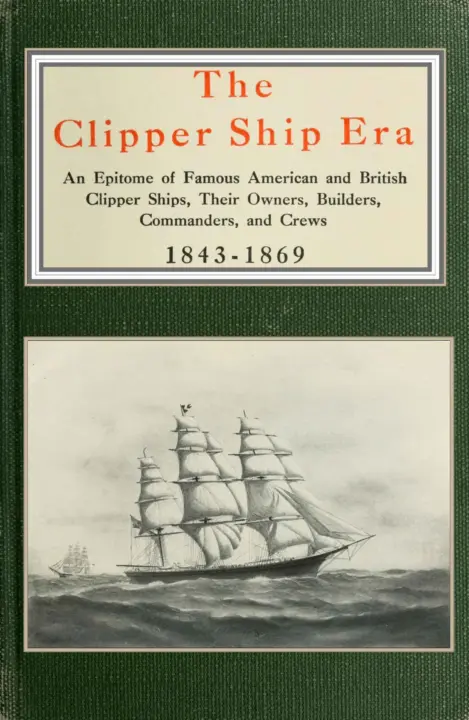
"The Clipper Ship Era" by Arthur H. Clark is a historical account written in the early 20th century. This work chronicles the thriving period of American and British clipper ships from the 1840s to the late 1860s, detailing their construction, speed, and significance in maritime history. The book likely highlights the technological advancements in shipbuilding, the cultural impacts of these vessels, and notable figures such as shipbuilders and captains from that era. The opening of the book introduces the Clipper Ship Era, noting that it began in 1843, driven by increased demand for swift tea deliveries from China and spurred by the gold rushes. Clark discusses the evolution of sailing ships, specifically focusing on the transition from traditional ships to the more agile and faster clipper ships. He emphasizes the personal connection he has with many of these vessels and their builders, sharing insights into the races and competitions among shipbuilders and mariners that characterized this exciting period on the seas. Overall, the beginning sets the stage for a detailed exploration of the maritime innovations and historical context of the clipper ships, laying a foundation for the chapters that follow.
Introduction adapted from the source catalogue; source summaries may be automatically generated.
Free to read · English · 98,778 words · No account needed
MAKE TIME FOR A GOOD BOOK
On by default. Untick to stop anonymous reading totals. Each page counts after 10 seconds in view. How this works.
Anonymous counting is on unless you have switched it off.
The first California clippers, thirteen in number, were launched during the year 1850, the Celestial, 860 tons, built by William H. Webb and owned by Bucklin & Crane, of New York, being the first to leave the ways. She was soon followed by the Mandarin, 776 tons, built by Smith & Dimon for Goodhue & Co., of New York, and the Surprise, 1361 tons, owned by A. A. Low & Brother; Game-Cock, 1392 tons, owned by Daniel C. Bacon, Boston, and the barque Race Horse, 512 tons, owned by Goddard & Co., Boston, all built by Samuel Hall at East Boston. The Witchcraft, 1310 tons, was built at Chelsea by Paul Curtis, for S. Rogers & W. D. Pickman, of Salem; the John Bertram, 1080 tons, by R. E. Jackson at East Boston, for Glidden & Williams, of Boston; the Governor Morton, 1318 tons, by James M. Hood at Somerset, for Handy & Everett, of New York; the Sea Serpent, 1337 tons, by George Raynes at Portsmouth, New Hampshire, for Grinnell, Minturn & Co., of New York; the Eclipse, 1223 tons, by J. Williams & Son at Williamsburg, for T. Wardle & Co., of New York; the Seaman, 546 tons, by Bell & Co., at Baltimore, for Funck & Meincke, of New York; the White Squall, 1118 tons, by Jacob Bell, for W. Platt & Son, of Philadelphia, and the Stag-Hound, 1535 tons, by Donald McKay at East Boston, for Sampson & Tappan and George B. Upton, of Boston.
The Celestial was a remarkably good-looking ship and much sharper than any vessel built by Mr. Webb up to that time. She carried long, slender spars, with plenty of canvas, and proved a very fast and able ship.
The Mandarin, also a fine-looking ship, was intended by her builders to be an improved Sea Witch, and although she made some excellent passages, she never came up to the older vessel in point of speed; the Sea Witch was her builders’ masterpiece, and they, like many others, found her a difficult ship to improve upon.
The Surprise was one of the most successful clipper ships ever constructed, and proved a mine of wealth for her owners. She was fully rigged on the stocks, with all her gear rove off, and was
launched with her three skysail yards across and colors flying, which attracted a multitude of people. They rather expected to see her capsize, and were no doubt highly delighted to find that nothing unusual happened as she glided swiftly down the ways, or at that critical instant when her hull was still partly supported on the land and partly on the waves, or when she swung to her anchors on even keel, with the beautiful skyline of Boston of half a century ago outlined in the distance.
Your reading position is saved on this browser. Take it to another device with a library code. Reading pages adapt to text, rather than matching a printed edition.
BEHIND THE BOOK
This eBook is for the use of anyone anywhere in the United States and most other parts of the world at no cost and with almost no restrictions whatsoever. You may copy it, give it away or re-use it under the terms of the Project Gutenberg License included with this eBook or online at www.gutenberg.org. If you are not located in the United States, you will have to check the laws of the country where you are located before using this eBook. Read the source licence.
The original source file, including credits and licence, is retained by this library. Request an original-format copy at no charge. Please include the book title and Project Gutenberg identifier #69154.
KEEP YOUR CURIOSITY GOING
Cécile Tormay

Moritz Busch
John L. Ransom
Frances Wright
Cécile Tormay

Mabel Potter Daggett