THE CLASSIC COLLECTION✦An outlaw’s diary: the CommuneCLASSIC FREE BOOKS
An outlaw’s diary: the Commune
Cécile Tormay
THE CLASSIC COLLECTION · 1910
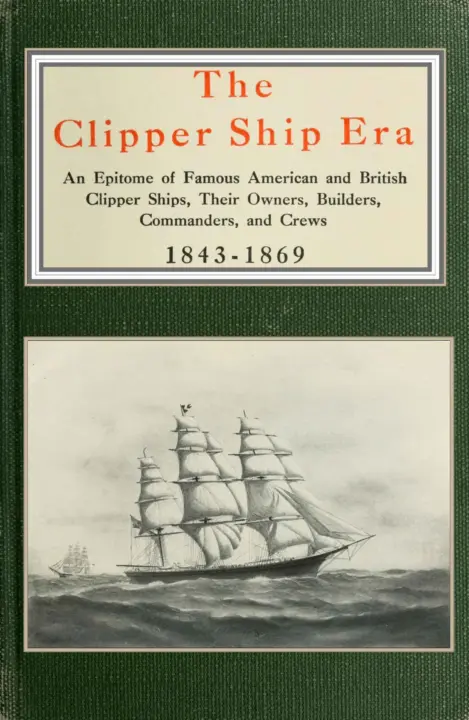
"The Clipper Ship Era" by Arthur H. Clark is a historical account written in the early 20th century. This work chronicles the thriving period of American and British clipper ships from the 1840s to the late 1860s, detailing their construction, speed, and significance in maritime history. The book likely highlights the technological advancements in shipbuilding, the cultural impacts of these vessels, and notable figures such as shipbuilders and captains from that era. The opening of the book introduces the Clipper Ship Era, noting that it began in 1843, driven by increased demand for swift tea deliveries from China and spurred by the gold rushes. Clark discusses the evolution of sailing ships, specifically focusing on the transition from traditional ships to the more agile and faster clipper ships. He emphasizes the personal connection he has with many of these vessels and their builders, sharing insights into the races and competitions among shipbuilders and mariners that characterized this exciting period on the seas. Overall, the beginning sets the stage for a detailed exploration of the maritime innovations and historical context of the clipper ships, laying a foundation for the chapters that follow.
Introduction adapted from the source catalogue; source summaries may be automatically generated.
Free to read · English · 98,778 words · No account needed
MAKE TIME FOR A GOOD BOOK
On by default. Untick to stop anonymous reading totals. Each page counts after 10 seconds in view. How this works.
Anonymous counting is on unless you have switched it off.
By this time the sails are loose and the gaskets made up; courses, topsails, topgallantsails, royals, and skysails flutter in their gear, and the clipper feels the breath of life. “Sheet home the topsails.” “Aye, aye, sir.” “Boatswain, look out for those clew-lines at the main; ease down handsomely as the sheets come home.” “Foretop there, overhaul your buntlines, look alive!” “Belay your port maintopsail sheet; clap a watch tackle on the starboard sheet and rouse her home.” “Maintop there, lay down on the main-yard and light the foot of that sail over the stay.” “That’s well, belay starboard.” “Well the mizzentopsail sheets, belay.” “Now then, my bullies, lead out your topsail halliards fore and aft and masthead her.” “Aye, aye, sir.” By this time the mate has put some ginger into the crew and longshoremen, and they walk away with the three topsail halliards:
“Away, way, way, yar,
We’ll kill Paddy Doyle for his boots.”
“Now then, long pulls, my sons.” “Here, you chantyman, haul off your boots, jump on that main-deck capstan and strike a light; the best in your locker.” “Aye, aye, sir.” And the three topsail-yards go aloft with a ringing chanty that can be heard up in Beaver Street:
“Then up aloft that yard must go,
Whiskey for my Johnny.
Oh, whiskey is the life of man,
Whiskey, Johnny.
I thought I heard the old man say,
Whiskey for my Johnny.
We are bound away this very day,
Whiskey, Johnny.
A dollar a day is a white man’s pay,
Whiskey for my Johnny.
Oh, whiskey killed my sister Sue,
Whiskey, Johnny,
And whiskey killed the old man, too,
Whiskey for my Johnny.
Whiskey’s gone, what shall I do?
Whiskey, Johnny,
Oh, whiskey’s gone, and I’ll go too,
Whiskey for my Johnny.”
“Belay your maintopsail halliards.” “Aye, aye, sir.” And so the canvas is set fore and aft, topsails, topgallantsails, royals, and skysails, flat as boards, the inner and outer jibs are run up and the sheets hauled to windward; the main-and after-yards are braced sharp to the wind, the foretopsail is laid to the mast, and the clipper looks like some great seabird ready for flight. The anchor is hove up to:
“I wish I was in Slewer’s Hall,
Lowlands, lowlands, hurra, my boys,
A-drinking luck to the old Black Ball,
My dollar and a half a day.”
And while some of the hands bring the anchor to the rail with cat and
fish tackle, and:
Your reading position is saved on this browser. Take it to another device with a library code. Reading pages adapt to text, rather than matching a printed edition.
BEHIND THE BOOK
This eBook is for the use of anyone anywhere in the United States and most other parts of the world at no cost and with almost no restrictions whatsoever. You may copy it, give it away or re-use it under the terms of the Project Gutenberg License included with this eBook or online at www.gutenberg.org. If you are not located in the United States, you will have to check the laws of the country where you are located before using this eBook. Read the source licence.
The original source file, including credits and licence, is retained by this library. Request an original-format copy at no charge. Please include the book title and Project Gutenberg identifier #69154.
KEEP YOUR CURIOSITY GOING
Cécile Tormay

Moritz Busch
John L. Ransom
Frances Wright
Cécile Tormay

Mabel Potter Daggett