THE CLASSIC COLLECTION✦An outlaw’s diary: the CommuneCLASSIC FREE BOOKS
An outlaw’s diary: the Commune
Cécile Tormay
THE CLASSIC COLLECTION · 1910
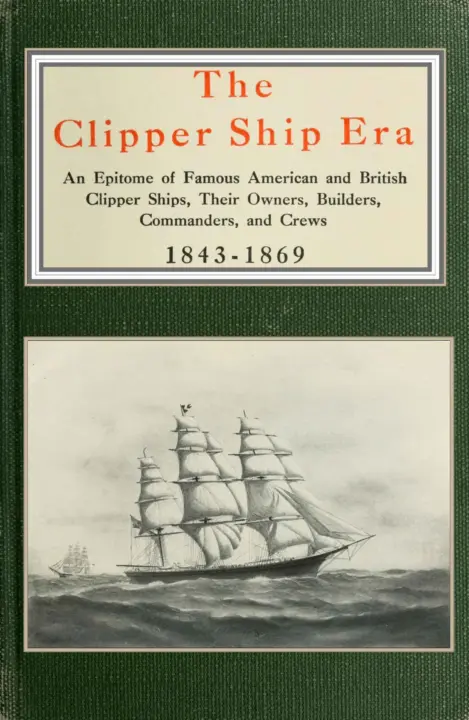
"The Clipper Ship Era" by Arthur H. Clark is a historical account written in the early 20th century. This work chronicles the thriving period of American and British clipper ships from the 1840s to the late 1860s, detailing their construction, speed, and significance in maritime history. The book likely highlights the technological advancements in shipbuilding, the cultural impacts of these vessels, and notable figures such as shipbuilders and captains from that era. The opening of the book introduces the Clipper Ship Era, noting that it began in 1843, driven by increased demand for swift tea deliveries from China and spurred by the gold rushes. Clark discusses the evolution of sailing ships, specifically focusing on the transition from traditional ships to the more agile and faster clipper ships. He emphasizes the personal connection he has with many of these vessels and their builders, sharing insights into the races and competitions among shipbuilders and mariners that characterized this exciting period on the seas. Overall, the beginning sets the stage for a detailed exploration of the maritime innovations and historical context of the clipper ships, laying a foundation for the chapters that follow.
Introduction adapted from the source catalogue; source summaries may be automatically generated.
Free to read · English · 98,778 words · No account needed
MAKE TIME FOR A GOOD BOOK
On by default. Untick to stop anonymous reading totals. Each page counts after 10 seconds in view. How this works.
Anonymous counting is on unless you have switched it off.
Of the next generation of builders, Stephen Smith, who like Isaac Webb was born in Stamford, formed with John Dimon the firm of Smith & Dimon, and prior to 1843 they had built among other vessels the packet ships Roscoe and Independence, the ship Mary Howland, the North River steamboats Rochester, James Kent, and Oregon, and the Greek frigate Liberator. Their building yard was at the foot of Fourth Street, East River. David Brown and Jacob Bell formed the firm of Brown & Bell, and had a yard at the foot of Stanton Street, a part of which had formerly been the Henry Eckford yard. Prior to 1843, this firm had built the ships Orbit and William Tell in 1821, the Canada, Calhoun, Savannah, Pacific, Washington, Great Britain, John Jay, Britannia, George Canning, Caledonia, Hibernia, and Congress from 1821 to 1831; the Victoria, Europe, Francis Depaw, Silvia de Grasse, Vicksburg, Emerald, Switzerland, Shakespeare, Garrick, Sheridan, Siddons, Roscius, and Cornelia from 1831 to 1841; and the Liverpool, Queen of the West, and Henry Clay in the period from 1841 to 1843, inclusive. Besides these, they built fifteen other ships, seven steamers, eight barques and brigs, thirty-nine steamboats, six ferry-and tow-boats, nineteen sloops and schooners, seven pilot boats, and four yachts.
Upon the death of Isaac Webb in 1840, his son William H. Webb, then only twenty-four years of age, continued the firm of Webb & Allen which built during the next ten years the packet ships Montezuma, Yorkshire, Havre, Fidelia, second Columbia, Sir Robert Peel, Splendid, Bavaria, Isaac Wright, Ivanhoe, Yorktown, London, Guy Mannering, Albert Gallatin, Isaac Webb, and Vanguard. Their yard extended from the foot of Fifth to Seventh Street, East River.
Jacob A. Westervelt, born at Hackensack, New Jersey, in 1800, was the son of a ship-builder. He went to sea before the mast and upon his return served his apprenticeship with Christian Bergh, subsequently becoming a partner in the firm and retiring with an ample fortune in 1837. Mr. Westervelt then made an extensive trip through Europe, and after returning built two ships at Williamsburg. He formed the firm of Westervelt & Mackay and built a number of London and Havre packet ships, among which were the Ocean Queen, West Point, Toronto, Devonshire, and American Eagle. The front door of Mr. Westervelt’s house in East Broadway was ornamented with a beautiful carved stone cap representing the stern of a packet ship. In later
years, he took his sons Daniel and Aaron into partnership, the firm being known as Westervelt & Co. Jacob A. Westervelt was Mayor of New York in 1854.
Your reading position is saved on this browser. Take it to another device with a library code. Reading pages adapt to text, rather than matching a printed edition.
BEHIND THE BOOK
This eBook is for the use of anyone anywhere in the United States and most other parts of the world at no cost and with almost no restrictions whatsoever. You may copy it, give it away or re-use it under the terms of the Project Gutenberg License included with this eBook or online at www.gutenberg.org. If you are not located in the United States, you will have to check the laws of the country where you are located before using this eBook. Read the source licence.
The original source file, including credits and licence, is retained by this library. Request an original-format copy at no charge. Please include the book title and Project Gutenberg identifier #69154.
KEEP YOUR CURIOSITY GOING
Cécile Tormay

Moritz Busch
John L. Ransom
Frances Wright
Cécile Tormay

Mabel Potter Daggett