THE CLASSIC COLLECTION✦An outlaw’s diary: the CommuneCLASSIC FREE BOOKS
An outlaw’s diary: the Commune
Cécile Tormay
THE CLASSIC COLLECTION · 1910
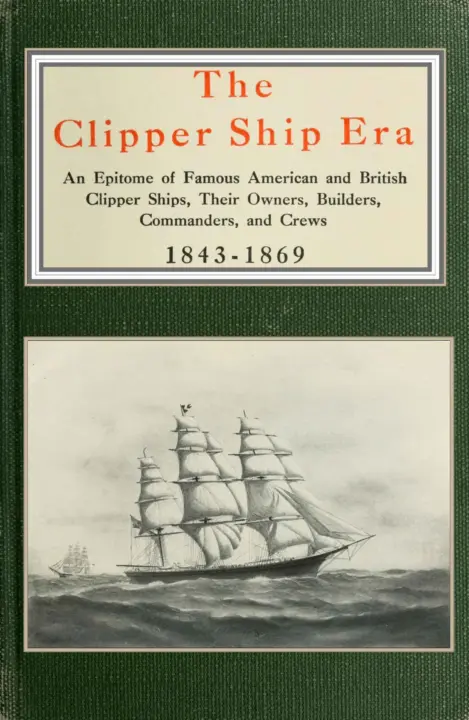
"The Clipper Ship Era" by Arthur H. Clark is a historical account written in the early 20th century. This work chronicles the thriving period of American and British clipper ships from the 1840s to the late 1860s, detailing their construction, speed, and significance in maritime history. The book likely highlights the technological advancements in shipbuilding, the cultural impacts of these vessels, and notable figures such as shipbuilders and captains from that era. The opening of the book introduces the Clipper Ship Era, noting that it began in 1843, driven by increased demand for swift tea deliveries from China and spurred by the gold rushes. Clark discusses the evolution of sailing ships, specifically focusing on the transition from traditional ships to the more agile and faster clipper ships. He emphasizes the personal connection he has with many of these vessels and their builders, sharing insights into the races and competitions among shipbuilders and mariners that characterized this exciting period on the seas. Overall, the beginning sets the stage for a detailed exploration of the maritime innovations and historical context of the clipper ships, laying a foundation for the chapters that follow.
Introduction adapted from the source catalogue; source summaries may be automatically generated.
Free to read · English · 98,778 words · No account needed
MAKE TIME FOR A GOOD BOOK
On by default. Untick to stop anonymous reading totals. Each page counts after 10 seconds in view. How this works.
Anonymous counting is on unless you have switched it off.
In 1821, Thomas Cope of Philadelphia started his line of packets between that port and Liverpool with the ships Lancaster, of 290 tons, and Tuscarora, of 379 tons, which were soon followed by larger vessels, among them some of the finest ships on the Atlantic.
The Red Star Line of Liverpool packets from New York was also established in 1821 with the Panther, Meteor, Hercules, and second Manhattan, and soon after, the Swallow Tail Line of Grinnell, Minturn & Co., came into existence with the Napoleon, Silas Richards, George, and York. Grinnell, Minturn & Co.’s London Line was established in 1823 with the Brighton, Columbia, Cortes, and Corinthian, of less than 500 tons each, and during this year John Griswold’s London Line was also started with the Sovereign, President, Cambria, Hudson, and the second Ontario.
The opening of the Erie Canal in 1825 gave a great impetus to commerce, causing New York to become the eastern gateway of the United States, and from that date to 1850 may be counted the glorious years of the Atlantic packet ships.
The Dramatic Line to Liverpool was started in 1836 with the Siddons, Shakespeare, Garrick, and Roscius, under the management of E. K. Collins. These vessels did not much exceed 700 tons, and when, in 1837, Isaac Webb & Co. built the Sheridan,
of 895 tons for this line, she was regarded as too large for a Liverpool packet, and after a few voyages was placed in the China trade.
The first Havre line of packets was founded by Francis Depaw in 1822 with the Stephania, Montana, Henry IV., Helen Mar, Louis Philippe, and Silvia de Grasse. A second line was formed in 1827 with the Baltimore, Charles Carroll, Erie, France, Oneida, Mercury, Utica, Rhone, William Tell, and in 1832 a third line, with the Formosa, Galia, Albany, Duchesse d’Orléans, Isaac Bell, Queen Mab, and Don Quixote.
In 1831 the New Orleans Line from New York was formed with the Nashville, Huntsville, Louisville, Creole, and Natchez. These were the first packet ships built with full poop-decks, then quite a new feature in ship-building. Gradually the flush deck gave place to house-and poop-deck cabins, then to the topgallant, forecastle, and house from the foremast to the main hatch. The fashion of painting also changed, and most if not all the packets carried painted ports, while the inside green was replaced by white or light shades of other colors.
Your reading position is saved on this browser. Take it to another device with a library code. Reading pages adapt to text, rather than matching a printed edition.
BEHIND THE BOOK
This eBook is for the use of anyone anywhere in the United States and most other parts of the world at no cost and with almost no restrictions whatsoever. You may copy it, give it away or re-use it under the terms of the Project Gutenberg License included with this eBook or online at www.gutenberg.org. If you are not located in the United States, you will have to check the laws of the country where you are located before using this eBook. Read the source licence.
The original source file, including credits and licence, is retained by this library. Request an original-format copy at no charge. Please include the book title and Project Gutenberg identifier #69154.
KEEP YOUR CURIOSITY GOING
Cécile Tormay

Moritz Busch
John L. Ransom
Frances Wright
Cécile Tormay

Mabel Potter Daggett