THE CLASSIC COLLECTION✦An outlaw’s diary: the CommuneCLASSIC FREE BOOKS
An outlaw’s diary: the Commune
Cécile Tormay
THE CLASSIC COLLECTION · 1910
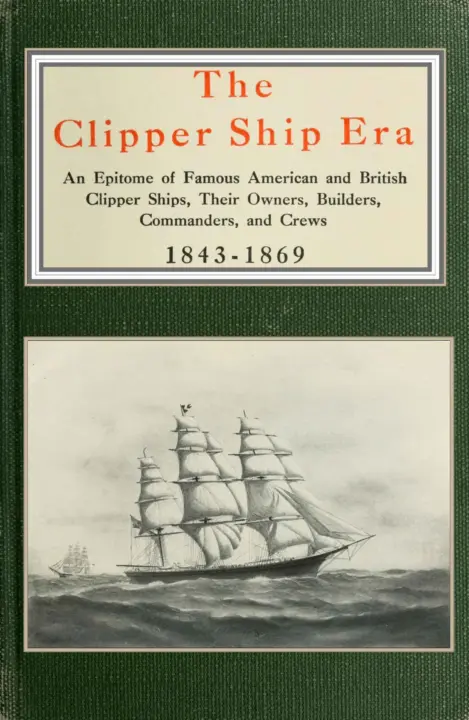
"The Clipper Ship Era" by Arthur H. Clark is a historical account written in the early 20th century. This work chronicles the thriving period of American and British clipper ships from the 1840s to the late 1860s, detailing their construction, speed, and significance in maritime history. The book likely highlights the technological advancements in shipbuilding, the cultural impacts of these vessels, and notable figures such as shipbuilders and captains from that era. The opening of the book introduces the Clipper Ship Era, noting that it began in 1843, driven by increased demand for swift tea deliveries from China and spurred by the gold rushes. Clark discusses the evolution of sailing ships, specifically focusing on the transition from traditional ships to the more agile and faster clipper ships. He emphasizes the personal connection he has with many of these vessels and their builders, sharing insights into the races and competitions among shipbuilders and mariners that characterized this exciting period on the seas. Overall, the beginning sets the stage for a detailed exploration of the maritime innovations and historical context of the clipper ships, laying a foundation for the chapters that follow.
Introduction adapted from the source catalogue; source summaries may be automatically generated.
Free to read · English · 98,778 words · No account needed
MAKE TIME FOR A GOOD BOOK
On by default. Untick to stop anonymous reading totals. Each page counts after 10 seconds in view. How this works.
Anonymous counting is on unless you have switched it off.
During the years 1819 and 1820 the Company sent to their different stations in Bengal, Madras, Bombay, China, Ceylon, and Penang, twenty-three of their own ships aggregating 26,200 tons, besides twenty-one chartered vessels measuring 10,948 tons. Among the Company’s ships were the Canning, Duke of York, Kellie Castle, Lady Melville, Thomas Coutts, and Waterloo, built by Wigram, and all from 1325 to 1350 tons, each mounting 20 guns with a crew of 130 men. The Buckinghamshire, Earl of Balcarras, Herefordshire, Thomas Granville, Minerva, and Charles Grant, all from 923 to 1417 tons, 26 guns, and 130 men with the exception of the Minerva and Thomas Granville which mounted the same number of guns but had 115 and 107 men, respectively, were built by the Company at Bombay. The Asia, Dorsetshire, Duneira, Marquis of Wellington, Prince Regent, Princess Amelia, and Windsor, which were all over 1000 tons and mounted 26 guns with crews of from 115 to 130 each, were built in the Barnard yard, also on the Thames. The London, Lowther Castle, Marquis of Camden, and Perseverance, all from 1329 to 1408 tons, 26 guns, and 130 men each, were built in the Pitcher yard at Northfleet in Kent. The Earl of Balcarras, of 1417 tons, built in 1815 at Bombay, was the largest ship owned by the Company. She was built of India teak, copper-fastened throughout, and mounted batteries on two decks. Her crew of 133 men was made up as follows: Commander, 6 mates, 2 surgeons, 6 midshipmen, purser, gunner, carpenter, master-at-arms, armour, butcher, baker, poulterer, caulker, cooper, 2 stewards, 2 cooks, 8 boatswains, gunner’s, carpenter’s, caulker’s, and cooper’s mates, 6 quartermasters, sailmaker, 7 servants for the commander and officers, and 78 seamen before the mast.
These facts illustrate not only the manner in which the ships of the East India Company were officered and manned, but also the extravagant scale upon which the affairs of the Company were administered. Of course, a gross monopoly like this, legalized though it was by Acts of Parliament, could not continue indefinitely among a free and intelligent people. For many years mutterings of discontent, gathering in force and volume, had been heard from all parts of Great Britain, indicating the disapproval of the people concerning the methods of the Company. At last, in 1832, these mutterings burst into a storm of indignation from the people through their representatives in Parliament, which swept the frigates of the Honorable John Company off the face of the deep; for in that year commerce to the Orient was thrown open to all British ships, and knowing their utter inability to compete successfully with free and intelligent personal energy, the East India Company condemned or sold their entire fleet. Sixteen ships were broken up for their massive copper fastenings and other valuable material, while forty-six were sold, and no finer tribute can be offered to the excellent construction of these vessels than the figures which they realized at what may justly be called a forced sale.
Your reading position is saved on this browser. Take it to another device with a library code. Reading pages adapt to text, rather than matching a printed edition.
BEHIND THE BOOK
This eBook is for the use of anyone anywhere in the United States and most other parts of the world at no cost and with almost no restrictions whatsoever. You may copy it, give it away or re-use it under the terms of the Project Gutenberg License included with this eBook or online at www.gutenberg.org. If you are not located in the United States, you will have to check the laws of the country where you are located before using this eBook. Read the source licence.
The original source file, including credits and licence, is retained by this library. Request an original-format copy at no charge. Please include the book title and Project Gutenberg identifier #69154.
KEEP YOUR CURIOSITY GOING
Cécile Tormay

Moritz Busch
John L. Ransom
Frances Wright
Cécile Tormay

Mabel Potter Daggett