THE CLASSIC COLLECTION✦An outlaw’s diary: the CommuneCLASSIC FREE BOOKS
An outlaw’s diary: the Commune
Cécile Tormay
THE CLASSIC COLLECTION · 1910
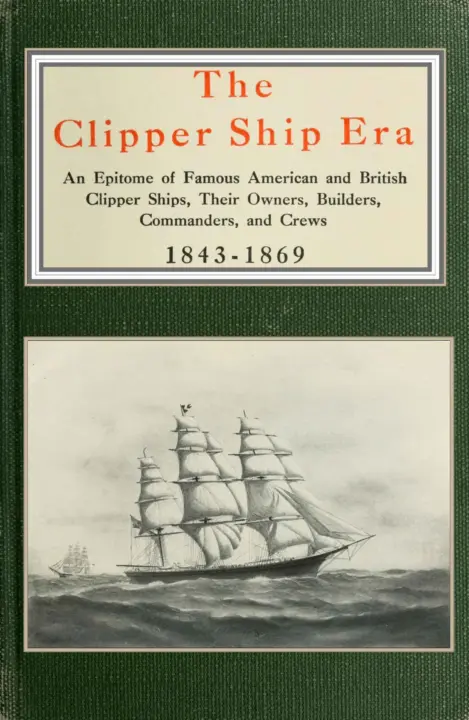
"The Clipper Ship Era" by Arthur H. Clark is a historical account written in the early 20th century. This work chronicles the thriving period of American and British clipper ships from the 1840s to the late 1860s, detailing their construction, speed, and significance in maritime history. The book likely highlights the technological advancements in shipbuilding, the cultural impacts of these vessels, and notable figures such as shipbuilders and captains from that era. The opening of the book introduces the Clipper Ship Era, noting that it began in 1843, driven by increased demand for swift tea deliveries from China and spurred by the gold rushes. Clark discusses the evolution of sailing ships, specifically focusing on the transition from traditional ships to the more agile and faster clipper ships. He emphasizes the personal connection he has with many of these vessels and their builders, sharing insights into the races and competitions among shipbuilders and mariners that characterized this exciting period on the seas. Overall, the beginning sets the stage for a detailed exploration of the maritime innovations and historical context of the clipper ships, laying a foundation for the chapters that follow.
Introduction adapted from the source catalogue; source summaries may be automatically generated.
Free to read · English · 98,778 words · No account needed
MAKE TIME FOR A GOOD BOOK
On by default. Untick to stop anonymous reading totals. Each page counts after 10 seconds in view. How this works.
Anonymous counting is on unless you have switched it off.
In 1854 this rule was changed by the Merchant Shipping Act, which provided that the actual cubic contents of a vessel’s hull should be measured, a registered ton being reckoned as 100 cubic feet. This is known as the Moorsom system, and is still in use and likely to continue. It was adopted by the United States in 1865; Denmark, 1867; Austria, 1871; Germany, France, and Italy, 1873; Spain, 1874; and Sweden, 1875.
The old practice of calculating tonnage in the United States was adapted from the English, and the mode of measurement was as follows:
The length was measured on deck from the fore part of the stem to the after part of the stern-post; the breadth from outside to outside planking at the broadest part of the vessel; the depth of the hold from the plank on deck to the ceiling of the hold. This last measurement was not used, the depth of a vessel for tonnage purposes being assumed to be one half of her breadth. In order to find the tonnage, three fifths of the breadth were deducted from the length and the remainder multiplied by the breadth, and this product multiplied by one half the breadth, or the assumed depth, the last product was then divided by 95, giving the formula:
Thus in a vessel measuring 100 ft. x 20 ft. x 18 ft.:
Length of vessel 100
Subtract ⅗ breadth 12
------
Length for measurement 88
Multiply by the breadth 20
------
1760
Multiply by half breadth 10
------
17,600
Divide 17,600 by 95 and
the result is 185 + 12/19
Total tonnage 185 + 12/19
This mode of measurement continued from colonial times until the Moorsom system was adopted in 1865.
The dimensions of ten representative American and British clippers were
as follows:
Length Breadth
Nightingale (1851) 178 “ 36 “
American Oriental (1849) 183 ft. 36 ft.
Celestial (1850) 158 “ 34 “ 6 in.
Stag-Hound (1850) 209 “ 39 “
Flying Dutchman (1852) 187 “ 38 “ 6 in.
British Falcon (1859) 191 “ 4 in. 32 “ 2 in.
Taitsing (1865) 192 “ 31 “ 5 in.
Titania (1866) 200 “ 35 “
Spindrift (1867) 219 “ 4 in. 35 “ 6 in.
Thermopylæ (1868) 210 “ 36 “
Although these British ships show less breadth than the American, yet they have more breadth in proportion to length than the earlier British clippers, such as the Stornoway (1850), Lord of the Isles (1855), etc.
Vessels not otherwise designated are American
Abbot Lawrence, medium clipper ship, 255, 256, 258
Abergeldie, British clipper ship, 205
Abrahams, J., builder, Baltimore, 357, 362
Abrahams & Ashcroft, owners, Baltimore, 357
Achilles, British iron screw steamer, 332
Ackley, Samuel, builder N. Y., 16, 17
Ada, Brit. clipper ship, tea-trade, 325-6, 371
Adamson & Bell, China merchants, 325
Adelaide, packet ship, 44
---- clipper ship, 298, 360
---- British iron screw steamer, 286
Admiral Gardner, Brit. E. Indiamen, 25
Adriatic, Collins Line S. S., 49, 250;
med. clipper ship, 258
Ajax, Brit. iron screw steamer, 332
Akbar, clipper ship, China trade, 62, 138
Alarm, Cal. clipper ship, 289, 299, 363
Albert Gallatin, packet ship, 42, 48, 142
Albion, packet ship, 38
Alert, Cal. clipper ship, 350
Alexander Marshall, packet ship, 41
Alfred, Brit. ship, 36-37
Alhambra, med. clipper ship, 258, 291
Allen, Wm. H., N. Y. packet captain, 44
Your reading position is saved on this browser. Take it to another device with a library code. Reading pages adapt to text, rather than matching a printed edition.
BEHIND THE BOOK
This eBook is for the use of anyone anywhere in the United States and most other parts of the world at no cost and with almost no restrictions whatsoever. You may copy it, give it away or re-use it under the terms of the Project Gutenberg License included with this eBook or online at www.gutenberg.org. If you are not located in the United States, you will have to check the laws of the country where you are located before using this eBook. Read the source licence.
The original source file, including credits and licence, is retained by this library. Request an original-format copy at no charge. Please include the book title and Project Gutenberg identifier #69154.
KEEP YOUR CURIOSITY GOING
Cécile Tormay

Moritz Busch
John L. Ransom
Frances Wright
Cécile Tormay

Mabel Potter Daggett