THE CLASSIC COLLECTION✦An outlaw’s diary: the CommuneCLASSIC FREE BOOKS
An outlaw’s diary: the Commune
Cécile Tormay
THE CLASSIC COLLECTION · 1910
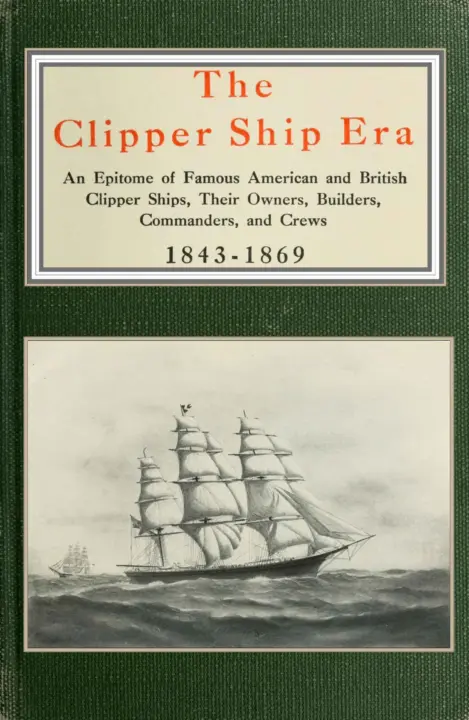
"The Clipper Ship Era" by Arthur H. Clark is a historical account written in the early 20th century. This work chronicles the thriving period of American and British clipper ships from the 1840s to the late 1860s, detailing their construction, speed, and significance in maritime history. The book likely highlights the technological advancements in shipbuilding, the cultural impacts of these vessels, and notable figures such as shipbuilders and captains from that era. The opening of the book introduces the Clipper Ship Era, noting that it began in 1843, driven by increased demand for swift tea deliveries from China and spurred by the gold rushes. Clark discusses the evolution of sailing ships, specifically focusing on the transition from traditional ships to the more agile and faster clipper ships. He emphasizes the personal connection he has with many of these vessels and their builders, sharing insights into the races and competitions among shipbuilders and mariners that characterized this exciting period on the seas. Overall, the beginning sets the stage for a detailed exploration of the maritime innovations and historical context of the clipper ships, laying a foundation for the chapters that follow.
Introduction adapted from the source catalogue; source summaries may be automatically generated.
Free to read · English · 98,778 words · No account needed
MAKE TIME FOR A GOOD BOOK
On by default. Untick to stop anonymous reading totals. Each page counts after 10 seconds in view. How this works.
Anonymous counting is on unless you have switched it off.
Captain Samuels was born in Philadelphia in 1823 and went to sea when he was eleven years old, and a narrative of his adventures afloat and on shore is contained in his interesting memoirs entitled, From the Forecastle to the Cabin, published in 1887. He was a most amiable and entertaining companion, full of good humor and penetrating wit. He also cherished a belief in the uplifting influence of an enterprising press agent, and perhaps no merchant ship of modern times has been better advertised than the Dreadnought. She sailed on her first voyage from New York for Liverpool, December 15, 1853, and from that date until her arrival at New York, January 28, 1855, had made eight passages between New York and Liverpool, the average time of her eastern passages being 21 days 15 hours, and her western passages 24 days 12 hours from dock to dock.
Captain Samuels commanded the Dreadnought for ten years, and during that time she made from seventy to eighty passages across the Atlantic, and must have had ample opportunity to make fast voyages and day’s runs. The following abstracts from the logs of her best passages are therefore of interest:
She sailed from New York for Liverpool, November 20, 1854; passed Sandy Hook at 6.30 P.M. and ran to noon, November 21st, 120 miles; 22d, 57 miles; 23d, 225 miles; 24th, 300 miles; 25th, 175 miles; 26th, 125 miles; 27th, 250 miles; 28th, 263 miles; 29th, 240 miles; 30th, 270 miles; December 1st, 242 miles; 2d, 222 miles; 3d, 212 miles; 4th, 320 miles. Total 3071 miles. The log records:
At noon on the 4th took a pilot off Point Lynas; was detained eight hours for want of water on the bar; arrived in the Mersey at 10 P.M.; thus making the passage in 14 days 4 hours, apparent time. Deducting eight hours for detention by tide at the bar, and also deducting the difference of longitude, 4 hours and 45 minutes, gives the mean or true time of passage, 13 days 11 hours and 15 minutes. Average speed for the passage, 9½ miles per hour. On this passage, the Dreadnought was off Cape Clear, Ireland, in 12 days 12 hours from Sandy Hook.
She sailed from New York, May 4, 1855, and arrived at Liverpool May 20th; passage recorded as 15 days 12 hours.
She sailed from Sandy Hook, January 24, 1856 (time not given), and ran to noon, January 25th, 345 miles; 26th, 312 miles; 27th, 252 miles; 28th, 223 miles; 29th, violent gale, drifted 90 miles west-southwest; 30th, 115 miles; 31st, 212 miles; February 1st, 228 miles; 2d, 208 miles; 3d, 185 miles; 4th, 238 miles; 5th, 252 miles; 6th, 244 miles; 7th, 212 miles; 8th, off Point Lynas. Hove-to until daylight for pilot and tide. Total distance run 3116 miles in 14 days, or an average of 222 miles per day.
Your reading position is saved on this browser. Take it to another device with a library code. Reading pages adapt to text, rather than matching a printed edition.
BEHIND THE BOOK
This eBook is for the use of anyone anywhere in the United States and most other parts of the world at no cost and with almost no restrictions whatsoever. You may copy it, give it away or re-use it under the terms of the Project Gutenberg License included with this eBook or online at www.gutenberg.org. If you are not located in the United States, you will have to check the laws of the country where you are located before using this eBook. Read the source licence.
The original source file, including credits and licence, is retained by this library. Request an original-format copy at no charge. Please include the book title and Project Gutenberg identifier #69154.
KEEP YOUR CURIOSITY GOING
Cécile Tormay

Moritz Busch
John L. Ransom
Frances Wright
Cécile Tormay

Mabel Potter Daggett