THE CLASSIC COLLECTION✦An outlaw’s diary: the CommuneCLASSIC FREE BOOKS
An outlaw’s diary: the Commune
Cécile Tormay
THE CLASSIC COLLECTION · 1910
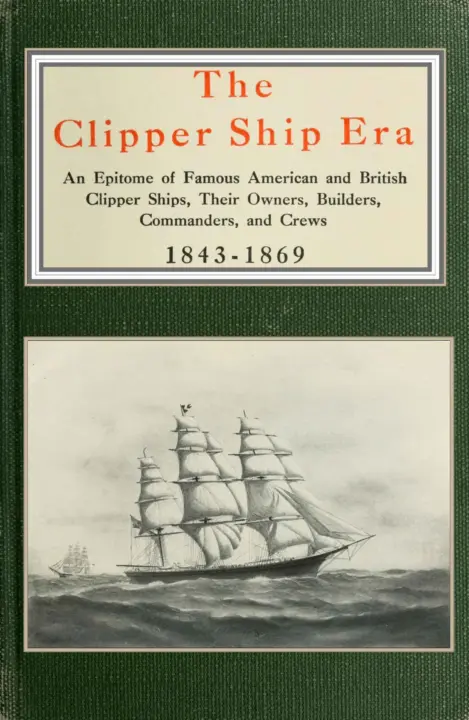
"The Clipper Ship Era" by Arthur H. Clark is a historical account written in the early 20th century. This work chronicles the thriving period of American and British clipper ships from the 1840s to the late 1860s, detailing their construction, speed, and significance in maritime history. The book likely highlights the technological advancements in shipbuilding, the cultural impacts of these vessels, and notable figures such as shipbuilders and captains from that era. The opening of the book introduces the Clipper Ship Era, noting that it began in 1843, driven by increased demand for swift tea deliveries from China and spurred by the gold rushes. Clark discusses the evolution of sailing ships, specifically focusing on the transition from traditional ships to the more agile and faster clipper ships. He emphasizes the personal connection he has with many of these vessels and their builders, sharing insights into the races and competitions among shipbuilders and mariners that characterized this exciting period on the seas. Overall, the beginning sets the stage for a detailed exploration of the maritime innovations and historical context of the clipper ships, laying a foundation for the chapters that follow.
Introduction adapted from the source catalogue; source summaries may be automatically generated.
Free to read · English · 98,778 words · No account needed
MAKE TIME FOR A GOOD BOOK
On by default. Untick to stop anonymous reading totals. Each page counts after 10 seconds in view. How this works.
Anonymous counting is on unless you have switched it off.
The halliards are led along the deck fore and aft in the grip of clean brawny fists with sinewy arms and broad backs behind them, the ordinary seamen and boys tailing on, and perhaps the cook, steward, carpenter, and sailmaker lending a hand, and all hands join in a ringing chorus of the ocean, mingling in harmony with the clear sky, indigo-blue waves, and the sea breeze purring aloft among the spars and rigging:
“Oh, poor Reuben Ranzo,
Ranzo, boys, O Ranzo,
Oh, Ranzo was no sailor,
Ranzo boys, O Ranzo.
So they shipped him aboard a whaler,
Ranzo boys, O Ranzo,
And he could not do his duty,
Ranzo boys, O Ranzo.
So the mate, he being a bad man,
Ranzo boys, O Ranzo,
He led him to the gangway,
Ranzo boys, O Ranzo,
And he gave him five-and-twenty,
Ranzo boys, O Ranzo,
But the captain, he being a good man,
Ranzo boys, O Ranzo,
He took him in the cabin,
Ranzo boys, O Ranzo,
And he gave him wine and whiskey,
Ranzo boys, O Ranzo,
And he learned him navigation,
Ranzo boys, O Ranzo,
And now he’s Captain Ranzo,
Ranzo boys, O Ranzo.”
Finally the mate’s clear, sharp order comes: “Belay there; clap a watch tackle on the lee fore brace.” “Aye, aye, sir!” And so every sheet, halliard, and brace is swayed up and tautened to the freshening breeze. The gear is coiled up, the brasswork polished until it glistens in the morning sun, the paintwork and gratings are wiped off, decks swabbed dry, and the pumps manned to another rousing chanty:
“London town is a-burning,
Oh, run with the bullgine, run.
Way, yay, way, yay, yar,
Oh, run with the bullgine, run.”
The “old man” gets his morning sights, the log is hove, the wheel and watch are relieved at eight bells, and the clipper is ready for another day of stress and strain.
Mornings like these bring keen appetites to officers and men, so the watch below sit about on their chests in the forecastle or on the fore hatch and dive into the mess kid with knives and spoons. It may be a chunk of salt pork or cold salt beef, or what Rufus Choate, in one of his flights of forensic eloquence, described as the “nutritious hash,” “succulent lob-scouse,” or “palatable dandy funk,” with plenty of hard tack in the bread barge, and all washed down with unlimited coffee. Not quail on toast or devilled kidneys, to be sure, but good substantial seamen’s food, upon which a man can work better at sea, grow stronger, and become less tired than on any other.
Your reading position is saved on this browser. Take it to another device with a library code. Reading pages adapt to text, rather than matching a printed edition.
BEHIND THE BOOK
This eBook is for the use of anyone anywhere in the United States and most other parts of the world at no cost and with almost no restrictions whatsoever. You may copy it, give it away or re-use it under the terms of the Project Gutenberg License included with this eBook or online at www.gutenberg.org. If you are not located in the United States, you will have to check the laws of the country where you are located before using this eBook. Read the source licence.
The original source file, including credits and licence, is retained by this library. Request an original-format copy at no charge. Please include the book title and Project Gutenberg identifier #69154.
KEEP YOUR CURIOSITY GOING
Cécile Tormay

Moritz Busch
John L. Ransom
Frances Wright
Cécile Tormay

Mabel Potter Daggett