THE CLASSIC COLLECTION✦An outlaw’s diary: the CommuneCLASSIC FREE BOOKS
An outlaw’s diary: the Commune
Cécile Tormay
THE CLASSIC COLLECTION · 1910
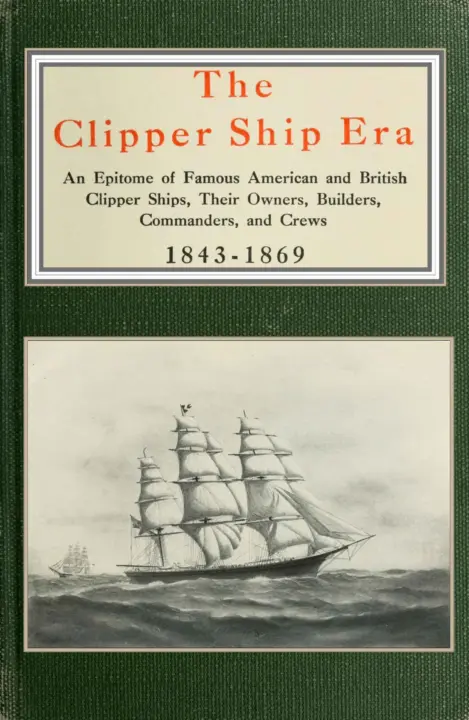
"The Clipper Ship Era" by Arthur H. Clark is a historical account written in the early 20th century. This work chronicles the thriving period of American and British clipper ships from the 1840s to the late 1860s, detailing their construction, speed, and significance in maritime history. The book likely highlights the technological advancements in shipbuilding, the cultural impacts of these vessels, and notable figures such as shipbuilders and captains from that era. The opening of the book introduces the Clipper Ship Era, noting that it began in 1843, driven by increased demand for swift tea deliveries from China and spurred by the gold rushes. Clark discusses the evolution of sailing ships, specifically focusing on the transition from traditional ships to the more agile and faster clipper ships. He emphasizes the personal connection he has with many of these vessels and their builders, sharing insights into the races and competitions among shipbuilders and mariners that characterized this exciting period on the seas. Overall, the beginning sets the stage for a detailed exploration of the maritime innovations and historical context of the clipper ships, laying a foundation for the chapters that follow.
Introduction adapted from the source catalogue; source summaries may be automatically generated.
Free to read · English · 98,778 words · No account needed
MAKE TIME FOR A GOOD BOOK
On by default. Untick to stop anonymous reading totals. Each page counts after 10 seconds in view. How this works.
Anonymous counting is on unless you have switched it off.
Thus the Stornoway, while she exceeded the Race Horse by 32 feet 8 inches in length and by 1 foot 8 inches in depth, yet had 4 feet 4 inches less breadth; and here began a contest, which extended over so many years, of breadth against length and depth. There can be no doubt that the Stornoway with more beam and the Race Horse with more length and depth, would have been faster, but at the same time considerably larger vessels.[8]
The Stornoway was commanded by Captain Richard Robinson, and on her first voyage she made the passage from the Downs to Java Head in 80 days, to Hong-kong in 102 days, and from Hong-kong to London in 103 days. These were at that time the quickest passages between these ports that had ever been made by a British vessel.
In 1851 Alexander Hall & Co. built the China tea-clipper Chrysolite, of 471 tons, for Taylor & Potter of Liverpool; length 149 feet 3 inches, breadth 29 feet, depth 17 feet. As will be seen this vessel approached more nearly the proportions of the Race Horse, having 8 feet 5 inches less length than the Stornoway, with 3 feet 4 inches more breadth, and 8 inches less depth. She made her first passage from Liverpool to Canton, under the command of Captain Anthony Enright, in 102 days, and came home in 104 days. She also made the passage from Liverpool to Java Head in 80 days, her best day’s run being 320 miles.
The very keen rivalry between the British and American clipper ships engaged in the China trade at this time, seems to have been stimulating to the imagination. W. S. Lindsay, in his History of Merchant Shipping (vol. iii., p. 291), relates an interesting story of one of the early races, and as I wish to do the narrative full justice, I give it in Mr. Lindsay’s own words:
“Mr. T. C. Cowper, of Aberdeen, himself a member of a well-known ship-building firm in Aberdeen, who had spent some time in China at the period to which I refer, and to whom I am much indebted for the information connected with our struggles to maintain our position in that trade, gives the following graphic description of his voyage home in the Ganges, Captain Deas, belonging to Leith, one of the vessels we had sent forth after the repeal of our Navigation Laws, to compete with the Americans in that trade: ‘We loaded,’ he says, ‘new teas at Wampoa, and sailed on the first of September, 1851. Two of the fastest American clippers, the Flying Cloud and Bald Eagle, sailed two or three days after us. A great deal of excitement existed in China about the race, the American ships being the favorites. The southwest monsoon being strong, the Ganges made a rather long passage to Anjer, but when we arrived there we found that neither of our rivals had been reported as having passed. We arrived in the English Channel on the evening of the 16th of December. On the following morning at daylight we were off Portland, well inshore and under short sail, light winds from the northeast, and weather rather thick. About 8 A.M. the wind freshened and the haze cleared away, which showed two large and lofty ships two or three miles to windward of us. They proved to be our American friends, having their Stars and Stripes flying for a pilot. Captain Deas at once gave orders to hoist his signals for a pilot also, and as, by this time, several cutters were standing out from Weymouth, the Ganges, being farthest inshore got her pilot first on board. I said that I would land in the pilot-boat and go to London by rail, and would report the ship that night or next morning at Austin Friars. (She was consigned to my firm.) The breeze had considerably freshened before I got on board the pilot cutter, when the Ganges filled away on the port tack, and Captain Deas, contrary to his wont, for he was a very cautious man, crowded on all small sails. The Americans lost no time and were after him, and I had three hours’ view of as fine an ocean race as I can wish to see; the wind being dead ahead, the ships were making short tacks. The Ganges showed herself to be the most weatherly of the three; and the gain on every tack inshore was obvious, neither did she seem to carry way behind in fore reaching. She arrived off Dungeness six hours before the other two, and was in the London docks twenty-four hours before the first, and thirty-six hours before the last of her opponents.’”
Your reading position is saved on this browser. Take it to another device with a library code. Reading pages adapt to text, rather than matching a printed edition.
BEHIND THE BOOK
This eBook is for the use of anyone anywhere in the United States and most other parts of the world at no cost and with almost no restrictions whatsoever. You may copy it, give it away or re-use it under the terms of the Project Gutenberg License included with this eBook or online at www.gutenberg.org. If you are not located in the United States, you will have to check the laws of the country where you are located before using this eBook. Read the source licence.
The original source file, including credits and licence, is retained by this library. Request an original-format copy at no charge. Please include the book title and Project Gutenberg identifier #69154.
KEEP YOUR CURIOSITY GOING
Cécile Tormay

Moritz Busch
John L. Ransom
Frances Wright
Cécile Tormay

Mabel Potter Daggett