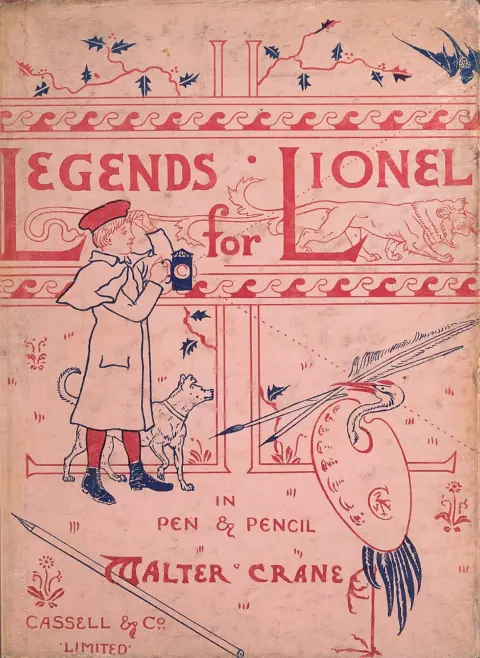
Legends for Lionel: in pen and pencil
Walter Crane
THE CLASSIC COLLECTION · 1892
"The claims of decorative art" by Walter Crane is a collection of essays on art and design written in the late 19th century. It argues for the dignity and centrality of the decorative and applied arts, their unity with architecture, and their deep ties to everyday life, labour, and social conditions. The work critiques commercialism and machine production for degrading taste, and champions craftsmanship, pattern, and figurative thought as foundations of a healthy artistic culture.
The opening of the work sets out a manifesto: decorative art is not a lesser field but the root system that sustains painting and sculpture, and beauty must permeate daily surroundings to nourish higher arts. Crane insists art is a language shaped by material, use, and social environment; he rebukes exhibition culture and “flatness-only” clichés, arguing adaptability, harmony, and decorum are the true tests of decoration. He broadens “architecture” to mean the structural background of life and thought, showing how economic forces and commercialism fragment the arts and stifle spontaneity, while a more communal mode of living could restore their unity. He then surveys figurative art’s vitality from satire to ideal allegory, defends sculpture and painting from a decorator’s standpoint, outlines the logic and evolution of pattern (from square and circle to scrolls, frets, and fans), and links art to labour, calling for revived handicraft against mechanised production and its erosion of both joy in work and public taste.
Introduction adapted from the source catalogue; source summaries may be automatically generated.
Free to read · English · 52,231 words · No account needed
MAKE TIME FOR A GOOD BOOK
On by default. Untick to stop anonymous reading totals. Each page counts after 10 seconds in view. How this works.
Anonymous counting is on unless you have switched it off.
Mere cunning of hand invariably tires, and this is why superficial literal imitation by itself is always so dull. We are bored to death by what is called realism, and can only keep up our interest by a constant succession of novelties; like the audience in a theatre, who tire of a mere scene, an arrangement of properties however real, according to stage realism. On the stage, however, strongly as it reflects the literal tendencies of the day, art may safely go much farther in that direction, as the meaning and expression (to which thought, scenery, and properties may contribute in a high degree) must finally depend upon the dramatic action of the living persons, and these, at least and from the pictorial point of view of the stage, from the very fact that they are alive, can never be overpowered by accessories.
Of course, I admit, as regards painting, apart from any poetic embodiment or abstract treatment, there is the expression of the facts of light and colour, texture and tones, and these--although, with the exception of colour, they can be rendered by photography with an accuracy and completeness quite unapproachable--really would appear to be at present the only qualities, the only facts, the expression of which is worth the attention of the painter. If that is really the case, painting--pending its final extinction by photography--must be content to take an inferior intellectual position among the arts. “Art is art, precisely because it is not nature,” said Goethe, but the modern painter, so far as he is articulate, would render it, “Art is art, precisely because it mocks nature.”
The career of an illustrious contemporary (as shown in a recent collection at the Grosvenor Gallery) illustrates in a remarkable way certain degrees of expressiveness and imitation in painting. It is remarkable, too, as showing that, even when the object in painting is to cast off all convention, and to represent nature without prejudice or prepossession, how, even then, unconsciously, under the influence of passionate feeling striving for expression, the painter develops, as it were, a new convention of his own. The most striking quality about the earlier pictures of Millais is not what was commonly supposed to be the chief characteristic of the pre-Raphaelite school, namely, their unflinching truth to nature, but rather the intellectual force of their poetic and dramatic expression. Comparing the work of the earlier period--say from 1849 to 1856--with the work of the later--say of the last ten years--one may see as totally different aims as are perhaps possible in the work of one man. The close textures, beautiful detail, fine and finished execution, deep though not always harmonious colours, and romantic feeling of the earlier time have in the later work entirely disappeared, and nearly everything is sacrificed to the more superficial facts of full relief, and accidents of lighting, atmosphere, and surface. I do not lay so much stress on the fact that the recent pictures are chiefly portraits in the technical sense (although one certainly does rather resent that personages of mere wealth and fashion should have usurped so much of the painter’s time, and filled so many of his canvases, to the extinction, in great part, of the romantic and dramatic element in his art), for Millais has always been a portrait painter whatever his subject. His one particular idiosyncrasy as an artist has, from the first, consisted in the force and directness of his realisation of nature, which is of the essence of portrayal, or portraiture. He never showed any tendency to idealism in any shape, so far as I am aware, but has always been content to take nature as he found her, without endeavouring, by careful and conscious selection and comparison, to build up types of form, or elaborate schemes of decorative composition and colour. He is not a seer of visions or a dreamer of dreams. Life and circumstance are enough, without reading between the lines. In this directness lie both his strength and his weakness as an artist.
Your reading position is saved on this browser. Take it to another device with a library code. Reading pages adapt to text, rather than matching a printed edition.
BEHIND THE BOOK
This eBook is for the use of anyone anywhere in the United States and most other parts of the world at no cost and with almost no restrictions whatsoever. You may copy it, give it away or re-use it under the terms of the Project Gutenberg License included with this eBook or online at www.gutenberg.org. If you are not located in the United States, you will have to check the laws of the country where you are located before using this eBook. Read the source licence.
The original source file, including credits and licence, is retained by this library. Request an original-format copy at no charge. Please include the book title and Project Gutenberg identifier #77149.
KEEP YOUR CURIOSITY GOING

Charles G. (Charles Griffith) Ross
Hannah Webster Foster

Emily Lawless
Edwin Hamlin Carr

Charles De Lano Hine
Andrew Ure