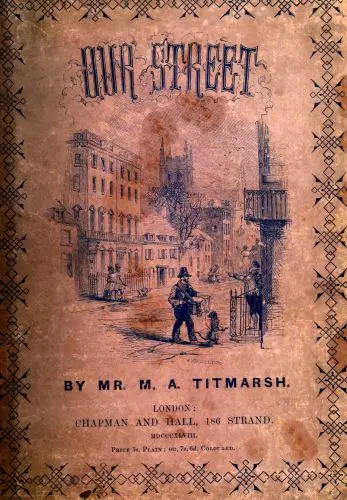
“Our Street”
William Makepeace Thackeray
THE CLASSIC COLLECTION · 1869
"The Christmas Books of Mr. M.A. Titmarsh" by William Makepeace Thackeray is a collection of stories written in the mid-19th century. The book features a humorous and satirical narrative style, centered around the character of Mr. M.A. Titmarsh, who appears to be a representative of the author's alter ego and serves as a storyteller for a whimsical exploration of English society, particularly during the festive season. The stories within this collection examine various aspects of life, social norms, and the quirks of contemporary characters, offering readers a vivid and entertaining portrayal of the times. The opening of the book introduces us to the character of Mr. M.A. Titmarsh, as he recounts the amusing social dynamics surrounding Mrs. Perkins's ball. Through his observations, we meet a colorful cast of characters, including the eccentric Mulligan, whose grandiose claims about his heritage and boisterous demeanor contrast humorously with the genteel surroundings of the ball. Titmarsh’s interactions with Mulligan and his reflections on the ball itself set the tone for the ensuing chaos, as he navigates the challenges of social expectations and personal eccentricities. The vivid descriptions of the ball and the guests, along with Titmarsh's wit, draw readers into a lively world that blends comedy with astute social commentary, hinting at the delightful narratives to come.
Introduction adapted from the source catalogue; source summaries may be automatically generated.
Free to read · English · 80,180 words · No account needed
MAKE TIME FOR A GOOD BOOK
On by default. Untick to stop anonymous reading totals. Each page counts after 10 seconds in view. How this works.
Anonymous counting is on unless you have switched it off.
JONES MINIMUS passes, laden with tarts.
Duval.--Hullo! you small boy with the tarts! Come here, sir. Jones Minimus.--Please, Duval, they ain't mine. Duval.--Oh, you abominable young story-teller. [He confiscates the goods.
I think I like young Duval's mode of levying contributions better than Bullock's. The former's, at least, has the merit of more candor. Duval is the pirate of Birch's, and lies in wait for small boys laden with money or provender. He scents plunder from afar off: and pounces out on it. Woe betide the little fellow when Duval boards him!
There was a youth here whose money I used to keep, as he was of an extravagant and weak taste; and I doled it out to him in weekly shillings, sufficient for the purchase of the necessary tarts. This boy came to me one day for half a sovereign, for a very particular purpose, he said. I afterwards found he wanted to lend the money to Duval.
The young ogre burst out laughing, when in a great wrath and fury I ordered him to refund to the little boy: and proposed a bill of exchange at three months. It is true Duval's father does not pay the Doctor, and the lad never has a shilling, save that which he levies; and though he is always bragging about the splendor of Freenystown, Co. Cork, and the fox-hounds his father keeps, and the claret they drink there--there comes no remittance from Castle Freeny in these bad times to the honest Doctor; who is a kindly man enough, and never yet turned an insolvent boy out of doors.
(Rather a cold winter night.)
Hewlett (flinging a shoe at Master Nightingale's bed, with which he hits that young gentleman).--Hullo, you! Get up and bring me that shoe!
Nightingale.--Yes, Hewlett. (He gets up.)
Hewlett.--Don't drop it, and be very careful of it, sir.
Nightingale.--Yes, Hewlett.
Hewlett.--Silence in the dormitory! Any boy who opens his mouth, I'll murder him. Now, sir, are not you the boy what can sing?
Nightingale.--Yes, Hewlett.
Hewlett.--Chant, then, till I go to sleep, and if I wake when you stop, you'll have this at your head.
[Master HEWLETT lays his Bluchers on the bed, ready to shy at Master Nightingale's head in the case contemplated.]
Nightingale (timidly).--Please, Hewlett?
Hewlett.--Well, sir?
Nightingale.--May I put on my trousers, please?
Hewlett.--No, sir. Go on, or I'll--
Nightingale.--
"Through pleasures and palaces
Though we may roam,
Be it ever so humble
There's no place like home."
Your reading position is saved on this browser. Take it to another device with a library code. Reading pages adapt to text, rather than matching a printed edition.
William Makepeace Thackeray
William Makepeace Thackeray
Charles Dickens & William Makepeace Thackeray
William Makepeace Thackeray
BEHIND THE BOOK
This eBook is for the use of anyone anywhere in the United States and most other parts of the world at no cost and with almost no restrictions whatsoever. You may copy it, give it away or re-use it under the terms of the Project Gutenberg License included with this eBook or online at www.gutenberg.org. If you are not located in the United States, you will have to check the laws of the country where you are located before using this eBook. Read the source licence.
The original source file, including credits and licence, is retained by this library. Request an original-format copy at no charge. Please include the book title and Project Gutenberg identifier #2731.
KEEP YOUR CURIOSITY GOING
Coulson Kernahan

Maurice Baring
Frances Wright
Cécile Tormay

Frederic Jesup Stimson

W. H. P. (William Henry Pope) Jarvis