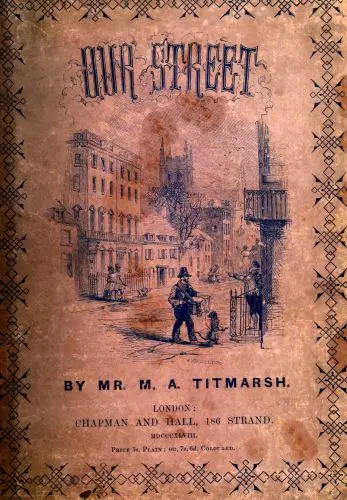
“Our Street”
William Makepeace Thackeray
THE CLASSIC COLLECTION · 1869
"The Christmas Books of Mr. M.A. Titmarsh" by William Makepeace Thackeray is a collection of stories written in the mid-19th century. The book features a humorous and satirical narrative style, centered around the character of Mr. M.A. Titmarsh, who appears to be a representative of the author's alter ego and serves as a storyteller for a whimsical exploration of English society, particularly during the festive season. The stories within this collection examine various aspects of life, social norms, and the quirks of contemporary characters, offering readers a vivid and entertaining portrayal of the times. The opening of the book introduces us to the character of Mr. M.A. Titmarsh, as he recounts the amusing social dynamics surrounding Mrs. Perkins's ball. Through his observations, we meet a colorful cast of characters, including the eccentric Mulligan, whose grandiose claims about his heritage and boisterous demeanor contrast humorously with the genteel surroundings of the ball. Titmarsh’s interactions with Mulligan and his reflections on the ball itself set the tone for the ensuing chaos, as he navigates the challenges of social expectations and personal eccentricities. The vivid descriptions of the ball and the guests, along with Titmarsh's wit, draw readers into a lively world that blends comedy with astute social commentary, hinting at the delightful narratives to come.
Introduction adapted from the source catalogue; source summaries may be automatically generated.
Free to read · English · 80,180 words · No account needed
MAKE TIME FOR A GOOD BOOK
On by default. Untick to stop anonymous reading totals. Each page counts after 10 seconds in view. How this works.
Anonymous counting is on unless you have switched it off.
By this time King Giglio's aides-de-camp had come up, whom his Majesty ordered to bind the prisoner. And they tied his hands behind him, and bound his legs tight under his horse, having set him with his face to the tail; and in this fashion he was led back to King Giglio's quarters, and thrust into the very dungeon where young Bulbo had been confined.
Padella (who was a very different person in the depth of his distress, to Padella, the proud wearer of the Crim Tartar crown), now most affectionately and earnestly asked to see his son--his dear eldest boy--his darling Bulbo; and that good-natured young man never once reproached his haughty parent for his unkind conduct the day before, when he would have left Bulbo to be shot without any pity, but came to see his father, and spoke to him through the grating of the door, beyond which he was not allowed to go; and brought him some sandwiches from the grand supper which his Majesty was giving above stairs, in honor of the brilliant victory which had just been achieved.
"I cannot stay with you long, sir," says Bulbo, who was in his best ball dress, as he handed his father in the prog. "I am engaged to dance the next quadrille with her Majesty Queen Rosalba, and I hear the fiddles playing at this very moment."
So Bulbo went back to the ball-room and the wretched Padella ate his solitary supper in silence and tears.
All was now joy in King Giglio's circle. Dancing, feasting, fun, illuminations, and jollifications of all sorts ensued. The people through whose villages they passed were ordered to illuminate their cottages at night, and scatter flowers on the roads during the day. They were requested--and I promise you they did not like to refuse--to serve the troops liberally with eatables and wine; besides, the army was enriched by the immense quantity of plunder which was found in King Padella's camp, and taken from his soldiers; who (after they had given up everything) were allowed to fraternize with the conquerors; and the united forces marched back by easy stages towards King Giglio's capital, his royal banner and that of Queen Rosalba being carried in front of the troops. Hedzoff was made a Duke and a Field Marshal. Smith and Jones were promoted to be Earls; the Crim Tartar Order of the Pumpkin and the Paflagonian decoration of the Cucumber were freely distributed by their Majesties to the army. Queen Rosalba wore the Paflagonian Ribbon of the Cucumber across her riding-habit, whilst King Giglio never appeared without the grand Cordon of the Pumpkin. How the people cheered them as they rode along side by side! They were pronounced to be the handsomest couple ever seen: that was a matter of course; but they really WERE very handsome, and, had they been otherwise, would have looked so, they were so happy! Their Majesties were never separated during the whole day, but breakfasted, dined, and supped together always, and rode side by side, interchanging elegant compliments, and indulging in the most delightful conversation. At night, her Majesty's ladies of honor (who had all rallied round her the day after King Padella's defeat) came and conducted her to the apartments prepared for her; whilst King Giglio, surrounded by his gentlemen, withdrew to his own Royal quarters. It was agreed they should be married as soon as they reached the capital, and orders were dispatched to the Archbishop of Blombodinga, to hold himself in readiness to perform the interesting ceremony. Duke Hedzoff carried the message, and gave instructions to have the Royal Castle splendidly refurnished and painted afresh. The Duke seized Glumboso, the Ex-Prime Minister, and made him refund that considerable sum of money which the old scoundrel had secreted out of the late King's treasure. He also clapped Valoroso into prison (who, by the way, had been dethroned for some considerable period past), and when the ex-monarch weakly remonstrated, Hedzoff said, "A soldier, sir, knows but his duty; my orders are to lock you up along with the ex-King Padella, whom I have brought hither a prisoner under guard." So these two ex-Royal personages were sent for a year to the House of Correction, and thereafter were obliged to become monks of the severest Order of Flagellants, in which state, by fasting, by vigils, by flogging (which they administered to one another, humbly but resolutely), no doubt they exhibited a repentance for their past misdeeds, usurpations, and private and public crimes.
Your reading position is saved on this browser. Take it to another device with a library code. Reading pages adapt to text, rather than matching a printed edition.
William Makepeace Thackeray
William Makepeace Thackeray
Charles Dickens & William Makepeace Thackeray
William Makepeace Thackeray
BEHIND THE BOOK
This eBook is for the use of anyone anywhere in the United States and most other parts of the world at no cost and with almost no restrictions whatsoever. You may copy it, give it away or re-use it under the terms of the Project Gutenberg License included with this eBook or online at www.gutenberg.org. If you are not located in the United States, you will have to check the laws of the country where you are located before using this eBook. Read the source licence.
The original source file, including credits and licence, is retained by this library. Request an original-format copy at no charge. Please include the book title and Project Gutenberg identifier #2731.
KEEP YOUR CURIOSITY GOING
Coulson Kernahan

Maurice Baring
Frances Wright
Cécile Tormay

Frederic Jesup Stimson

W. H. P. (William Henry Pope) Jarvis