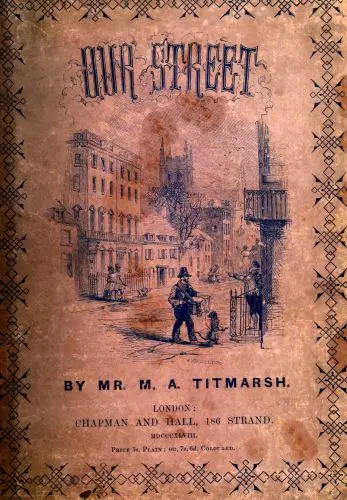
“Our Street”
William Makepeace Thackeray
THE CLASSIC COLLECTION · 1869
"The Christmas Books of Mr. M.A. Titmarsh" by William Makepeace Thackeray is a collection of stories written in the mid-19th century. The book features a humorous and satirical narrative style, centered around the character of Mr. M.A. Titmarsh, who appears to be a representative of the author's alter ego and serves as a storyteller for a whimsical exploration of English society, particularly during the festive season. The stories within this collection examine various aspects of life, social norms, and the quirks of contemporary characters, offering readers a vivid and entertaining portrayal of the times. The opening of the book introduces us to the character of Mr. M.A. Titmarsh, as he recounts the amusing social dynamics surrounding Mrs. Perkins's ball. Through his observations, we meet a colorful cast of characters, including the eccentric Mulligan, whose grandiose claims about his heritage and boisterous demeanor contrast humorously with the genteel surroundings of the ball. Titmarsh’s interactions with Mulligan and his reflections on the ball itself set the tone for the ensuing chaos, as he navigates the challenges of social expectations and personal eccentricities. The vivid descriptions of the ball and the guests, along with Titmarsh's wit, draw readers into a lively world that blends comedy with astute social commentary, hinting at the delightful narratives to come.
Introduction adapted from the source catalogue; source summaries may be automatically generated.
Free to read · English · 80,180 words · No account needed
MAKE TIME FOR A GOOD BOOK
On by default. Untick to stop anonymous reading totals. Each page counts after 10 seconds in view. How this works.
Anonymous counting is on unless you have switched it off.
Miss Fanny came tripping after me. She held out her little hand with such a pretty look of deprecation, that I could not but take it; and she said, "Mr. Titmarsh, if you please, I want to speak to you, if you please;" and, choking with emotion, I bade her speak on.
"My brother knows all about it, and, highly approves of Captain Hicks," she said, with her head hanging down; "and oh, he's very good and kind: and I know him MUCH better now, than I did when we were on board the steamer."
I thought how I had mimicked him, and what an ass I had been.
"And you know," she continued, "that you have quite deserted me for the last ten days for your great acquaintances."
"I have been to play chess with Lord Knightsbridge, who has the gout."
"And to drink tea constantly with that American lady; and you have written verses in her album; and in Lavinia's album; and as I saw that you had quite thrown me off, why I--my brother approves of it highly; and--and Captain Hicks likes you very much, and says you amuse him very much--indeed he does," says the arch little wretch. And then she added a postscript, as it were to her letter, which contained, as usual, the point which she wished to urge:--
"You--won't break it to mamma--will you be so kind? My brother will do that"--and I promised her; and she ran away, kissing her hand to me. And I did not say a word to Lady Kicklebury, and not above a thousand people at Noirbourg knew that Miss Kicklebury and Captain Hicks were engaged.
And now let those who are too confident of their virtue listen to the truthful and melancholy story which I have to relate, and humble themselves, and bear in mind that the most perfect among us are occasionally liable to fall. Kicklebury was not perfect,--I do not defend his practice. He spent a great deal more time and money than was good for him at M. Lenoir's gaming-table, and the only thing which the young fellow never lost was his good humor. If Fortune shook her swift wings and fled away from him, he laughed at the retreating pinions, and you saw him dancing and laughing as gayly after losing a rouleau, as if he was made of money, and really had the five thousand a year which his mother said was the amount of the Kicklebury property. But when her ladyship's jointure, and the young ladies' allowances, and the interest of mortgages were paid out of the five thousand a year, I grieve to say that the gallant Kicklebury's income was to be counted by hundreds and not by thousands; so that, for any young lady who wants a carriage (and who can live without one?) our friend the baronet is not a desirable specimen of bachelors. Now, whether it was that the presence of his mamma interrupted his pleasures, or certain of her ways did not please him, or that he had lost all his money at roulette and could afford no more, certain it is, that after about a fortnight's stay at Noirbourg, he went off to shoot with Count Einhorn in Westphalia; he and Hicks parting the dearest of friends, and the baronet going off on a pony which the captain lent to him. Between him and Millikin, his brother-in-law, there was not much sympathy: for he pronounced Mr. Milliken to be what is called a muff; and had never been familiar with his elder sister Lavinia, of whose poems he had a mean opinion, and who used to tease and worry him by teaching him French, and telling tales of him to his mamma, when he was a schoolboy home for the holidays. Whereas, between the baronet and Miss Fanny there seemed to be the closest affection: they walked together every morning to the waters; they joked and laughed with each other as happily as possible. Fanny was almost ready to tell fibs to screen her brother's malpractices from her mamma: she cried when she heard of his mishaps, and that he had lost too much money at the green table; and when Sir Thomas went away, the good little soul brought him five louis; which was all the money she had: for you see she paid her mother handsomely for her board; and when her little gloves and milliner's bills were settled how much was there left out of two hundred a year? And she cried when she heard that Hicks had lent Sir Thomas money, and went up and said, "Thank you, Captain Hicks;" and shook hands with the captain so eagerly, that I thought he was a lucky fellow, who had a father a wealthy attorney in Bedford Row. Heighho! I saw how matters were going. The birds MUST sing in the spring-time, and the flowers bud.
Your reading position is saved on this browser. Take it to another device with a library code. Reading pages adapt to text, rather than matching a printed edition.
William Makepeace Thackeray
William Makepeace Thackeray
Charles Dickens & William Makepeace Thackeray
William Makepeace Thackeray
BEHIND THE BOOK
This eBook is for the use of anyone anywhere in the United States and most other parts of the world at no cost and with almost no restrictions whatsoever. You may copy it, give it away or re-use it under the terms of the Project Gutenberg License included with this eBook or online at www.gutenberg.org. If you are not located in the United States, you will have to check the laws of the country where you are located before using this eBook. Read the source licence.
The original source file, including credits and licence, is retained by this library. Request an original-format copy at no charge. Please include the book title and Project Gutenberg identifier #2731.
KEEP YOUR CURIOSITY GOING
Coulson Kernahan

Maurice Baring
Frances Wright
Cécile Tormay

Frederic Jesup Stimson

W. H. P. (William Henry Pope) Jarvis