
Last letters from the living dead man
David Patterson (Spirit) Hatch
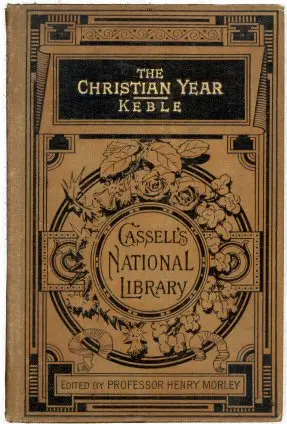
THE CLASSIC COLLECTION · 1827
"The Christian Year" by John Keble is a series of poems written in 1827 for the Sundays and feasts of the Church of England's liturgical calendar. This devotional work became the most popular volume of verse in the nineteenth century, with over 375,000 copies sold by 1873. Several of its poems became beloved hymns. Initially published anonymously, its success led to Keble's appointment as Oxford Professor of Poetry and significantly influenced the Oxford Movement.
Introduction adapted from the source catalogue; source summaries may be automatically generated.
Free to read · English · 48,087 words · No account needed
MAKE TIME FOR A GOOD BOOK
On by default. Untick to stop anonymous reading totals. Each page counts after 10 seconds in view. How this works.
Anonymous counting is on unless you have switched it off.
He dearly loves, and not alone:
For his winged thoughts are soaring high
Where never yet frail heart was known
To breathe its vain Affection’s sigh.
He loves and weeps—but more than tears
Have sealed Thy welcome and his love—
One look lives in him, and endears
Crosses and wrongs where’er he rove:
That gracious chiding look, Thy call
To win him to himself and Thee,
Sweetening the sorrow of his fall
Which else were rued too bitterly.
E’en through the veil of sheep it shines,
The memory of that kindly glance;—
The Angel watching by, divines
And spares awhile his blissful trance.
Or haply to his native lake
His vision wafts him back, to talk
With JESUS, ere His flight He take,
As in that solemn evening walk,
When to the bosom of His friend,
The Shepherd, He whose name is Good.
Did His dear lambs and sheep commend,
Both bought and nourished with His blood:
Then laid on him th’ inverted tree,
Which firm embraced with heart and arm,
Might cast o’er hope and memory,
O’er life and death, its awful charm.
With brightening heart he bears it on,
His passport through this eternal gates,
To his sweet home—so nearly won,
He seems, as by the door he waits,
The unexpressive notes to hear
Of angel song and angel motion,
Rising and falling on the ear
Like waves in Joy’s unbounded ocean.—
His dream is changed—the Tyrant’s voice
Calls to that last of glorious deeds—
But as he rises to rejoice,
Not Herod but an Angel leads.
He dreams he sees a lamp flash bright,
Glancing around his prison room—
But ’tis a gleam of heavenly light
That fills up all the ample gloom.
The flame, that in a few short years
Deep through the chambers of the dead
Shall pierce, and dry the fount of tears,
Is waving o’er his dungeon-bed.
Touched he upstarts—his chains unbind—
Through darksome vault, up massy stair,
His dizzy, doubting footsteps wind
To freedom and cool moonlight air.
Then all himself, all joy and calm,
Though for a while his hand forego,
Just as it touched, the martyr’s palm,
He turns him to his task below;
The pastoral staff, the keys of Heaven,
To wield a while in grey-haired might,
Then from his cross to spring forgiven,
And follow JESUS out of sight.
St. James’s Day.
Your reading position is saved on this browser. Take it to another device with a library code. Reading pages adapt to text, rather than matching a printed edition.
BEHIND THE BOOK
This eBook is for the use of anyone anywhere in the United States and most other parts of the world at no cost and with almost no restrictions whatsoever. You may copy it, give it away or re-use it under the terms of the Project Gutenberg License included with this eBook or online at www.gutenberg.org. If you are not located in the United States, you will have to check the laws of the country where you are located before using this eBook. Read the source licence.
The original source file, including credits and licence, is retained by this library. Request an original-format copy at no charge. Please include the book title and Project Gutenberg identifier #4272.
KEEP YOUR CURIOSITY GOING
David Patterson (Spirit) Hatch

David Patterson (Spirit) Hatch

David Patterson (Spirit) Hatch

Edwin Abbott Abbott

Richard Watson
T. G. (Theophilus Gould) Steward