
Last letters from the living dead man
David Patterson (Spirit) Hatch
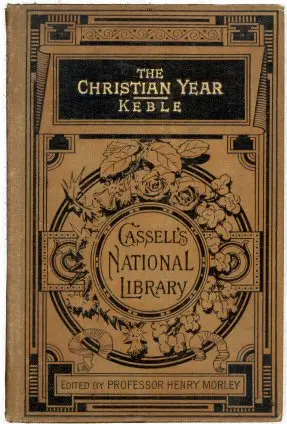
THE CLASSIC COLLECTION · 1827
"The Christian Year" by John Keble is a series of poems written in 1827 for the Sundays and feasts of the Church of England's liturgical calendar. This devotional work became the most popular volume of verse in the nineteenth century, with over 375,000 copies sold by 1873. Several of its poems became beloved hymns. Initially published anonymously, its success led to Keble's appointment as Oxford Professor of Poetry and significantly influenced the Oxford Movement.
Introduction adapted from the source catalogue; source summaries may be automatically generated.
Free to read · English · 48,087 words · No account needed
MAKE TIME FOR A GOOD BOOK
On by default. Untick to stop anonymous reading totals. Each page counts after 10 seconds in view. How this works.
Anonymous counting is on unless you have switched it off.
DEAR is the morning gale of spring,
And dear th’ autumnal eve;
But few delights can summer bring
A Poet’s crown to weave.
Her bowers are mute, her fountains dry,
And ever Fancy’s wing
Speed’s from beneath her cloudless sky
To autumn or to spring.
Sweet is the infant’s waking smile,
And sweet the old man’s rest—
But middle age by no fond wile,
No soothing calm is blest.
Still in the world’s hot restless gleam
She plies her weary task,
While vainly for some pleasant dream
Her wandering glances ask.—
O shame upon thee, listless heart,
So sad a sigh to heave,
As if thy SAVIOUR had no part
In thoughts, that make thee grieve.
As if along His lonesome way
He had not borne for thee
Sad languors through the summer day,
Storms on the wintry sea.
Youth’s lightning flash of joy secure
Passed seldom o’er His spright,—
A well of serious thought and pure.
Too deep for earthly light.
No spring was His—no fairy gleam—
For He by trial knew
How cold and bare what mortals dream,
To worlds where all is true.
Then grudge not thou the anguish keen
Which makes thee like thy LORD,
And learn to quit with eye serene
Thy youth’s ideal hoard.
Thy treasured hopes and raptures high—
Unmurmuring let them go,
Nor grieve the bliss should quickly fly
Which CHRIST disdained to know.
Thou shalt have joy in sadness soon;
The pure, calm hope be thine,
Which brightens, like the eastern moon,
As day’s wild lights decline.
Thus souls, by nature pitched too high,
By sufferings plunged too low,
Meet in the Church’s middle sky,
Half way ’twixt joy and woe,
To practise there the soothing lay
That sorrow best relieves;
Thankful for all God takes away,
Humbled by all He glass.
St. Barnabas.
The sea of consolation, a Levite. Acts iv. 36.
THE world’s a room of sickness, where each heart
Knows its own anguish and unrest;
The truest wisdom there, and noblest art,
Is his, who skills of comfort best;
Whom by the softest step and gentlest tone
Enfeebled spirits own,
And love to raise the languid eye,
When, like an angel’s wing, they feel him fleeting by:—
Feel only—for in silence gently gliding
Fain would he shun both ear and sight,
’Twixt Prayer and watchful Love his heart dividing,
A nursing-father day and night.
Such were the tender arms, where cradled lay,
In her sweet natal day,
The Church of JESUS; such the love
He to His chosen taught for His dear widowed Dove.
Your reading position is saved on this browser. Take it to another device with a library code. Reading pages adapt to text, rather than matching a printed edition.
BEHIND THE BOOK
This eBook is for the use of anyone anywhere in the United States and most other parts of the world at no cost and with almost no restrictions whatsoever. You may copy it, give it away or re-use it under the terms of the Project Gutenberg License included with this eBook or online at www.gutenberg.org. If you are not located in the United States, you will have to check the laws of the country where you are located before using this eBook. Read the source licence.
The original source file, including credits and licence, is retained by this library. Request an original-format copy at no charge. Please include the book title and Project Gutenberg identifier #4272.
KEEP YOUR CURIOSITY GOING
David Patterson (Spirit) Hatch

David Patterson (Spirit) Hatch

David Patterson (Spirit) Hatch

Edwin Abbott Abbott

Richard Watson
T. G. (Theophilus Gould) Steward