
Last letters from the living dead man
David Patterson (Spirit) Hatch
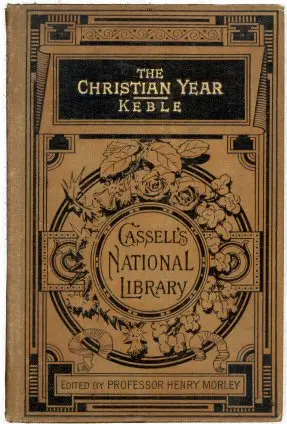
THE CLASSIC COLLECTION · 1827
"The Christian Year" by John Keble is a series of poems written in 1827 for the Sundays and feasts of the Church of England's liturgical calendar. This devotional work became the most popular volume of verse in the nineteenth century, with over 375,000 copies sold by 1873. Several of its poems became beloved hymns. Initially published anonymously, its success led to Keble's appointment as Oxford Professor of Poetry and significantly influenced the Oxford Movement.
Introduction adapted from the source catalogue; source summaries may be automatically generated.
Free to read · English · 48,087 words · No account needed
MAKE TIME FOR A GOOD BOOK
On by default. Untick to stop anonymous reading totals. Each page counts after 10 seconds in view. How this works.
Anonymous counting is on unless you have switched it off.
These we have scorned, O false and frail!
And now once more th’ appalling tale,
How love divine may woo and fail,
Of our lost year in Heaven is told—
What if as far our life were past,
Our weeks all numbered to the last,
With time and hope behind us cast,
And all our work to do with palsied hands and cold?
O watch and pray ere Advent dawn!
For thinner than the subtlest lawn
’Twixt thee and death the veil is drawn.
But Love too late can never glow:
The scattered fragments Love can glean
Refine the dregs, and yield us clean
To regions where one thought serene
Breathes sweeter than whole years of sacrifice below.
St. Andrew’s Day
He first findeth his own brother Simon, and saith unto him, We have found the Messias . . . And he brought him to Jesus. St. John i. 41, 42.
WHEN brothers part for manhood’s race,
What gift may most endearing prove
To keep fond memory its her place,
And certify a brother’s love?
’Tis true, bright hours together told,
And blissful dreams in secret shared,
Serene or solemn, gay or bold,
Shall last in fancy unimpaired.
E’en round the death-bed of the good
Such dear remembrances will hover,
And haunt us with no vexing mood
When all the cares of earth are over.
But yet our craving spirits feel,
We shall live on, though Fancy die,
And seek a surer pledge—a seal
Of love to last eternally.
Who art thou, that wouldst grave thy name
Thus deeply in a brother’s heart?
Look on this saint, and learn to frame
Thy love-charm with true Christian art.
First seek thy Saviour out, and dwell
Beneath this shadow of His roof,
Till thou have scanned His features well,
And known Him for the Christ by proof;
Such proof as they are sure to find
Who spend with Him their happy days,
Clean hands, and a self-ruling mind
Ever in tune for love and praise.
Then, potent with the spell of Heaven,
Go, and thine erring brother gain,
Entice him home to be forgiven,
Till he, too, see his Saviour plain.
Or, if before thee in the race,
Urge him with thine advancing tread,
Till, like twin stars, with even pace,
Each lucid course be duly aped.
No fading frail memorial give
To soothe his soul when thou art gone,
But wreaths of hope for aye to live,
And thoughts of good together done.
That so, before the judgment-seat,
Though changed and glorified each face,
Not unremembered ye may meet
For endless ages to embrace.
St. Thomas’ Day.
Your reading position is saved on this browser. Take it to another device with a library code. Reading pages adapt to text, rather than matching a printed edition.
BEHIND THE BOOK
This eBook is for the use of anyone anywhere in the United States and most other parts of the world at no cost and with almost no restrictions whatsoever. You may copy it, give it away or re-use it under the terms of the Project Gutenberg License included with this eBook or online at www.gutenberg.org. If you are not located in the United States, you will have to check the laws of the country where you are located before using this eBook. Read the source licence.
The original source file, including credits and licence, is retained by this library. Request an original-format copy at no charge. Please include the book title and Project Gutenberg identifier #4272.
KEEP YOUR CURIOSITY GOING
David Patterson (Spirit) Hatch

David Patterson (Spirit) Hatch

David Patterson (Spirit) Hatch

Edwin Abbott Abbott

Richard Watson
T. G. (Theophilus Gould) Steward