
Last letters from the living dead man
David Patterson (Spirit) Hatch
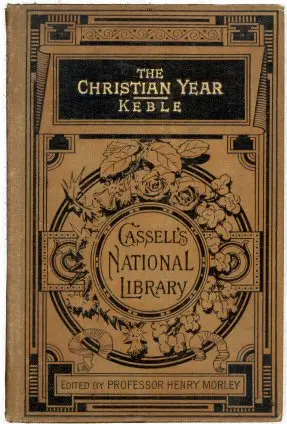
THE CLASSIC COLLECTION · 1827
"The Christian Year" by John Keble is a series of poems written in 1827 for the Sundays and feasts of the Church of England's liturgical calendar. This devotional work became the most popular volume of verse in the nineteenth century, with over 375,000 copies sold by 1873. Several of its poems became beloved hymns. Initially published anonymously, its success led to Keble's appointment as Oxford Professor of Poetry and significantly influenced the Oxford Movement.
Introduction adapted from the source catalogue; source summaries may be automatically generated.
Free to read · English · 48,087 words · No account needed
MAKE TIME FOR A GOOD BOOK
On by default. Untick to stop anonymous reading totals. Each page counts after 10 seconds in view. How this works.
Anonymous counting is on unless you have switched it off.
WHY should we faint and fear to live alone, Since all alone, so Heaven has willed, we die, Nor e’en the tenderest heart, and next our own, Knows half the reasons why we smile and sigh?
Each in his hidden sphere of joy or woe
Our hermit spirits dwell, and range apart,
Our eyes see all around in gloom or glow—
Hues of their own, fresh borrowed from the heart.
And well it is for us our GOD should feel
Alone our secret throbbings: so our prayer
May readier spring to Heaven, nor spend its zeal
On cloud-born idols of this lower air.
For if one heart in perfect sympathy
Beat with another, answering love for love,
Weak mortals, all entranced, on earth would lie,
Nor listen for those purer strains above.
Or what if Heaven for once its searching light Lent to some partial eye, disclosing all The rude bad thoughts, that in our bosom’s night Wander at large, nor heed Love’s gentle thrall?
Who would not shun the dreary uncouth place?
As if, fond leaning where her infant slept,
A mother’s arm a serpent should embrace:
So might we friendless live, and die unwept.
Then keep the softening veil in mercy drawn,
Thou who canst love us, thro’ Thou read us true;
As on the bosom of th’ aërial lawn
Melts in dim haze each coarse ungentle hue.
So too may soothing Hope Thy heave enjoy
Sweet visions of long-severed hearts to frame:
Though absence may impair, or cares annoy,
Some constant mind may draw us still the same.
We in dark dreams are tossing to and fro, Pine with regret, or sicken with despair, The while she bathes us in her own chaste glow, And with our memory wings her own fond prayer.
O bliss of child-like innocence, and love
Tried to old age! creative power to win,
And raise new worlds, where happy fancies rove,
Forgetting quite this grosser world of sin.
Bright are their dreams, because their thoughts are clear, Their memory cheering: but th’ earth-stained spright, Whose wakeful musings are of guilt and fear, Must hover nearer earth, and less in light.
Farewell, for her, th’ ideal scenes so fair— Yet not farewell her hope, since thou hast deigned, Creator of all hearts! to own and share The woe of what Thou mad’st, and we have stained.
Thou knowst our bitterness—our joys are Thine— No stranger Thou to all our wanderings wild: Nor could we bear to think, how every line Of us, Thy darkened likeness and defiled,
Your reading position is saved on this browser. Take it to another device with a library code. Reading pages adapt to text, rather than matching a printed edition.
BEHIND THE BOOK
This eBook is for the use of anyone anywhere in the United States and most other parts of the world at no cost and with almost no restrictions whatsoever. You may copy it, give it away or re-use it under the terms of the Project Gutenberg License included with this eBook or online at www.gutenberg.org. If you are not located in the United States, you will have to check the laws of the country where you are located before using this eBook. Read the source licence.
The original source file, including credits and licence, is retained by this library. Request an original-format copy at no charge. Please include the book title and Project Gutenberg identifier #4272.
KEEP YOUR CURIOSITY GOING
David Patterson (Spirit) Hatch

David Patterson (Spirit) Hatch

David Patterson (Spirit) Hatch

Edwin Abbott Abbott

Richard Watson
T. G. (Theophilus Gould) Steward