
Last letters from the living dead man
David Patterson (Spirit) Hatch
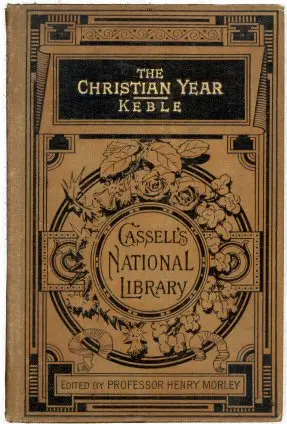
THE CLASSIC COLLECTION · 1827
"The Christian Year" by John Keble is a series of poems written in 1827 for the Sundays and feasts of the Church of England's liturgical calendar. This devotional work became the most popular volume of verse in the nineteenth century, with over 375,000 copies sold by 1873. Several of its poems became beloved hymns. Initially published anonymously, its success led to Keble's appointment as Oxford Professor of Poetry and significantly influenced the Oxford Movement.
Introduction adapted from the source catalogue; source summaries may be automatically generated.
Free to read · English · 48,087 words · No account needed
MAKE TIME FOR A GOOD BOOK
On by default. Untick to stop anonymous reading totals. Each page counts after 10 seconds in view. How this works.
Anonymous counting is on unless you have switched it off.
“Bring all our wandering fancies home,
For Thou hast every spell,
And ’mid the heathen where they roam,
Thou knowest, LORD, too well.
“Thou know’st our service sad and hard,
Thou know’st us fond and frail;
Win us to be loved and spared
When all the world shall fail.
“So when at last our weary days
Are well-nigh wasted here,
And we can trace Thy wondrous ways
In distance calm and clear,
“When in Thy love and Israel’s sin
We read our story true,
We may not, all too late, begin
To wish our hopes were new.
“Long loved, long tried, long spared as they,
Unlike in this alone,
That, by Thy grace, our hearts shall stay
For evermore Thine own.”
Nineteenth Sunday after Trinity.
Then Nebuchadnezzar the king was astonished, and rose up in haste, and spake, and said unto his counsellors, Did not we cast three men bound into the midst of the fire? They answered and said unto the king, True, O king. He answered and said, Lo, I see four men loose, walking in the midst of the fire, and they have no hurt; and the form of the fourth is like the Son of God. Daniel iii. 24, 25.
WHEN Persecution’s torrent blaze
Wraps the unshrinking Martyr’s head;
When fade all earthly flowers and bays,
When summer friends are gone and fled,
Is he alone in that dark hour
Who owns the Lord of love and power?
Or waves there not around his brow
A wand no human arm may wield,
Fraught with a spell no angels know,
His steps to guide, his soul to shield?
Thou, Saviour, art his Charmèd Bower,
His Magic Ring, his Rock, his Tower.
And when the wicked ones behold
Thy favourites walking in Thy light,
Just as, in fancy triumph bold,
They deemed them lost in deadly night,
Amazed they cry, “What spell is this,
Which turns their sufferings all to bliss?
“How are they free whom we had bound?
Upright, whom in the gulf we cast?
What wondrous helper have they found
To screen them from the scorching blast?
Three were they—who hath made them four?
And sure a form divine he wore,
“E’en like the Son of God.” So cried
The Tyrant, when in one fierce flame
The Martyrs lived, the murderers died:
Yet knew he not what angel came
To make the rushing fire-flood seem
Like summer breeze by woodland stream.
He knew not, but there are who know:
The Matron, who alone hath stood,
When not a prop seemed left below,
The first lorn hour of widowhood,
Yet cheered and cheering all, the while,
With sad but unaffected smile;—
Your reading position is saved on this browser. Take it to another device with a library code. Reading pages adapt to text, rather than matching a printed edition.
BEHIND THE BOOK
This eBook is for the use of anyone anywhere in the United States and most other parts of the world at no cost and with almost no restrictions whatsoever. You may copy it, give it away or re-use it under the terms of the Project Gutenberg License included with this eBook or online at www.gutenberg.org. If you are not located in the United States, you will have to check the laws of the country where you are located before using this eBook. Read the source licence.
The original source file, including credits and licence, is retained by this library. Request an original-format copy at no charge. Please include the book title and Project Gutenberg identifier #4272.
KEEP YOUR CURIOSITY GOING
David Patterson (Spirit) Hatch

David Patterson (Spirit) Hatch

David Patterson (Spirit) Hatch

Edwin Abbott Abbott

Richard Watson
T. G. (Theophilus Gould) Steward