
Last letters from the living dead man
David Patterson (Spirit) Hatch
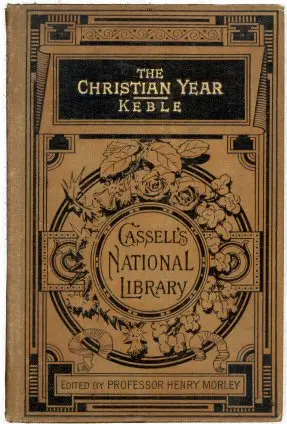
THE CLASSIC COLLECTION · 1827
"The Christian Year" by John Keble is a series of poems written in 1827 for the Sundays and feasts of the Church of England's liturgical calendar. This devotional work became the most popular volume of verse in the nineteenth century, with over 375,000 copies sold by 1873. Several of its poems became beloved hymns. Initially published anonymously, its success led to Keble's appointment as Oxford Professor of Poetry and significantly influenced the Oxford Movement.
Introduction adapted from the source catalogue; source summaries may be automatically generated.
Free to read · English · 48,087 words · No account needed
MAKE TIME FOR A GOOD BOOK
On by default. Untick to stop anonymous reading totals. Each page counts after 10 seconds in view. How this works.
Anonymous counting is on unless you have switched it off.
And Jesus answering said, Were there not ten cleansed? but where are the nine? There are not found that returned to give glory to God, save this stranger. St. Luke xvii. 17, 18.
TEN cleansed, and only one remain!
Who would have thought our nature’s stain
Was dyed so foul, so deep in grain?
E’en He who reads the heart—
Knows what He gave and what we lost,
Sin’s forfeit, and redemption’s cost,—
By a short pang of wonder crossed
Seems at the sight to start:
Yet ’twas not wonder, but His love
Our wavering spirits would reprove,
That heavenward seem so free to move
When earth can yield no more
Then from afar on God we cry,
But should the mist of woe roll by,
Not showers across an April sky
Drift, when the storm is o’er,
Faster than those false drops and few
Fleet from the heart, a worthless dew.
What sadder scene can angels view
Than self-deceiving tears,
Poured idly over some dark page
Of earlier life, though pride or rage,
The record of to-day engage,
A woe for future years?
Spirits, that round the sick man’s bed
Watched, noting down each prayer he made,
Were your unerring roll displayed,
His pride of health to abase;
Or, when, soft showers in season fall
Answering a famished nation’s call,
Should unseen fingers on the wall
Our vows forgotten trace:
How should we gaze in trance of fear!
Yet shines the light as thrilling clear
From Heaven upon that scroll severe,
“Ten cleansed and one remain!”
Nor surer would the blessing prove
Of humbled hearts, that own Thy love,
Should choral welcome from above
Visit our senses plain:
Than by Thy placid voice and brow,
With healing first, with comfort now,
Turned upon him, who hastes to bow
Before Thee, heart and knee;
“Oh! thou, who only wouldst be blest,
On thee alone My blessing rest!
Rise, go thy way in peace, possessed
For evermore of Me.”
Fifteenth Sunday after Trinity.
Consider the lilies of the field, how they grow. St. Matthew, vi.
28.
SWEET nurslings of the vernal skies,
Bathed in soft airs, and fed with dew,
What more than magic in you lies,
To fill the heart’s fond view?
In childhood’s sports, companions gay,
In sorrow, on Life’s downward way,
How soothing! in our last decay
Memorials prompt and true.
Your reading position is saved on this browser. Take it to another device with a library code. Reading pages adapt to text, rather than matching a printed edition.
BEHIND THE BOOK
This eBook is for the use of anyone anywhere in the United States and most other parts of the world at no cost and with almost no restrictions whatsoever. You may copy it, give it away or re-use it under the terms of the Project Gutenberg License included with this eBook or online at www.gutenberg.org. If you are not located in the United States, you will have to check the laws of the country where you are located before using this eBook. Read the source licence.
The original source file, including credits and licence, is retained by this library. Request an original-format copy at no charge. Please include the book title and Project Gutenberg identifier #4272.
KEEP YOUR CURIOSITY GOING
David Patterson (Spirit) Hatch

David Patterson (Spirit) Hatch

David Patterson (Spirit) Hatch

Edwin Abbott Abbott

Richard Watson
T. G. (Theophilus Gould) Steward