
Last letters from the living dead man
David Patterson (Spirit) Hatch
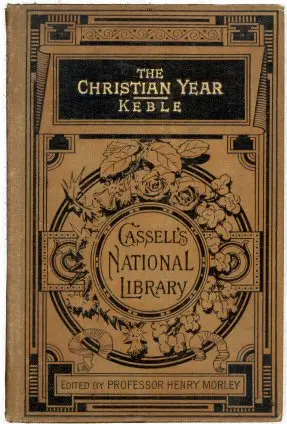
THE CLASSIC COLLECTION · 1827
"The Christian Year" by John Keble is a series of poems written in 1827 for the Sundays and feasts of the Church of England's liturgical calendar. This devotional work became the most popular volume of verse in the nineteenth century, with over 375,000 copies sold by 1873. Several of its poems became beloved hymns. Initially published anonymously, its success led to Keble's appointment as Oxford Professor of Poetry and significantly influenced the Oxford Movement.
Introduction adapted from the source catalogue; source summaries may be automatically generated.
Free to read · English · 48,087 words · No account needed
MAKE TIME FOR A GOOD BOOK
On by default. Untick to stop anonymous reading totals. Each page counts after 10 seconds in view. How this works.
Anonymous counting is on unless you have switched it off.
And still it lasts; by day and night,
With one consenting voice,
All hymn Thy glory, Lord, aright,
All worship and rejoice.
Man only mars the sweet accord
O’erpowering with “harsh din”
The music of Thy works and word,
Ill matched with grief and sin.
Sin is with man at morning break,
And through the livelong day
Deafens the ear that fain would wake
To Nature’s simple lay.
But when eve’s silent footfall steals
Along the eastern sky,
And one by one to earth reveals
Those purer fires on high,
When one by one each human sound
Dies on the awful ear,
Then Nature’s voice no more is drowned,
She speaks, and we must hear.
Then pours she on the Christian heart
That warning still and deep,
At which high spirits of old would start
E’en from their Pagan sleep.
Just guessing, through their murky blind
Few, faint, and baffling sight,
Streaks of a brighter heaven behind,
A cloudless depth of light.
Such thoughts, the wreck of Paradise,
Through many a dreary age,
Upbore whate’er of good and wise
Yet lived in bard or sage:
They marked what agonizing throes
Shook the great mother’s womb:
But Reason’s spells might not disclose
The gracious birth to come:
Nor could the enchantress Hope forecast
God’s secret love and power;
The travail pangs of Earth must last
Till her appointed hour.
The hour that saw from opening heaven
Redeeming glory stream,
Beyond the summer hues of even,
Beyond the mid-day beam.
Thenceforth, to eyes of high desire,
The meanest thing below,
As with a seraph’s robe of fire
Invested, burn and glow:
The rod of Heaven has touched them all,
The word from Heaven is spoken:
“Rise, shine, and sing, thou captive thrall;
Are not thy fetters broken?
“The God Who hallowed thee and blest,
Pronouncing thee all good—
Hath He not all thy wrongs redrest,
And all thy bliss renewed?
“Why mourn’st thou still as one bereft,
Now that th’ eternal Son
His blessèd home in Heaven hath left
To make thee all His own?”
Thou mourn’st because sin lingers still
In Christ’s new heaven and earth;
Because our rebel works and will
Stain our immortal birth:
Because, as Love and Prayer grow cold,
The Saviour hides His face,
And worldlings blot the temple’s gold
With uses vile and base.
Hence all thy groans and travail pains,
Hence, till thy God return,
In Wisdom’s ear thy blithest strains,
Oh Nature, seem to mourn.
Fifth Sunday after Trinity.
Your reading position is saved on this browser. Take it to another device with a library code. Reading pages adapt to text, rather than matching a printed edition.
BEHIND THE BOOK
This eBook is for the use of anyone anywhere in the United States and most other parts of the world at no cost and with almost no restrictions whatsoever. You may copy it, give it away or re-use it under the terms of the Project Gutenberg License included with this eBook or online at www.gutenberg.org. If you are not located in the United States, you will have to check the laws of the country where you are located before using this eBook. Read the source licence.
The original source file, including credits and licence, is retained by this library. Request an original-format copy at no charge. Please include the book title and Project Gutenberg identifier #4272.
KEEP YOUR CURIOSITY GOING
David Patterson (Spirit) Hatch

David Patterson (Spirit) Hatch

David Patterson (Spirit) Hatch

Edwin Abbott Abbott

Richard Watson
T. G. (Theophilus Gould) Steward