
Last letters from the living dead man
David Patterson (Spirit) Hatch
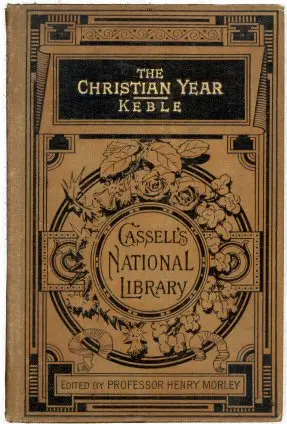
THE CLASSIC COLLECTION · 1827
"The Christian Year" by John Keble is a series of poems written in 1827 for the Sundays and feasts of the Church of England's liturgical calendar. This devotional work became the most popular volume of verse in the nineteenth century, with over 375,000 copies sold by 1873. Several of its poems became beloved hymns. Initially published anonymously, its success led to Keble's appointment as Oxford Professor of Poetry and significantly influenced the Oxford Movement.
Introduction adapted from the source catalogue; source summaries may be automatically generated.
Free to read · English · 48,087 words · No account needed
MAKE TIME FOR A GOOD BOOK
On by default. Untick to stop anonymous reading totals. Each page counts after 10 seconds in view. How this works.
Anonymous counting is on unless you have switched it off.
So be it, Lord; I know it best,
Though not as yet this wayward breast
Beat quite in answer to Thy voice,
Yet surely I have made my choice;
I know not yet the promised bliss,
Know not if I shall win or miss;
So doubting, rather let me die,
Than close with aught beside, to last eternally.
What is the Heaven we idly dream?
The self-deceiver’s dreary theme,
A cloudless sun that softly shines,
Bright maidens and unfailing vines,
The warrior’s pride, the hunter’s mirth,
Poor fragments all of this low earth:
Such as in sleep would hardly soothe
A soul that once had tasted of immortal Truth.
What is the Heaven our God bestows?
No Prophet yet, no Angel knows;
Was never yet created eye
Could see across Eternity;
Not seraph’s wing for ever soaring
Can pass the flight of souls adoring,
That nearer still and nearer grow
To the unapproachèd Lord, once made for them so low.
Unseen, unfelt their earthly growth,
And self-accused of sin and sloth,
They live and die; their names decay,
Their fragrance passes quite away;
Like violets in the freezing blast
No vernal steam around they cast.—
But they shall flourish from the tomb,
The breath of God shall wake them into odorous bloom.
Then on the incarnate Saviour’s breast,
The fount of sweetness, they shall rest,
Their spirits every hour imbued
More deeply with His precious blood.
But peace—still voice and closèd eye
Suit best with hearts beyond the sky,
Hearts training in their low abode,
Daily to lose themselves in hope to find their God.
Septuagesima Sunday.
The invisible things of Him from the creation of the world are clearly seen, being understood by the things that are made. Romans i. 20.
THERE is a book, who runs may read,
Which heavenly truth imparts,
And all the lore its scholars need,
Pure eyes and Christian hearts.
The works of God above, below,
Within us and around,
Are pages in that book, to show
How God Himself is found.
The glorious sky embracing all
Is like the Maker’s love,
Wherewith encompassed, great and small
In peace and order move.
The Moon above, the Church below,
A wondrous race they run,
But all their radiance, all their glow,
Each borrows of its Sun.
The Savour lends the light and heat
That crowns His holy hill;
The saints, like stars, around His seat
Perform their courses still.
The saints above are stars in heaven—
What are the saints on earth?
Like tress they stand whom God has given,
Our Eden’s happy birth.
Your reading position is saved on this browser. Take it to another device with a library code. Reading pages adapt to text, rather than matching a printed edition.
BEHIND THE BOOK
This eBook is for the use of anyone anywhere in the United States and most other parts of the world at no cost and with almost no restrictions whatsoever. You may copy it, give it away or re-use it under the terms of the Project Gutenberg License included with this eBook or online at www.gutenberg.org. If you are not located in the United States, you will have to check the laws of the country where you are located before using this eBook. Read the source licence.
The original source file, including credits and licence, is retained by this library. Request an original-format copy at no charge. Please include the book title and Project Gutenberg identifier #4272.
KEEP YOUR CURIOSITY GOING
David Patterson (Spirit) Hatch

David Patterson (Spirit) Hatch

David Patterson (Spirit) Hatch

Edwin Abbott Abbott

Richard Watson
T. G. (Theophilus Gould) Steward