
Last letters from the living dead man
David Patterson (Spirit) Hatch
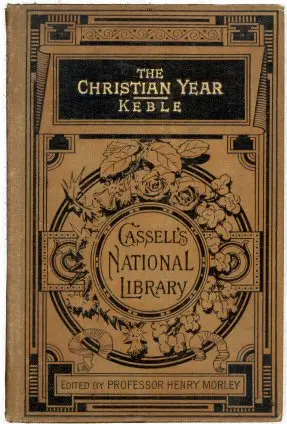
THE CLASSIC COLLECTION · 1827
"The Christian Year" by John Keble is a series of poems written in 1827 for the Sundays and feasts of the Church of England's liturgical calendar. This devotional work became the most popular volume of verse in the nineteenth century, with over 375,000 copies sold by 1873. Several of its poems became beloved hymns. Initially published anonymously, its success led to Keble's appointment as Oxford Professor of Poetry and significantly influenced the Oxford Movement.
Introduction adapted from the source catalogue; source summaries may be automatically generated.
Free to read · English · 48,087 words · No account needed
MAKE TIME FOR A GOOD BOOK
On by default. Untick to stop anonymous reading totals. Each page counts after 10 seconds in view. How this works.
Anonymous counting is on unless you have switched it off.
LESSONS sweet of spring returning,
Welcome to the thoughtful heart!
May I call ye sense or learning,
Instinct pure, or Heaven-taught art?
Be your title what it may,
Sweet this lengthening April day,
While with you the soul is free,
Ranging wild o’er hill and lea.
Soft as Memnon’s harp at morning,
To the inward ear devout,
Touched by light, with heavenly warning
Your transporting chords ring out.
Every leaf in every nook,
Every wave in every brook,
Chanting with a solemn voice,
Minds us of our better choice.
Needs no show of mountain hoary,
Winding shore or deepening glen,
Where the landscape in its glory
Teaches truth to wandering men:
Give true hearts but earth and sky,
And some flowers to bloom and die,
Homely scenes and simple views
Lowly thoughts may best infuse.
See the soft green willow springing
Where the waters gently pass,
Every way her free arms flinging
O’er the moist and reedy grass.
Long ere winter blasts are fled,
See her tipped with vernal red,
And her kindly flower displayed
Ere her leaf can cast a shade.
Though the rudest hand assail her,
Patiently she droops awhile,
But when showers and breezes hail her,
Wears again her willing smile.
Thus I learn Contentment’s power
From the slighted willow bower,
Ready to give thanks and live
On the least that Heaven may give.
If, the quiet brooklet leaving,
Up the stony vale I wind,
Haply half in fancy grieving
For the shades I leave behind,
By the dusty wayside drear,
Nightingales with joyous cheer
Sing, my sadness to reprove,
Gladlier than in cultured grove.
Where the thickest boughs are twining
Of the greenest darkest tree,
There they plunge, the light declining—
All may hear, but none may see.
Fearless of the passing hoof,
Hardly will they fleet aloof;
So they live in modest ways,
Trust entire, and ceaseless praise.
Second Sunday after Epiphany.
Every man at the beginning doth set forth good wine: and when men have well drunk, then that which is worse; but thou hast kept the good wine until now. St. John ii. 10.
THE heart of childhood is all mirth:
We frolic to and fro
As free and blithe, as if on earth
Were no such thing as woe.
But if indeed with reckless faith
We trust the flattering voice,
Which whispers, “Take thy fill ere death,
Indulge thee and rejoice;”
Too surely, every setting day,
Some lost delight we mourn;
The flowers all die along our way
Till we, too, die forlorn.
Such is the world’s gay garish feast,
In her first charming bowl
Infusing all that fires the breast,
And cheats the unstable soul.
Your reading position is saved on this browser. Take it to another device with a library code. Reading pages adapt to text, rather than matching a printed edition.
BEHIND THE BOOK
This eBook is for the use of anyone anywhere in the United States and most other parts of the world at no cost and with almost no restrictions whatsoever. You may copy it, give it away or re-use it under the terms of the Project Gutenberg License included with this eBook or online at www.gutenberg.org. If you are not located in the United States, you will have to check the laws of the country where you are located before using this eBook. Read the source licence.
The original source file, including credits and licence, is retained by this library. Request an original-format copy at no charge. Please include the book title and Project Gutenberg identifier #4272.
KEEP YOUR CURIOSITY GOING
David Patterson (Spirit) Hatch

David Patterson (Spirit) Hatch

David Patterson (Spirit) Hatch

Edwin Abbott Abbott

Richard Watson
T. G. (Theophilus Gould) Steward