
Last letters from the living dead man
David Patterson (Spirit) Hatch
THE CLASSIC COLLECTION · 1827
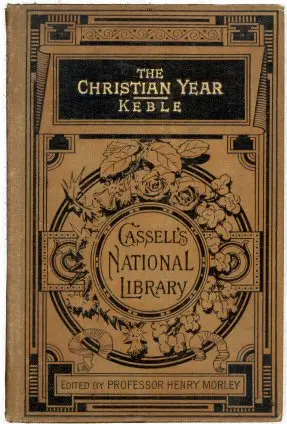
"The Christian Year" by John Keble is a series of poems written in 1827 for the Sundays and feasts of the Church of England's liturgical calendar. This devotional work became the most popular volume of verse in the nineteenth century, with over 375,000 copies sold by 1873. Several of its poems became beloved hymns. Initially published anonymously, its success led to Keble's appointment as Oxford Professor of Poetry and significantly influenced the Oxford Movement.
Introduction adapted from the source catalogue; source summaries may be automatically generated.
Free to read · English · 48,087 words · No account needed
MAKE TIME FOR A GOOD BOOK
On by default. Untick to stop anonymous reading totals. Each page counts after 10 seconds in view. How this works.
Anonymous counting is on unless you have switched it off.
I came again: the place was bright
“With something of celestial light”—
A simple Altar by the bed
For high Communion meetly spread,
Chalice, and plate, and snowy vest.—
We ate and drank: then calmly blest,
All mourners, one with dying breath,
We sate and talked of Jesus’ death.
Once more I came: the silent room
Was veiled in sadly-soothing gloom,
And ready for her last abode
The pale form like a lily showed,
By Virgin fingers duly spread,
And prized for love of summer fled.
The light from those soft-smiling eyes
Had fleeted to its parent skies.
O soothe us, haunt us, night and day,
Ye gentle Spirits far away,
With whom we shared the cup of grace,
Then parted; ye to Christ’s embrace,
We to this lonesome world again,
Yet mindful of th’ unearthly strain
Practised with you at Eden’s door,
To be sung on, where Angels soar,
With blended voices evermore.
Burial of the Dead.
And when the Lord saw her, He had compassion on her, and said unto her, Weep not. And He came and touched the bier; and they that bare him stood still. And He said, Young man, I say unto thee, Arise.—St. Luke vii. 13, 14.
WHO says, the wan autumnal soon
Beams with too faint a smile
To light up nature’s face again,
And, though the year be on this wane,
With thoughts of spring the heart beguile?
Waft him, thou soft September breeze,
And gently lay him down
Within some circling woodland wall,
Where bright leaves, reddening ere they fall,
Wave gaily o’er the waters brown.
And let some graceful arch be there
With wreathèd mullions proud,
With burnished ivy for its screen,
And moss, that glows as fresh and green
As thought beneath an April cloud.—
Who says the widow’s heart must break,
The childless mother sink?—
A kinder truer voice I hear,
Which e’en beside that mournful bier
Whence parents’ eyes would hopeless shrink,
Bids weep no more—O heart bereft,
How strange, to thee, that sound!
A widow o’er her only son,
Feeling more bitterly alone
For friends that press officious round.
Yet is the voice of comfort heard,
For Christ hath touched the bier—
The bearers wait with wondering eye,
The swelling bosom dares not sigh,
But all is still, ’twixt hope and fear.
E’en such an awful soothing calm
We sometimes see alight
On Christian mourners, while they wait
In silence, by some churchyard gate,
Their summons to this holy rite.
Your reading position is saved on this browser. Take it to another device with a library code. Reading pages adapt to text, rather than matching a printed edition.
BEHIND THE BOOK
This eBook is for the use of anyone anywhere in the United States and most other parts of the world at no cost and with almost no restrictions whatsoever. You may copy it, give it away or re-use it under the terms of the Project Gutenberg License included with this eBook or online at www.gutenberg.org. If you are not located in the United States, you will have to check the laws of the country where you are located before using this eBook. Read the source licence.
The original source file, including credits and licence, is retained by this library. Request an original-format copy at no charge. Please include the book title and Project Gutenberg identifier #4272.
KEEP YOUR CURIOSITY GOING
David Patterson (Spirit) Hatch

David Patterson (Spirit) Hatch

David Patterson (Spirit) Hatch

Edwin Abbott Abbott

Richard Watson
T. G. (Theophilus Gould) Steward