
Last letters from the living dead man
David Patterson (Spirit) Hatch
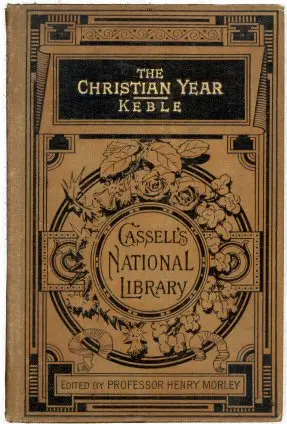
THE CLASSIC COLLECTION · 1827
"The Christian Year" by John Keble is a series of poems written in 1827 for the Sundays and feasts of the Church of England's liturgical calendar. This devotional work became the most popular volume of verse in the nineteenth century, with over 375,000 copies sold by 1873. Several of its poems became beloved hymns. Initially published anonymously, its success led to Keble's appointment as Oxford Professor of Poetry and significantly influenced the Oxford Movement.
Introduction adapted from the source catalogue; source summaries may be automatically generated.
Free to read · English · 48,087 words · No account needed
MAKE TIME FOR A GOOD BOOK
On by default. Untick to stop anonymous reading totals. Each page counts after 10 seconds in view. How this works.
Anonymous counting is on unless you have switched it off.
Blest eyes, that see the smiling gleam
Upon the slumbering features glow,
When the life-giving stream
Touches the tender brow!
Or when the holy cross is signed,
And the young soldier duly sworn,
With true and fearless mind
To serve the Virgin-born.
But happiest ye, who sealed and blest
Back to your arms your treasure take,
With Jesus’ mark impressed
To nurse for Jesus’ sake:
To whom—as if in hallowed air
Ye knelt before some awful shrine—
His innocent gestures wear
A meaning half divine:
By whom Love’s daily touch is seen
In strengthening form and freshening hue,
In the fixed brow serene,
The deep yet eager view.—
Who taught thy pure and even breath
To come and go with such sweet grace?
Whence thy reposing Faith,
Though in our frail embrace?
O tender gem, and full of Heaven!
Not in the twilight stars on high,
Not in moist flowers at even
See we our God so nigh.
Sweet one, make haste and know Him too,
Thine own adopting Father love,
That like thine earliest dew
Thy dying sweets may prove.
Catechism.
OH! say not, dream not, heavenly notes
To childish ears are vain,
That the young mind at random floats,
And cannot reach the strain.
Dim or unheard, the words may fall,
And yet the heaven-taught mind
May learn the sacred air, and all
The harmony unwind.
Was not our Lord a little child,
Taught by degrees to pray,
By father dear and mother mild
Instructed day by day?
And loved He not of Heaven to talk
With children in His sight,
To meet them in His daily walk,
And to His arms invite?
What though around His throne of fire
The everlasting chant
Be wafted from the seraph choir
In glory jubilant?
Yet stoops He, ever pleased to mark
Our rude essays of love,
Faint as the pipe of wakening lark,
Heard by some twilight grove:
Yet is He near us, to survey
These bright and ordered files,
Like spring-flowers in their best array,
All silence and all smiles.
Save that each little voice in turn
Some glorious truth proclaims,
What sages would have died to learn,
Now taught by cottage dames.
And if some tones be false or low,
What are all prayers beneath
But cries of babes, that cannot know
Half the deep thought they breathe?
In His own words we Christ adore,
But angels, as we speak,
Higher above our meaning soar
Than we o’er children weak:
And yet His words mean more than they,
And yet He owns their praise:
Why should we think, He turns away
From infants’ simple lays?
Confirmation.
Your reading position is saved on this browser. Take it to another device with a library code. Reading pages adapt to text, rather than matching a printed edition.
BEHIND THE BOOK
This eBook is for the use of anyone anywhere in the United States and most other parts of the world at no cost and with almost no restrictions whatsoever. You may copy it, give it away or re-use it under the terms of the Project Gutenberg License included with this eBook or online at www.gutenberg.org. If you are not located in the United States, you will have to check the laws of the country where you are located before using this eBook. Read the source licence.
The original source file, including credits and licence, is retained by this library. Request an original-format copy at no charge. Please include the book title and Project Gutenberg identifier #4272.
KEEP YOUR CURIOSITY GOING
David Patterson (Spirit) Hatch

David Patterson (Spirit) Hatch

David Patterson (Spirit) Hatch

Edwin Abbott Abbott

Richard Watson
T. G. (Theophilus Gould) Steward