
Life of Harriet Beecher Stowe Compiled From Her Letters and Journals by Her Son Charles Edward Stowe
Harriet Beecher Stowe
THE CLASSIC COLLECTION · 1868
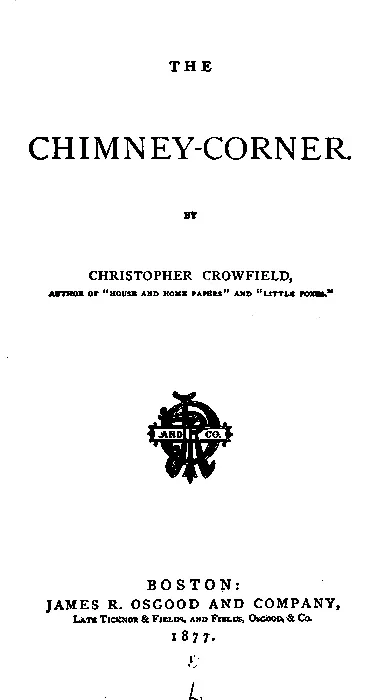
"The Chimney-Corner" by Harriet Beecher Stowe is a fictional work written in the late 19th century. This narrative likely explores the complexities of women's roles in society, focusing particularly on the challenges they face amid evolving societal expectations. Key characters include Christopher Crowfield, who grapples with the plight of women seeking meaningful work and stable livelihoods, reflecting on the broader social issues of gender and employment. At the start of the book, we are introduced to Christopher and his wife as they engage in a discussion about a struggling young woman seeking assistance. The woman, who has lost her fiancé and now bears the burden of providing for her family, embodies the struggles faced by many women of the time. The dialogue between Christopher and his wife reveals their compassion and earnestness as they contemplate how to help her amid the rigid societal conventions and prejudices that limit women’s opportunities. Their conversation expands into a broader examination of the roles of women in society, raising critical questions about work, respectability, and dignity within the domestic sphere.
Introduction adapted from the source catalogue; source summaries may be automatically generated.
Free to read · English · 72,232 words · No account needed
MAKE TIME FOR A GOOD BOOK
On by default. Untick to stop anonymous reading totals. Each page counts after 10 seconds in view. How this works.
Anonymous counting is on unless you have switched it off.
"Madame Recamier for years had a circle of friends who met every afternoon in her salon from four to six o'clock, for the simple and sole pleasure of talking with each other. The very first wits and men of letters and statesmen and savans were enrolled in it, and each brought to the entertainment some choice morceau which he had laid aside from his own particular field to add to the feast. The daily intimacy gave each one such perfect insight into all the others' habits of thought, tastes, and preferences, that the conversation was like the celebrated music of the Conservatoire in Paris, a concert of perfectly chorded instruments taught by long habit of harmonious intercourse to keep exact time and tune together.
"Real conversation presupposes intimate acquaintance. People must see each other often enough to wear off the rough bark and outside rind of commonplaces and conventionalities in which their real ideas are enwrapped, and give forth without reserve their innermost and best feelings. Now what is called a large party is the first and rudest form of social intercourse. The most we can say of it is, that it is better than nothing. Men and women are crowded together like cattle in a pen. They look at each other, they jostle each other, exchange a few common bleatings, and eat together; and so the performance terminates. One may be crushed evening after evening against men or women, and learn very little about them. You may decide that a lady is good-tempered, when any amount of trampling on the skirt of her new silk dress brings no cloud to her brow. But is it good temper, or only wanton carelessness, which cares nothing for waste? You can see that a man is not a gentleman who squares his back to ladies at the supper-table, and devours boned turkey and paté de fois gras, while they vainly reach over and around him for something, and that another is a gentleman so far as to prefer the care of his weaker neighbors to the immediate indulgence of his own appetites; but further than this you learn little. Sometimes, it is true, in some secluded corner, two people of fine nervous system, undisturbed by the general confusion, may have a sociable half-hour, and really part feeling that they like each other better, and know more of each other than before. Yet these general gatherings have, after all, their value. They are not so good as something better would be, but they cannot be wholly dispensed with. It is far better that Mrs. Bogus should give an annual party, when she takes down all her bedsteads and throws open her whole house, than that she should never see her friends and neighbors inside her doors at all. She may feel that she has neither the taste nor the talent for constant small reunions. Such things, she may feel, require a social tact which she has not. She would be utterly at a loss how to conduct them. Each one would cost her as much anxiety and thought as her annual gathering, and prove a failure after all; whereas the annual demonstration can be put wholly into the hands of the caterer, who comes in force, with flowers, silver, china, servants, and, taking the house into his own hands, gives her entertainment for her, leaving to her no responsibility but the payment of the bills; and if Mr. Bogus does not quarrel with them, we know no reason why any one else should; and I think Mrs. Bogus merits well of the republic, for doing what she can do towards the hospitalities of the season. I'm sure I never cursed her in my heart, even when her strong coffee has held mine eyes open till morning, and her superlative lobster-salads have given me the very darkest views of human life that ever dyspepsia and east wind could engender. Mrs. Bogus is the Eve who offers the apple; but, after all, I am the foolish Adam who take and eat what I know is going to hurt me, and I am too gallant to visit my sins on the head of my too obliging tempter. In country places in particular, where little is going on and life is apt to stagnate, a good, large, generous party, which brings the whole neighborhood into one house to have a jolly time, to eat, drink, and be merry, is really quite a work of love and mercy. People see one another in their best clothes, and that is something; the elders exchange all manner of simple pleasantries and civilities, and talk over their domestic affairs, while the young people flirt, in that wholesome manner which is one of the safest of youthful follies. A country party, in fact, may be set down as a work of benevolence, and the money expended thereon fairly charged to the account of the great cause of peace and good-will on earth."
Your reading position is saved on this browser. Take it to another device with a library code. Reading pages adapt to text, rather than matching a printed edition.
Harriet Beecher Stowe

Harriet Beecher Stowe
Harriet Beecher Stowe

Harriet Beecher Stowe
BEHIND THE BOOK
This eBook is for the use of anyone anywhere in the United States and most other parts of the world at no cost and with almost no restrictions whatsoever. You may copy it, give it away or re-use it under the terms of the Project Gutenberg License included with this eBook or online at www.gutenberg.org. If you are not located in the United States, you will have to check the laws of the country where you are located before using this eBook. Read the source licence.
The original source file, including credits and licence, is retained by this library. Request an original-format copy at no charge. Please include the book title and Project Gutenberg identifier #45415.
KEEP YOUR CURIOSITY GOING
Coulson Kernahan

Maurice Baring
Frances Wright
Cécile Tormay

Frederic Jesup Stimson

W. H. P. (William Henry Pope) Jarvis