THE CLASSIC COLLECTION✦An outlaw’s diary: the CommuneCLASSIC FREE BOOKS
An outlaw’s diary: the Commune
Cécile Tormay
THE CLASSIC COLLECTION · 1916
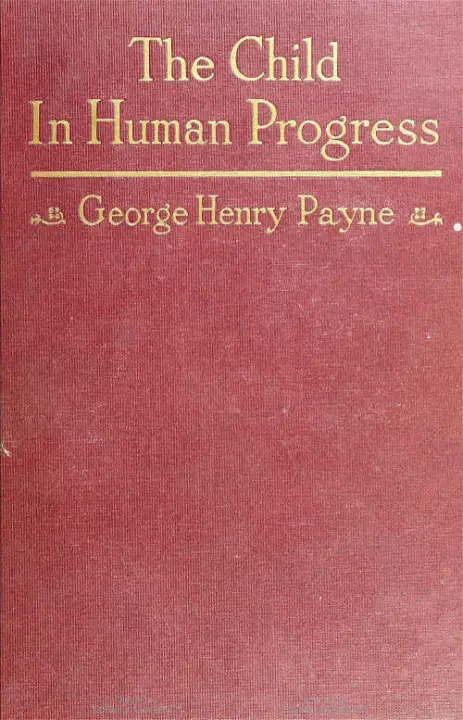
"The Child in Human Progress" by George Henry Payne is a historical account written in the early 20th century. This work delves into the evolving perception and treatment of children throughout history, examining societal attitudes, practices, and the slow emergence of a humanitarian approach towards child welfare across different cultures and eras. The book is significant for its comprehensive exploration of the often neglected history of childhood, aiming to shed light on how civilization has progressed in its treatment of the young. The opening of the book features a foreword by Dr. A. Jacobi, who acknowledges the book’s unique contribution to the discourse on children's rights and welfare. He emphasizes how historical reflections on the status of children have been largely overlooked in existing literature, creating a significant gap. Payne sets the stage for a detailed examination of the evolution of societal attitudes towards children, asserting that maternal affection is foundational to human altruism. He hints at the complex interplay between economic conditions, societal norms, and the treatment of children, suggesting that the book will chronicle these relations back through history to illustrate the gradual shift from barbarity to a more humane consideration of children's rights and care.
Introduction adapted from the source catalogue; source summaries may be automatically generated.
Free to read · English · 95,089 words · No account needed
MAKE TIME FOR A GOOD BOOK
On by default. Untick to stop anonymous reading totals. Each page counts after 10 seconds in view. How this works.
Anonymous counting is on unless you have switched it off.
[193] George Aaron Barton, A Sketch of Semitic Origins, p. 269.
[194] Archibald Duff, The Theology and Ethics of the Hebrews, p. 17.
[195] D. Chwolson, The Semitic Nations, p. 25.
[196] Grimm, Teutonic Mythology, vol. i., p. 43.
[197] Tylor, Primitive Culture, vol. ii., p. 362.
[198] M. L. Milloue, Le Sacrifice, Conférences faites au Musée
Guimet, p. 3.
[199] Lord Avebury, Marriage, Totemism, and Religion, preface, p. vi.
[200] R. Campbell Thompson, Semitic Magic, p. xiii.
[201] Wm. Mariner, The Natives of the Tonga Islands, vol. ii., p. 220.
[202] Mariner, The Natives of the Tonga Islands, vol. i., p. 229.
[203] Father Joseph de Acosta, The Natural and Moral History of the
Indies, vol. ii., p. 344.
[204] Francisco de Jerez, Conquista del Peru, under cover of Biblioteca ed Aurores Españoles, vol. xxvi., part 2, p. 327.
[205] P. Lafaitau, quoting Le Moyne in Mœurs des Sauvages Américains,
vol. i., p. 181.
[206] Narrative of Le Moyne, transl. from the Latin of De Bry, p. 13,
Boston, 1875.
[207] Antonio de Herrera, The General History of the Vast Continent and Islands of America, commonly called the West Indies, vol. ii., pp. 347–348.
[208] Wm. Strachey, The History of Travaile into Virginia Britannia,
p. 84.
[209] R. Brough Smyth, The Aborigines of Victoria, vol. ii., p. 311
[210] W. Crooke, The Popular Religion and Folk-Lore of Northern
India, vol. ii., p. 169.
[211] Ibid., vol. ii., p. 172.
[212] W. H. Sleeman, Rambles and Recollections of an Indian Official,
vol. i., p. 133.
[213] R. Cain, “Bhadrachellam and Rekapalli Taluquas,” the Indian Antiquary, vol. viii., p. 219, Bombay, 1879.
[214] J. J. M. de Groote, The Religious System of China, vol. ii.,
book i., p. 679.
[215] R. A. S. MacAlister, The Excavation of Gezer, pp. 405–6, 432.
[216] Ernest Sellin, “Tell Ta’Annek,” Denkschriften der Kaiserlichen Akademie der Wissenschaften, vols. l.-li., 1904–1906.
[217] Driver, Modern Research as Illustrating the Bible, p. 68.
[218] W. K. S. Ralston, Songs of the Russian People, p. 128.
[219] H. C. Trumbull, Threshold Covenant, p. 49.
[220] Jacob Grimm, Teutonic Mythology, vol. iii., p. 1144.
[221] Tylor, Primitive Culture, vol. i., p. 96.
[222] Theodor Waitz, Anthropologie der Naturvolker, vol. ii., p. 197.
[223] H. C. Trumbull, The Threshold Covenant, p. 146.
[224] Tylor, Primitive Culture, vol. i., p. 96.
[225] Jacob Grimm, Teutonic Mythology, vol. iii., p. 1142.
[226] Jacob Grimm, Teutonic Mythology, vol. iii., p. 1142.
[227] W. Crooke, The Religion, etc., Northern India, vol. ii., p. 174.
[228] The Journal of American Folk-Lore, vol. vi., p. 51, Boston, New
York, and London, 1893.
[229] E. Renan, History of the People of Israel, vol. i., preface, p.
viii.
[230] J. F. McCurdy, Jewish Encyclopædia.
[231] A. Kuenen, The Religion of Israel, p. 102.
[232] Genesis xxii., 13.
[233] Renan, History of the People of Israel, p. 63.
[234] Genesis xvii., 10.
[235] P. C. Remondino, History of Circumcision, p. 31. Remondino cites Benjamin—David brought 200 prepuces to Saul to show the number of slain Philistines.
[236] Remondino, p. 32.
[237] Exodus, chap. xii.
[238] Joshua, chap. xxiv., v. 14.
[239] Renan, History of the People of Israel, vol. i., p. 149.
[240] Judges, chap. ix.
Your reading position is saved on this browser. Take it to another device with a library code. Reading pages adapt to text, rather than matching a printed edition.
BEHIND THE BOOK
This eBook is for the use of anyone anywhere in the United States and most other parts of the world at no cost and with almost no restrictions whatsoever. You may copy it, give it away or re-use it under the terms of the Project Gutenberg License included with this eBook or online at www.gutenberg.org. If you are not located in the United States, you will have to check the laws of the country where you are located before using this eBook. Read the source licence.
The original source file, including credits and licence, is retained by this library. Request an original-format copy at no charge. Please include the book title and Project Gutenberg identifier #58656.
KEEP YOUR CURIOSITY GOING
Cécile Tormay

Moritz Busch
John L. Ransom
Frances Wright
Cécile Tormay

Mabel Potter Daggett