
The Writing of News A Handbook with Chapters on Newspaper Correspondence and Copy Reading
Charles G. (Charles Griffith) Ross
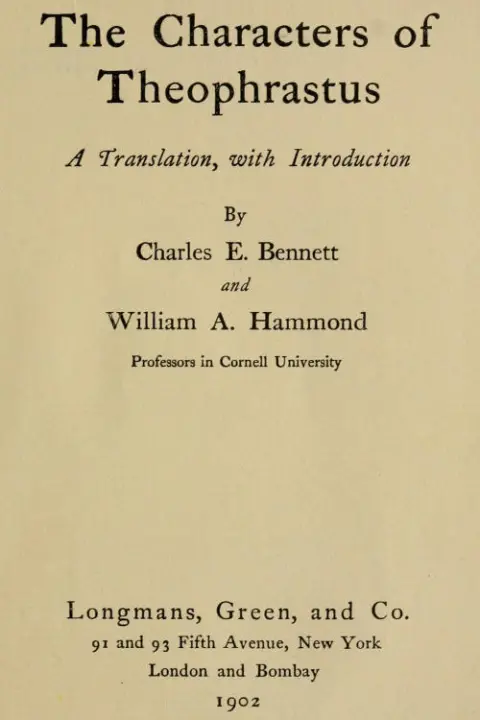
THE CLASSIC COLLECTION · 1902
"The Characters of Theophrastus" by Theophrastus is a collection of character sketches written in ancient Greece during the late 4th century BC. This work is often recognized as one of the earliest studies of human character types, describing various moral and social defects observed in individuals of his time. Theophrastus, a pupil of Aristotle, provides a unique window into both the personalities prevalent in Athenian society and the timeless qualities of human nature that are still relevant today. The book consists of thirty brief but incisive portraits, each highlighting a different flawed character, from "The Flatterer" to "The Coward," and "The Boor" to "The Avaricious Man." Theophrastus employs a straightforward and vivid style to showcase these character types, often emphasizing their behaviors in everyday situations. Instead of delving into complex narratives or moral judgments, he illustrates how these archetypes manifest in society and interact with others. Consequently, these sketches serve not only as observations but also as a reflection of the human condition, showcasing the absurdities and follies that people continue to exhibit in all cultures and eras.
Introduction adapted from the source catalogue; source summaries may be automatically generated.
Free to read · English · 15,246 words · No account needed
MAKE TIME FOR A GOOD BOOK
On by default. Untick to stop anonymous reading totals. Each page counts after 10 seconds in view. How this works.
Anonymous counting is on unless you have switched it off.
[Sidenote: Theophrastus and Aristotle]
[Sidenote: Theophrastus Chosen by Aristotle to be President of the
Lyceum]
[Sidenote: Death of Theophrastus]
[Sidenote: His Writings and Genius]
[Sidenote: His Will]
We have little information as to the personal history of Theophrastus, beyond what we learn from the extant fragments of his writings and from the meagre biography of Diogenes of Laërte. He was born at Eresus, a village on the island of Lesbos, in 371 B.C., and his father was one Melantas, a fuller by trade. He first went to school to Alcippus in his native island, but afterwards travelled to Athens, the intellectual metropolis, and became a pupil of Plato at the Academy, with whom he appears to have studied until the Master’s death. Theophrastus was then in his twenty-fifth year. At that time he attached himself to Aristotle, who was some twelve years his senior and who had also been a member of the Academy, until Plato died scribens. During the twelve years which elapsed from the death of Plato until Aristotle established the new school of the Lyceum (in 335 B.C.), Theophrastus was probably with his new leader, at least part of the time, in Stagira or at the Macedonian court, where the youthful Alexander was under the tutorial discipline of Aristotle. Theophrastus was an intimate friend of Callisthenes, the unfortunate fellow-student and companion of Alexander, and it is probable that the two studied together at Pella. The story is told that Aristotle, in speaking of these two pupils, said: “Callisthenes needs a spur, but Theophrastus,[3] a bridle.” Many years later, when Aristotle was dead and Cassander (see Character VII.) had gained control of Alexander’s throne, Theophrastus was invited to an office at the court where he had spent his student days, and Ptolemy Soter, Cassander’s political ally, sent him an invitation to the court of Egypt. But he declined these calls into the social and political world, and maintained steadfastly his devotion to philosophy. It was a fashion for the rectors or presidents of the great schools of Athens, such as the Cynosarges, the Academy, and the Lyceum, before their death to name their successors in office. And so when Aristotle was asked who should succeed him in the presidency of the Lyceum, tradition tells of the delicate way in which he left record of his wish. His two most distinguished pupils were Theophrastus of Lesbos and Eudemus of Rhodes. Aristotle replied to the question as to his successor by asking for two sorts of wine,—Lesbian and Rhodian. After tasting of them he said: “They are both excellent; but the Lesbian is the sweeter.” Thereby it was known that he had decided in favor of Theophrastus, who on the death of Aristotle (322 B.C.) succeeded to the presidency of the Lyceum, over which he continued to preside for thirty-five years. His administration was one of almost unparalleled success. Diogenes Laertius reports that two thousand students thronged to him. Although not born at Athens, he was one of the most popular and beloved members of that somewhat exclusive community. This is illustrated by the story of Agonides, who preferred against him a charge of atheism,—a charge similar to that which brought Socrates to martyrdom and drove Aristotle into exile and caused his early death; but instead of injuring Theophrastus, Agonides narrowly escaped paying a fine for his folly. Amongst his contemporaries Theophrastus was a great personal force by reason of his amiable character, his charities and lavish benefactions, the amenity of his manners, his great erudition, and gifts of oratory. He died in 287 B.C. in the eighty-fifth year of his age, and Diogenes Laertius says that “the whole population of Athens, honoring him greatly, followed him to the grave.” Theophrastus was one of the greatest polygraphs of antiquity. Two hundred and twenty-seven works[4] are attributed to him. The range of his learning is similar to that of Aristotle’s, with the emphasis laid rather more strongly on the side of natural science. His genius, however, is not marked by Aristotle’s profundity. He served his age rather as a great popularizer of science; he was not an originator of epoch-making ideas or theories. Yet as a local and popular force he surpassed Aristotle. His influence on subsequent ages, however, is less marked. Of the 227 works (containing 232,908 lines) attributed to Theophrastus, fragments of nine only are now extant, excluding certain insignificant remains.
Your reading position is saved on this browser. Take it to another device with a library code. Reading pages adapt to text, rather than matching a printed edition.
BEHIND THE BOOK
This eBook is for the use of anyone anywhere in the United States and most other parts of the world at no cost and with almost no restrictions whatsoever. You may copy it, give it away or re-use it under the terms of the Project Gutenberg License included with this eBook or online at www.gutenberg.org. If you are not located in the United States, you will have to check the laws of the country where you are located before using this eBook. Read the source licence.
The original source file, including credits and licence, is retained by this library. Request an original-format copy at no charge. Please include the book title and Project Gutenberg identifier #58242.
KEEP YOUR CURIOSITY GOING
Charles G. (Charles Griffith) Ross
Hannah Webster Foster

Emily Lawless
Edwin Hamlin Carr

Charles De Lano Hine
Andrew Ure