THE CLASSIC COLLECTION✦The art of fictionCLASSIC FREE BOOKS
The art of fiction
Walter Besant
THE CLASSIC COLLECTION · 1881
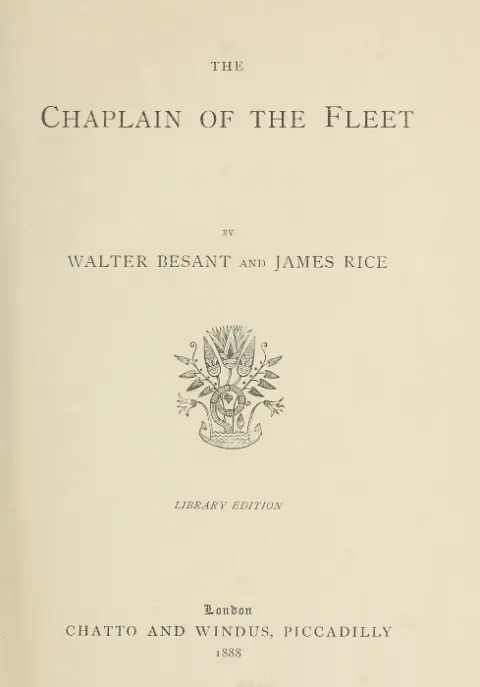
"The Chaplain of the Fleet" by Walter Besant and James Rice is a novel written in the late 19th century. The story begins with the poignant life of a young girl named Kitty Pleydell, who has recently lost her father, a kind and pious clergyman. As she navigates her grief, she is thrust into a world of uncertainty and adventure, compelled to seek out her uncle in London as per her father's last wishes. At the start of the book, we witness Kitty's deep sorrow as she mourns her father's death, reflecting on his life and their shared moments. In the aftermath of the funeral, Kitty must come to terms with her new reality—a life devoid of parental guidance and filled with new responsibilities. She learns about her inheritance, including a sum of money hidden in her father’s belongings, and is determined to follow his final instructions, leading her to London. The opening chapters set the stage for Kitty's journey as she prepares to leave her rural home, highlighting her innocence, courage, and the great unknown that awaits her.
Introduction adapted from the source catalogue; source summaries may be automatically generated.
Free to read · English · 160,817 words · No account needed
MAKE TIME FOR A GOOD BOOK
On by default. Untick to stop anonymous reading totals. Each page counts after 10 seconds in view. How this works.
Anonymous counting is on unless you have switched it off.
I saw that the difference between the sisters lay chiefly in their
voices.
"She will, I trust, be serviceable to you," said the Doctor, waving his hand. "She hath been well and piously brought up to obedient ways. Under your care, ladies, I look for a good account of her."
"Dear and reverend sir," Mrs. Esther cooed, "we are pleased and happy to be of use to you in this matter. No doubt little miss, who is well grown of her years, will repay your kindness with her prayers. As for us, the memory of your past and present goodness----"
"Tut, tut!" he replied, shaking his great head till his cheeks waggled, "let us hear no more of that. In this place"--here he laid his right hand upon his heart, elevating his left, and leaning his head to one side--"in this place, where infamy and well-deserved misery attend most of those who dwell in it, it is yours, as it should be mine, to keep burning continually the pure flame of a Christian life."
"How sweet! how noble!" murmured the sisters.
Was it possible? The man whom we had just seen reading the service of Mother Church, which my father had taught me to regard as little less sacred than the words of the Bible itself, in a squalid room, reeking with the fumes of rum and stale tobacco, before a gang of half-drunken sailors, assumed naturally and easily, as if it belonged to him, the attitude and language of one devoted entirely to the contemplation and practice of virtue and good works. Why, his face glowed with goodness like the sun at noonday, or the sun after a shower, or, say, the sun after a good action. The Doctor, indeed, as I learned later, could assume almost any character he pleased. It pleased him, not out of hypocrisy, but because for a time it was a return to the promise of his youth, to be with these ladies the devout Christian priest. In that character he felt, I am convinced, the words which came spontaneously to his lips: for the moment he was that character. Outside, in the Fleet Market, he was the great Dr. Shovel--great, because among the Fleet parsons he was the most successful, the most learned, the most eloquent, the most important. In his own room he married all comers, after the manner we have seen; and it raised the envy of his rivals to see how the crowd flocked to him. But in the evening he received his friends, and drank and talked with them in such fashion as I never saw, but of which I have heard. Again, it raised their envy to witness how men came from all quarters to drink with the Doctor. At that time he was no longer the Christian advocate, nor the clergyman; he was a rollicking, jovial, boon companion, who delighted to tell better stories, sing better songs, and hold better talk--meaning more witty, not more spiritual talk--than any of those who sat with him. I have never been able to comprehend what pleasure men, especially men of mature years, can find in telling stories, and laughing, drinking, smoking tobacco, and singing with one another. Women find their pleasures in more sober guise: they may lie in small things, but they are innocent. Think what this world would be were the women to live like the men, as disorderly, as wastefully, as noisily!
Your reading position is saved on this browser. Take it to another device with a library code. Reading pages adapt to text, rather than matching a printed edition.
Walter Besant
Walter Besant

Walter Besant

Walter Besant
BEHIND THE BOOK
This eBook is for the use of anyone anywhere in the United States and most other parts of the world at no cost and with almost no restrictions whatsoever. You may copy it, give it away or re-use it under the terms of the Project Gutenberg License included with this eBook or online at www.gutenberg.org. If you are not located in the United States, you will have to check the laws of the country where you are located before using this eBook. Read the source licence.
The original source file, including credits and licence, is retained by this library. Request an original-format copy at no charge. Please include the book title and Project Gutenberg identifier #45734.
KEEP YOUR CURIOSITY GOING
Cécile Tormay

Moritz Busch
Coulson Kernahan
John L. Ransom

Maurice Baring
Frances Wright