
Lucia in London
E. F. (Edward Frederic) Benson
THE CLASSIC COLLECTION · 1904
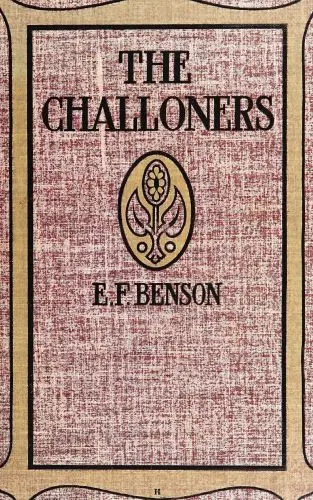
"The Challoners" by E. F. Benson is a novel written in the early 20th century. The story revolves around the Challoner family, focusing particularly on the experiences and perspectives of Helen and her brother Martin as they navigate their lives entangled with familial expectations, societal norms, and their own desires. The narrative hints at greater themes of duty, love, the conflict between individual aspirations and family obligations, as well as the delicate balance between artistic inclinations and moral responsibilities. The opening of the book introduces readers to Helen Challoner, who is enjoying a serene moment in the garden while reading "The Mill on the Floss," a choice that reflects her more liberal views compared to those of her strict father, the Reverend Sidney Challoner. This scene sets the foundation for the dynamic between the siblings, particularly highlighting Helen's frustration with her restricted life in a vicarage characterized by stringent moral expectations. As they discuss literature and their conflicting aspirations, their playful exchanges reveal deeper tensions within the family, particularly between Martin's artistic inclinations and their father's stern principles. The interaction also elicits hints about the father's struggle to balance discipline with love in a changing world, making it clear that this relationship will unfold as a pivotal element of the story.
Introduction adapted from the source catalogue; source summaries may be automatically generated.
Free to read · English · 96,939 words · No account needed
MAKE TIME FOR A GOOD BOOK
On by default. Untick to stop anonymous reading totals. Each page counts after 10 seconds in view. How this works.
Anonymous counting is on unless you have switched it off.
“Ah, Lady Sunningdale,” said Mr. Challoner, “how are you? And Martin wasting his time at the piano, as usual. How kind of you to let him play to you!”
Martin wasted no more time there; at the noise of interruption, before his brain had conjectured who it was, his hands stopped, the eager, active vitality died out of his face, as when a candle is blown out, and he banged a random chord in sheer rage. Then, instantaneously, he recognized the voice, and he rose quickly from the music-stool, trembling.
“Yes, wasting my time, as usual,” he said, excitedly, the artist in him suddenly struck dead, leaving just an angry, startled boy. “I must go home, Lady Sunningdale. Thank you so much for letting me play to you, and I hope I haven’t bored you. Good-bye. I have a lot of work to do.”
He closed the piano lid as he spoke, but it slipped from his fingers and shut with a bang that set all the strings jarring.
“Ah, how could you interrupt like that?” cried Lady Sunningdale to his father. “Yes, how are you, Mr. Challoner? Martin, pray begin it again. We will all sit quite quiet without stirring a finger or breathing. You are superb!”
His father sat down, distressed at Martin’s rudeness, but honestly desirous of being sympathetic.
“Dear boy, I am so sorry,” he said. “Pray, play your piece.”
“I can’t,” said Martin. “I don’t know it.”
For a moment father and son looked at each other, the one with surprise and indignation, the other in impetuous rebellion and anger.
“Lady Sunningdale asks you to play again what you were playing,” said his father, the desire to be sympathetic vanishing, the sternness deserved by this deplorable lack of manners in Martin increasing every moment.
“It is quite impossible that I should play it,” said Martin. “I couldn’t play a note of it.”
“You seemed to me to know it,” said Mr. Challoner. “Surely you have played it a hundred times at home.”
Martin was really incapable in the shock of this transition from the world which he loved and in which he was at home to this other world of decent behaviour.
“More like a thousand times,” he said and simply, and directly left the
room.
Your reading position is saved on this browser. Take it to another device with a library code. Reading pages adapt to text, rather than matching a printed edition.
E. F. (Edward Frederic) Benson

E. F. (Edward Frederic) Benson

E. F. (Edward Frederic) Benson

E. F. (Edward Frederic) Benson
BEHIND THE BOOK
This eBook is for the use of anyone anywhere in the United States and most other parts of the world at no cost and with almost no restrictions whatsoever. You may copy it, give it away or re-use it under the terms of the Project Gutenberg License included with this eBook or online at www.gutenberg.org. If you are not located in the United States, you will have to check the laws of the country where you are located before using this eBook. Read the source licence.
The original source file, including credits and licence, is retained by this library. Request an original-format copy at no charge. Please include the book title and Project Gutenberg identifier #57002.
KEEP YOUR CURIOSITY GOING
Coulson Kernahan

Maurice Baring
Frances Wright
Cécile Tormay

Frederic Jesup Stimson

W. H. P. (William Henry Pope) Jarvis