
Lucia in London
E. F. (Edward Frederic) Benson
THE CLASSIC COLLECTION · 1904
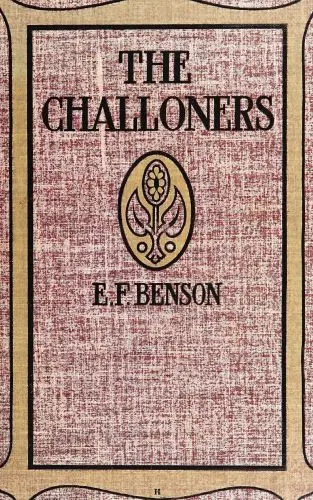
"The Challoners" by E. F. Benson is a novel written in the early 20th century. The story revolves around the Challoner family, focusing particularly on the experiences and perspectives of Helen and her brother Martin as they navigate their lives entangled with familial expectations, societal norms, and their own desires. The narrative hints at greater themes of duty, love, the conflict between individual aspirations and family obligations, as well as the delicate balance between artistic inclinations and moral responsibilities. The opening of the book introduces readers to Helen Challoner, who is enjoying a serene moment in the garden while reading "The Mill on the Floss," a choice that reflects her more liberal views compared to those of her strict father, the Reverend Sidney Challoner. This scene sets the foundation for the dynamic between the siblings, particularly highlighting Helen's frustration with her restricted life in a vicarage characterized by stringent moral expectations. As they discuss literature and their conflicting aspirations, their playful exchanges reveal deeper tensions within the family, particularly between Martin's artistic inclinations and their father's stern principles. The interaction also elicits hints about the father's struggle to balance discipline with love in a changing world, making it clear that this relationship will unfold as a pivotal element of the story.
Introduction adapted from the source catalogue; source summaries may be automatically generated.
Free to read · English · 96,939 words · No account needed
MAKE TIME FOR A GOOD BOOK
On by default. Untick to stop anonymous reading totals. Each page counts after 10 seconds in view. How this works.
Anonymous counting is on unless you have switched it off.
“Yes; and then you grew too big. After that you used each to have a chair, one on each side of me.”
“And we did our lessons there,” said Helen. Then she stopped suddenly, for there was a foot on the stairs.
Nurse Baker came in.
“You must both come,” she said.
The blind was drawn up in Martin’s room, and the same wonderful sun flooded the room, and outside many thrushes were singing. There was but little apparatus of medicine there,--it was just a boy’s clean room: cricket bats and racquets stood in one corner, on the table there was a heap of music, school-books were in the bookcase by the door. And on the bed lay Martin. His eyes were still open, but they were blind and unseeing no more, and he turned them wearily to the door when Helen and his father entered. But when he saw them, they brightened a little. The doctor had stood back from the bed, Nurse Baker was by him. Then Martin spoke.
“It is nice to be in my own room again,” he said in a voice just audible. “Oh, good-morning, Helen; good-morning, father. I have had horrible dreams, father. I dreamed you were angry with me. How silly. You are not angry?”
Mr. Challoner came up to the bed, and knelt there, his arm resting on
the blanket.
“No, dear lad,” he said. “I am not; indeed, I am not.”
Martin shifted his position a little.
“I’m glad,” he said, “because I’m so tired. Helen, I played well, really well, did I?”
“Yes, Martin; Karl Rusoff said--he said nobody ever played better.”
And she was silent because she could not say any more just then.
“And what is to-day?” asked Martin at length.
“It is Easter Sunday, dear Martin,” said his father.
Martin half raised his head.
“I ought to be at Mass,” he said, “but I can’t. It doesn’t matter, does it, if one can’t?”
His father came a little closer yet.
“No, dear boy,” he said. “It is Mass everywhere this morning. He was crucified, and this morning He rose again. That is all the world holds, and the heaven of heavens.”
“Yes, all,” said the boy. “And to-day----“
The whisper in which he had spoken died, and Dr. Thaxter took a step towards the bed, looked at him a moment, and then went back again.
For a minute or two Martin lay there quite still; then he put out his two hands on each side of the bed, one towards Helen, one to his father.
Your reading position is saved on this browser. Take it to another device with a library code. Reading pages adapt to text, rather than matching a printed edition.
E. F. (Edward Frederic) Benson

E. F. (Edward Frederic) Benson

E. F. (Edward Frederic) Benson

E. F. (Edward Frederic) Benson
BEHIND THE BOOK
This eBook is for the use of anyone anywhere in the United States and most other parts of the world at no cost and with almost no restrictions whatsoever. You may copy it, give it away or re-use it under the terms of the Project Gutenberg License included with this eBook or online at www.gutenberg.org. If you are not located in the United States, you will have to check the laws of the country where you are located before using this eBook. Read the source licence.
The original source file, including credits and licence, is retained by this library. Request an original-format copy at no charge. Please include the book title and Project Gutenberg identifier #57002.
KEEP YOUR CURIOSITY GOING
Coulson Kernahan

Maurice Baring
Frances Wright
Cécile Tormay

Frederic Jesup Stimson

W. H. P. (William Henry Pope) Jarvis