
Lucia in London
E. F. (Edward Frederic) Benson
THE CLASSIC COLLECTION · 1904
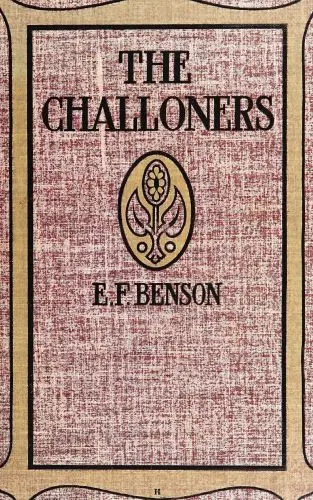
"The Challoners" by E. F. Benson is a novel written in the early 20th century. The story revolves around the Challoner family, focusing particularly on the experiences and perspectives of Helen and her brother Martin as they navigate their lives entangled with familial expectations, societal norms, and their own desires. The narrative hints at greater themes of duty, love, the conflict between individual aspirations and family obligations, as well as the delicate balance between artistic inclinations and moral responsibilities. The opening of the book introduces readers to Helen Challoner, who is enjoying a serene moment in the garden while reading "The Mill on the Floss," a choice that reflects her more liberal views compared to those of her strict father, the Reverend Sidney Challoner. This scene sets the foundation for the dynamic between the siblings, particularly highlighting Helen's frustration with her restricted life in a vicarage characterized by stringent moral expectations. As they discuss literature and their conflicting aspirations, their playful exchanges reveal deeper tensions within the family, particularly between Martin's artistic inclinations and their father's stern principles. The interaction also elicits hints about the father's struggle to balance discipline with love in a changing world, making it clear that this relationship will unfold as a pivotal element of the story.
Introduction adapted from the source catalogue; source summaries may be automatically generated.
Free to read · English · 96,939 words · No account needed
MAKE TIME FOR A GOOD BOOK
On by default. Untick to stop anonymous reading totals. Each page counts after 10 seconds in view. How this works.
Anonymous counting is on unless you have switched it off.
“My dear boy, I have told you that that does not matter in the slightest degree,” said Karl. “The moment you touch the notes that will cease absolutely. Why, even now my hands always tremble before I begin!”
Martin apparently was not listening.
“And I have not the remotest notion how the ‘Études Symphoniques’
begin,” he said.
Karl tried to laugh, but he was not very successful. As a matter of fact he was quite as nervous as Martin.
“That’s a great pity,” he said, “as you open with it. I don’t know
either.”
But Martin did not smile.
“What will you do if I break down?” he said; “if I can’t begin? It is more than possible.”
“I shall hiss; I shall boo; I shall demand the return of my money,” said
he.
But Martin still remained perfectly grave.
“Ah, don’t,” he said; “the others may boo if they like, and I shan’t mind--much. But I couldn’t stand it if you did.”
“Did you drink a good, stiff glass of whiskey-and-soda for lunch, as I told you to?” demanded Karl.
“I tried to, but I should have been dead drunk if I had gone on. So what will you do if I break down?” he asked again. “You told me, but I have forgotten.”
Karl rose from his chair.
“I shall break my heart, Martin,” he said.
Then he spoke to him quickly, peremptorily, seeing he was really on the
verge of hysterics.
“We’ve had quite enough of this nonsense, my dear boy,” he said. “If you give me any more of it, I shall lose my temper with you. You are not going to break down, I forbid you, and you are to do as I tell you. You are going to play your very best,--better than you have ever played before. Now I must get to my place. Give them five minutes law before you appear, and as soon as I see the top of your black head coming up the stairs I shall have all the doors closed till the end of the Études. We’ll have no interruptions; they are frightfully distracting. You know where I shall be sitting, don’t you? Bow twice, right and left, walk straight to the piano, and begin instantly, without playing any fluffy arpeggios. It is going to be a great day for you. And for me.”
Martin looked despairingly round.
“Don’t leave me, don’t leave me,” he said. “Can’t you sit by me?”
“And hold your hand? Ah, this is altogether childish!”
For the first time the shadow of a smile crossed Martin’s face.
Your reading position is saved on this browser. Take it to another device with a library code. Reading pages adapt to text, rather than matching a printed edition.
E. F. (Edward Frederic) Benson

E. F. (Edward Frederic) Benson

E. F. (Edward Frederic) Benson

E. F. (Edward Frederic) Benson
BEHIND THE BOOK
This eBook is for the use of anyone anywhere in the United States and most other parts of the world at no cost and with almost no restrictions whatsoever. You may copy it, give it away or re-use it under the terms of the Project Gutenberg License included with this eBook or online at www.gutenberg.org. If you are not located in the United States, you will have to check the laws of the country where you are located before using this eBook. Read the source licence.
The original source file, including credits and licence, is retained by this library. Request an original-format copy at no charge. Please include the book title and Project Gutenberg identifier #57002.
KEEP YOUR CURIOSITY GOING
Coulson Kernahan

Maurice Baring
Frances Wright
Cécile Tormay

Frederic Jesup Stimson

W. H. P. (William Henry Pope) Jarvis