
Lucia in London
E. F. (Edward Frederic) Benson
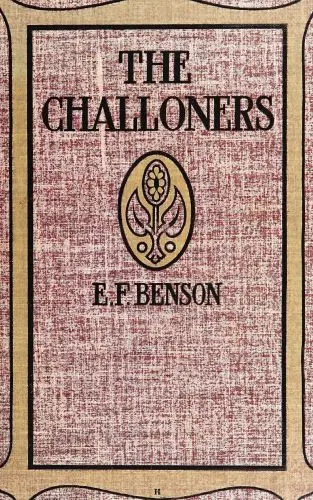
THE CLASSIC COLLECTION · 1904
"The Challoners" by E. F. Benson is a novel written in the early 20th century. The story revolves around the Challoner family, focusing particularly on the experiences and perspectives of Helen and her brother Martin as they navigate their lives entangled with familial expectations, societal norms, and their own desires. The narrative hints at greater themes of duty, love, the conflict between individual aspirations and family obligations, as well as the delicate balance between artistic inclinations and moral responsibilities. The opening of the book introduces readers to Helen Challoner, who is enjoying a serene moment in the garden while reading "The Mill on the Floss," a choice that reflects her more liberal views compared to those of her strict father, the Reverend Sidney Challoner. This scene sets the foundation for the dynamic between the siblings, particularly highlighting Helen's frustration with her restricted life in a vicarage characterized by stringent moral expectations. As they discuss literature and their conflicting aspirations, their playful exchanges reveal deeper tensions within the family, particularly between Martin's artistic inclinations and their father's stern principles. The interaction also elicits hints about the father's struggle to balance discipline with love in a changing world, making it clear that this relationship will unfold as a pivotal element of the story.
Introduction adapted from the source catalogue; source summaries may be automatically generated.
Free to read · English · 96,939 words · No account needed
MAKE TIME FOR A GOOD BOOK
On by default. Untick to stop anonymous reading totals. Each page counts after 10 seconds in view. How this works.
Anonymous counting is on unless you have switched it off.
“All is food for you,” he said. “It is only in that way, by harvesting every grain of corn you see, that you can be great. A lot of harvesting is done unconsciously. Supplement that by conscious harvesting. You may learn perfectly all the harmony and counterpoint that can be learned, you may learn to play things impossible, but all that is no good by itself. You can already play,--I am not flattering you, but the reverse,--if you practise a little, all the printed music ever written, as far as notes go. That is no good either. But--if I had not seen this when first I heard you play, I should never have wasted ten minutes of my time on you--you can do more than that. You can, if you are very alert, quite untiring, very critical, and always ready to catch beauty in whatever form it may present itself, you can do more than this. At least I believe so.”
He got up from his seat and leaned his hands on the boy’s shoulders as
he sat by the table.
“Ah, Martin, don’t disappoint me,” he said, “or, being old, I shall die of it. Drink from every spring but one, and drink deep.”
Martin turned in his chair and faced him.
“Do I know what spring you mean?” he asked. “Love?”
Karl looked at him with a sort of wonder.
“No, I did not mean that,” he said.
He drew a long breath.
“My God, if that had been granted to me,” he said, “I too might have been great. But I never fell in love. Oh, I am successful; I know I understand; I am the only person, perhaps, who does know what is missing in me. It is that. But missing that, I never, no, not once, parodied what I did not know. Parody, parody!” he repeated.
Martin looked at him with that direct, lucid gaze Karl knew so well, level beneath the straight line of his eyebrows. His smooth, brown cheeks were a little flushed with some emotion he could not have put a name to. Slight injury was there, that Karl could possibly have supposed him bestial, the rest was clean modesty.
“I am not beastly,” he said, “if you mean that.”
“I did mean that,” he said. “And I beg your pardon.”
Martin stood up.
“I think you had no right to suppose that,” he said.
“No, I had none. I did not suppose it. I warned you, though.”
A tenderness such as he had never known rose like a blush into his old bones, tenderness for this supreme talent that had been placed in his hands.
Your reading position is saved on this browser. Take it to another device with a library code. Reading pages adapt to text, rather than matching a printed edition.
E. F. (Edward Frederic) Benson

E. F. (Edward Frederic) Benson

E. F. (Edward Frederic) Benson

E. F. (Edward Frederic) Benson
BEHIND THE BOOK
This eBook is for the use of anyone anywhere in the United States and most other parts of the world at no cost and with almost no restrictions whatsoever. You may copy it, give it away or re-use it under the terms of the Project Gutenberg License included with this eBook or online at www.gutenberg.org. If you are not located in the United States, you will have to check the laws of the country where you are located before using this eBook. Read the source licence.
The original source file, including credits and licence, is retained by this library. Request an original-format copy at no charge. Please include the book title and Project Gutenberg identifier #57002.
KEEP YOUR CURIOSITY GOING
Coulson Kernahan

Maurice Baring
Frances Wright
Cécile Tormay

Frederic Jesup Stimson

W. H. P. (William Henry Pope) Jarvis