
Lucia in London
E. F. (Edward Frederic) Benson
THE CLASSIC COLLECTION · 1904
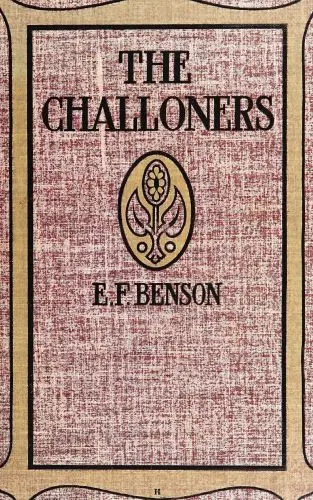
"The Challoners" by E. F. Benson is a novel written in the early 20th century. The story revolves around the Challoner family, focusing particularly on the experiences and perspectives of Helen and her brother Martin as they navigate their lives entangled with familial expectations, societal norms, and their own desires. The narrative hints at greater themes of duty, love, the conflict between individual aspirations and family obligations, as well as the delicate balance between artistic inclinations and moral responsibilities. The opening of the book introduces readers to Helen Challoner, who is enjoying a serene moment in the garden while reading "The Mill on the Floss," a choice that reflects her more liberal views compared to those of her strict father, the Reverend Sidney Challoner. This scene sets the foundation for the dynamic between the siblings, particularly highlighting Helen's frustration with her restricted life in a vicarage characterized by stringent moral expectations. As they discuss literature and their conflicting aspirations, their playful exchanges reveal deeper tensions within the family, particularly between Martin's artistic inclinations and their father's stern principles. The interaction also elicits hints about the father's struggle to balance discipline with love in a changing world, making it clear that this relationship will unfold as a pivotal element of the story.
Introduction adapted from the source catalogue; source summaries may be automatically generated.
Free to read · English · 96,939 words · No account needed
MAKE TIME FOR A GOOD BOOK
On by default. Untick to stop anonymous reading totals. Each page counts after 10 seconds in view. How this works.
Anonymous counting is on unless you have switched it off.
Later, Martin played, there was Bridge, and Lord Sunningdale, as usual, went to sleep, and, on awaking, revoked, subsequently explaining the revoke to the satisfaction of everybody but his partner, who remained dissatisfied to the last. Women took bed-candles, men gravitated to the smoking-room, though, since every one had previously smoked in the drawing-room, this seemed unnecessary. But, the fact is one without exception, men left alone leave drawing-rooms.
Soon, again, after the long day’s shoot, the smoking-room yawned itself to bed, and cabinet ministers, the traveller, and the astronomer being gone, Frank was left alone with Martin. There was no design in the matter,--both hated going to bed as much as both detested getting up, but they were neither of them sorry to have the opportunity of more talk. Frank had got up from his chair on the last exit, took a whiskey-and-soda, and moved to the fireplace.
“Lady Sunningdale is extraordinarily clever,” he remarked, “but I can no more discuss anything with her than I could with a dragon-fly. She is always darting.”
Martin laughed.
“Go on, then,” he said.
Frank sat down.
“Are you determined, Martin?” he asked.
“I think so. I don’t see what else I can do.”
“I asked you a question before dinner, which you didn’t have time to answer. Is it as much to you as Chopin?”
“Why do you repeat that?” asked Martin. “It does not seem to me apt. How can I make such a comparison?”
“Easily, I should have thought.”
Again Martin’s likeness to his father started to his face.
“You say, ‘easily,’” he said. “Take this, then. What would you do if in order to get Helen you had to tell a real, mortal, mean lie, the sort of lie that would make you blush in the dark?”
“It’s like that, is it?”
“Yes; just like that. I must. I can’t tell you why. I don’t know whether I know, except as regards what I said in Lady Sunningdale’s room, that, if in anything, in worship above all is beauty necessary. That is true, but it is only a sort of symbol of what I feel. Other people feel differently; they are less materialistic than I, and ugliness doesn’t get in their way. But if you happen to be gifted or cursed with the artistic temperament--Lord, how priggish that sounds!--I don’t see how you can help demanding beauty in the service of what is sublime.”
“I never knew you thought about these things,” said Frank, rather
lamely.
Martin snapped his fingers impatiently.
Your reading position is saved on this browser. Take it to another device with a library code. Reading pages adapt to text, rather than matching a printed edition.
E. F. (Edward Frederic) Benson

E. F. (Edward Frederic) Benson

E. F. (Edward Frederic) Benson

E. F. (Edward Frederic) Benson
BEHIND THE BOOK
This eBook is for the use of anyone anywhere in the United States and most other parts of the world at no cost and with almost no restrictions whatsoever. You may copy it, give it away or re-use it under the terms of the Project Gutenberg License included with this eBook or online at www.gutenberg.org. If you are not located in the United States, you will have to check the laws of the country where you are located before using this eBook. Read the source licence.
The original source file, including credits and licence, is retained by this library. Request an original-format copy at no charge. Please include the book title and Project Gutenberg identifier #57002.
KEEP YOUR CURIOSITY GOING
Coulson Kernahan

Maurice Baring
Frances Wright
Cécile Tormay

Frederic Jesup Stimson

W. H. P. (William Henry Pope) Jarvis