
Lucia in London
E. F. (Edward Frederic) Benson
THE CLASSIC COLLECTION · 1904
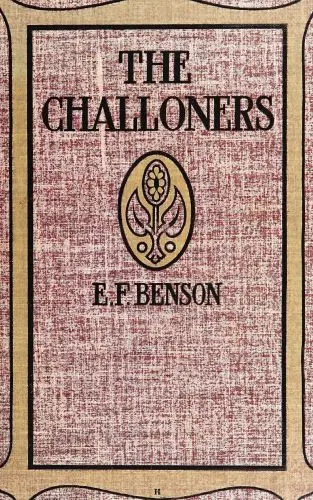
"The Challoners" by E. F. Benson is a novel written in the early 20th century. The story revolves around the Challoner family, focusing particularly on the experiences and perspectives of Helen and her brother Martin as they navigate their lives entangled with familial expectations, societal norms, and their own desires. The narrative hints at greater themes of duty, love, the conflict between individual aspirations and family obligations, as well as the delicate balance between artistic inclinations and moral responsibilities. The opening of the book introduces readers to Helen Challoner, who is enjoying a serene moment in the garden while reading "The Mill on the Floss," a choice that reflects her more liberal views compared to those of her strict father, the Reverend Sidney Challoner. This scene sets the foundation for the dynamic between the siblings, particularly highlighting Helen's frustration with her restricted life in a vicarage characterized by stringent moral expectations. As they discuss literature and their conflicting aspirations, their playful exchanges reveal deeper tensions within the family, particularly between Martin's artistic inclinations and their father's stern principles. The interaction also elicits hints about the father's struggle to balance discipline with love in a changing world, making it clear that this relationship will unfold as a pivotal element of the story.
Introduction adapted from the source catalogue; source summaries may be automatically generated.
Free to read · English · 96,939 words · No account needed
MAKE TIME FOR A GOOD BOOK
On by default. Untick to stop anonymous reading totals. Each page counts after 10 seconds in view. How this works.
Anonymous counting is on unless you have switched it off.
“Well, in one word, ‘Beauty,’” said he.
Lady Sunningdale was completely bewildered.
“Incense? The Virgin Mary?” she suggested, vaguely.
Martin frowned. For a moment he looked exactly like his father.
“Ah, what is the use of my telling you, if you say that sort of thing?”
he asked.
“But I really haven’t an idea,” said she. “Did I say anything dreadful?”
“Frank, speak. You know,” said he. “I never know what I am talking about when I begin to talk.”
“It is only a guess.”
“You have guessed right. I believe you are always right.”
“Well, get on somebody,” said Lady Sunningdale, with a show of
impatience.
“All is Beauty,” said Frank, “and knowing this is Love, and Love is
Duty.”
He smiled across to Martin.
“You quoted that, you know, to Helen,” he said, “on the day your father found ‘The Mill on the Floss.’”
“What did he find the mill on?” asked Lady Sunningdale. “Oh, I see. George Eliot, isn’t it? How dull! I read a book of hers once, ‘Scenes from Something,’ and thought it so like your father’s house, Martin. But all is Beauty, is it? I should have said almost everything was ugly. Anyhow, what has it all got to do with the Pope?”
Lady Sunningdale’s discursiveness, the reader will have noticed, was liable to put in an appearance at any time, even when she was really interested. She herself explained this by the fact that she never thought about less than three things at once. Consequently, when she opened her mouth, any of the three was liable to make its escape.
“Yes, that is it,” said Martin, answering Frank’s last remark. “I am a Christian, and I cannot any longer be of a church that leaves out beauty from its worship. Why, if you love a thing, if you believe in a thing, you must approach it through beauty, it seems to me.”
He paused a moment, and then the words came as they had never come before. A sudden clearness of vision was his. He saw his own thought with precision, and he could at that moment of self-revelation delineate it very accurately.
Your reading position is saved on this browser. Take it to another device with a library code. Reading pages adapt to text, rather than matching a printed edition.
E. F. (Edward Frederic) Benson

E. F. (Edward Frederic) Benson

E. F. (Edward Frederic) Benson

E. F. (Edward Frederic) Benson
BEHIND THE BOOK
This eBook is for the use of anyone anywhere in the United States and most other parts of the world at no cost and with almost no restrictions whatsoever. You may copy it, give it away or re-use it under the terms of the Project Gutenberg License included with this eBook or online at www.gutenberg.org. If you are not located in the United States, you will have to check the laws of the country where you are located before using this eBook. Read the source licence.
The original source file, including credits and licence, is retained by this library. Request an original-format copy at no charge. Please include the book title and Project Gutenberg identifier #57002.
KEEP YOUR CURIOSITY GOING
Coulson Kernahan

Maurice Baring
Frances Wright
Cécile Tormay

Frederic Jesup Stimson

W. H. P. (William Henry Pope) Jarvis