THE CLASSIC COLLECTION✦The secret of Father BrownCLASSIC FREE BOOKS
The secret of Father Brown
G. K. (Gilbert Keith) Chesterton
THE CLASSIC COLLECTION · 1926
"The Catholic Church and conversion" by G. K. Chesterton is a religious apologetic treatise written in the early 20th century. It contends that Catholicism appears in the modern world as a fresh, disruptive reality rather than a mere survival, and examines conversion as the Church’s distinctive mark. Chesterton clears away popular anti-Catholic myths, contrasts national loyalties with the Church’s universal claim, and maps the inner journey from curiosity to resistance to assent. The opening of the treatise begins with an editor’s note stressing how converts, coming from every sort of background and by innumerable paths, powerfully witness to the Faith’s reality. Chesterton then argues that Catholicism functions today like a “new religion,” a living force that attracts where other traditions have grown stale; the Church’s true stamp is conversion, not mere tradition. He dismisses stock slanders (about Scripture, priests, and Jesuits), contrasts narrow patriotism with the Church’s prior and wider human solidarity, and identifies the real hurdles as fear of the Faith’s demanding virtues—especially the honesty and responsibility of confession—rather than the vices others allege. He outlines three stages of conversion (defending the Church from injustice, discovering its ideas, then trying to flee the final step) and finally flips the perspective: the Church is not one sect among many but the vast cathedral that contains them, while modern movements are partial exaggerations of Catholic truths; conversion, he insists, enlarges thought and freedom rather than confining them.
Introduction adapted from the source catalogue; source summaries may be automatically generated.
Free to read · English · 25,012 words · No account needed
MAKE TIME FOR A GOOD BOOK
On by default. Untick to stop anonymous reading totals. Each page counts after 10 seconds in view. How this works.
Anonymous counting is on unless you have switched it off.
Now he has no fear lest he should fall among Calvinists. He has no fear that his children will become seventeenth-century Supralapsarians, however much he may dislike that doctrine. He is not even particularly troubled by the possibility of their adopting the extreme solifidian conceptions once common among some of the more extravagant Methodists. He is not likely to await with terror the telegram that will inform him that his son has become a Fifth-Monarchy man, any more than that he has joined the Albigensians. He does not exactly lie awake at night wondering whether Tom at Oxford has become a Lutheran any more than a Lollard. All these religions he dimly recognises as dead religions; or at any rate as old religions. And he is only frightened of new religions. He is only frightened of those fresh, provocative, paradoxical new notions that fly to the young people’s heads. But amongst these dangerous juvenile attractions he does in practice class the freshness and novelty of Rome.
Now this is rather odd; because Rome is not so very new. Among these annoying new religions, one is rather an old religion; but it is the only old religion that is so new. When it was originally and really new, no doubt a Roman father often found himself in the same position as the Anglican or Puritan father. He too might find all his children going strange ways and deserting the household gods and the sacred temple of the Capitol. He too might find that one of those children had joined the Christians in their Ecclesia and possibly in their Catacombs. But he would have found that, of his other children, one cared for nothing but the Mysteries of Orpheus, another was inclined to follow Mithras, another was a Neo-Pythagorean who had learned vegetarianism from the Hindoos, and so on. Though the Roman father, unlike the Victorian father, might have the pleasure of exercising the patria potestas and cutting off the heads of all the heretics, he could not cut off the stream of all the heresies. Only by this time most of the streams have run rather dry. It is now seldom necessary for the anxious parent to warn his children against the undesirable society of the Bull of Mithras, or even to wean him from the exclusive contemplation of Orpheus; and though we have vegetarians always with us, they mostly know more about proteids than about Pythagoras. But that other youthful extravagance is still youthful. That other new religion is once again new. That one fleeting fashion has refused to fleet; and that ancient bit of modernity is still modern. It is still to the Protestant parent now exactly what it was to the pagan parent then. We might say simply that it is a nuisance; but anyhow it is a novelty. It is not simply what the father is used to, or even what the son is used to. It is coming in as something fresh and disturbing, whether as it came to the Greeks who were always seeking some new thing, or as it came to the shepherds who first heard the cry upon the hills of the good news that our language calls the Gospel. We can explain the fact of the Greeks in the time of St. Paul regarding it as a new thing, because it was a new thing. But who will explain why it is still as new to the last of the converts as it was to the first of the shepherds? It is as if a man a hundred years old entered the Olympian games among the young Greek athletes; which would surely have been the basis of a Greek legend. There is something almost as legendary about the religion that is two thousand years old now appearing as a rival of the new religions. That is what has to be explained and cannot be explained away; nothing can turn the legend into a myth. We have seen with our own eyes and heard with our own ears this great modern quarrel between young Catholics and old Protestants; and it is the first step to recognise in any study of modern conversion.
Your reading position is saved on this browser. Take it to another device with a library code. Reading pages adapt to text, rather than matching a printed edition.
G. K. (Gilbert Keith) Chesterton
G. K. (Gilbert Keith) Chesterton
G. K. (Gilbert Keith) Chesterton
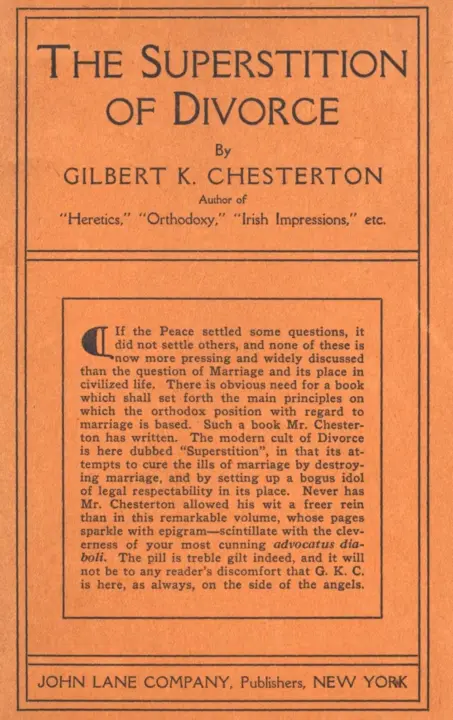
G. K. (Gilbert Keith) Chesterton
BEHIND THE BOOK
This eBook is for the use of anyone anywhere in the United States and most other parts of the world at no cost and with almost no restrictions whatsoever. You may copy it, give it away or re-use it under the terms of the Project Gutenberg License included with this eBook or online at www.gutenberg.org. If you are not located in the United States, you will have to check the laws of the country where you are located before using this eBook. Read the source licence.
The original source file, including credits and licence, is retained by this library. Request an original-format copy at no charge. Please include the book title and Project Gutenberg identifier #76305.
KEEP YOUR CURIOSITY GOING

David Patterson (Spirit) Hatch

David Patterson (Spirit) Hatch

David Patterson (Spirit) Hatch

Ralph Waldo Emerson

Maurice Baring

Oscar Wilde & James McNeill Whistler