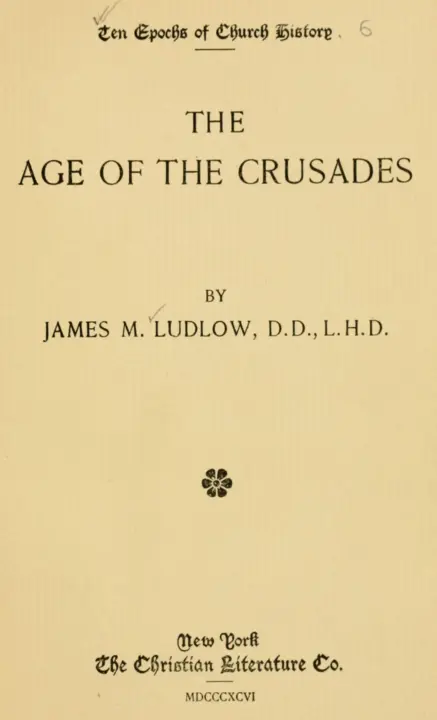
The age of the crusades
James M. (James Meeker) Ludlow
THE CLASSIC COLLECTION · 1886
"The Captain of the Janizaries" by James M. Ludlow is a historical novel likely written in the late 19th century. The narrative unfolds during the tumultuous times of Scanderbeg, a notable figure in the struggle against the Ottoman Empire, and captures the events surrounding the fall of Constantinople. The main character, George Castriot, known as Scanderbeg, is a compelling figure torn between his Christian roots and his role within the Ottoman military, which frames the conflict at the heart of the story. The opening of the novel introduces a richly detailed world shaped by political intrigue and the personal struggles of its characters. It begins with Scanderbeg's contemplative moments atop the fortress of Brousa, where he reflects on his past and current status as a leading figure in the Ottoman army. The narrative swings between scenes of his commanding presence on the battlefield and the emotional turmoil he faces due to his allegiance to the Sultan, juxtaposed with his deep longing for Albania and his family legacy. As the plot unfolds, Scanderbeg receives disheartening news about his father and is confronted with the realities of betrayal and duty, setting the stage for his eventual rebellion against the Ottomans. The sense of impending action and fate is palpable, making readers eager to dive into the unfolding historical drama.
Introduction adapted from the source catalogue; source summaries may be automatically generated.
Free to read · English · 106,960 words · No account needed
MAKE TIME FOR A GOOD BOOK
On by default. Untick to stop anonymous reading totals. Each page counts after 10 seconds in view. How this works.
Anonymous counting is on unless you have switched it off.
"Tut! Woman, you never saw the stars shine on the Balkans. They do shine there, though, like the very eyes of Allah. A woman with such eyes would frighten the Padishah himself."
Kala Hanoum took courage at this first evidence of interest on the part of the officer, and plied her advantage.
"And her teeth are as white as the snows in the grotto of Slatiza--"
"The grotto of Slatiza? You mean some bear's cave. But the snows are white there, whiter and purer than anywhere else on earth, except as I once saw them, so red with blood, there in the Pass of Slatiza. But how know you of Slatiza, my good woman?"
"And altogether she is as fair as the bride of Sigismund of Hungary," said Kala, without regarding his question.
"And who was she, Hanoum?" asked the man, with curiosity fully
aroused.
"Why, Elizabeth Morsiney, of course."
The officer turned fully toward the woman, and scanned closely her features as if to discover something familiar. Was there not some hint to be picked from these words?
"Hanoum, who told you to say that?"
The woman in turn studied his face before she replied. She would learn whether the allusions had excited a pleasant interest, or roused antagonism in him. It required but a moment for her to discover that Morsinia had given her some clue that the man would willingly follow, so she boldly replied:
"The odalisk herself has talked to me of these things."
"The odalisk! What is she like?" said he eagerly. "Describe her to
me."
"Why, I have been describing her for this half-hour; but you would not listen. So I will go off and do my next errand."
The woman turned away, but, as she intended it should be, the officer was now in the attitude of the beggar.
"Hold, Hanoum, I will buy your perfume--But tell me what she is like in plain words. Is she of light hair?"
"Ay, as if she washed it in the sunshine and dried it in the moonlight, and as glossy as the beams of both."
"Think you she belonged to Stamboul before the siege?"
"Ay, and to the great Scanderbeg before that."
The officer was bewildered and stood thinking, until Kala interrupted
him.
"But you said you would buy it, Captain."
"Did I? Well, take your lira."
As the woman took the piece of money she added: "And don't forget that the odalisk said she had dreamed of you since she was a child, and that at sunset if you looked through the phials you would see her face."
"Nonsense, woman!"
Your reading position is saved on this browser. Take it to another device with a library code. Reading pages adapt to text, rather than matching a printed edition.
James M. (James Meeker) Ludlow
James M. (James Meeker) Ludlow

James M. (James Meeker) Ludlow

James M. (James Meeker) Ludlow
BEHIND THE BOOK
This eBook is for the use of anyone anywhere in the United States and most other parts of the world at no cost and with almost no restrictions whatsoever. You may copy it, give it away or re-use it under the terms of the Project Gutenberg License included with this eBook or online at www.gutenberg.org. If you are not located in the United States, you will have to check the laws of the country where you are located before using this eBook. Read the source licence.
The original source file, including credits and licence, is retained by this library. Request an original-format copy at no charge. Please include the book title and Project Gutenberg identifier #40519.
KEEP YOUR CURIOSITY GOING
Cécile Tormay

Moritz Busch
Coulson Kernahan
John L. Ransom

Maurice Baring
Frances Wright