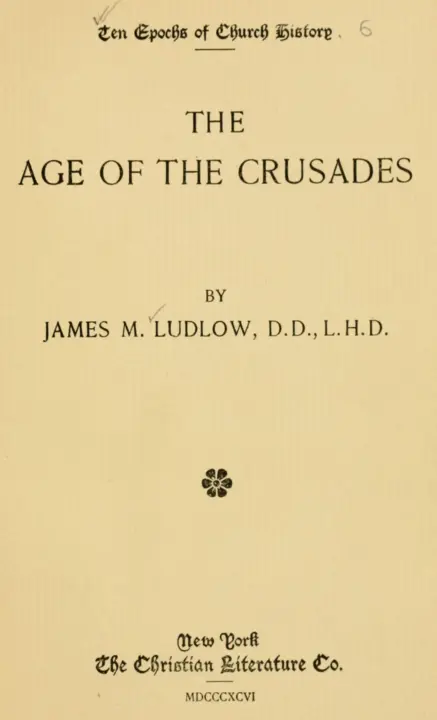
The age of the crusades
James M. (James Meeker) Ludlow
THE CLASSIC COLLECTION · 1886
"The Captain of the Janizaries" by James M. Ludlow is a historical novel likely written in the late 19th century. The narrative unfolds during the tumultuous times of Scanderbeg, a notable figure in the struggle against the Ottoman Empire, and captures the events surrounding the fall of Constantinople. The main character, George Castriot, known as Scanderbeg, is a compelling figure torn between his Christian roots and his role within the Ottoman military, which frames the conflict at the heart of the story. The opening of the novel introduces a richly detailed world shaped by political intrigue and the personal struggles of its characters. It begins with Scanderbeg's contemplative moments atop the fortress of Brousa, where he reflects on his past and current status as a leading figure in the Ottoman army. The narrative swings between scenes of his commanding presence on the battlefield and the emotional turmoil he faces due to his allegiance to the Sultan, juxtaposed with his deep longing for Albania and his family legacy. As the plot unfolds, Scanderbeg receives disheartening news about his father and is confronted with the realities of betrayal and duty, setting the stage for his eventual rebellion against the Ottomans. The sense of impending action and fate is palpable, making readers eager to dive into the unfolding historical drama.
Introduction adapted from the source catalogue; source summaries may be automatically generated.
Free to read · English · 106,960 words · No account needed
MAKE TIME FOR A GOOD BOOK
On by default. Untick to stop anonymous reading totals. Each page counts after 10 seconds in view. How this works.
Anonymous counting is on unless you have switched it off.
A smile passed over the man's face, which Amesa might have detected the meaning of had his mind been less occupied with thoughts about his personal safety from the yataghan, whose point was seeking his throat according to the most approved rules of single combat.
"And what if I am Arnaud's man?"
As he said this the yataghan made a thorough reconnoissance of all the vulnerable parts of Amesa's body from the fifth rib upwards, followed by Amesa's dagger in ward.
"You do not deny it?" said the Albanian between breaths.
"I deny nothing. Nor need I confess anything, since you say I am
known."
"Shall we be friends?" asked Amesa, cautiously lowering his arm.
"You made war, and can withdraw its declaration, or take the
consequences," was the reply.
The two men put up their weapons.
"So good a soldier as you are should not be here guarding a girl,"
said Amesa.
"Guarding a girl?" said the man in amazement, but, recollecting himself, added, "And why not guard a girl?"
"Come," replied Amesa, "you and I can serve each other. You can do that for me which no other man can; and I can give to you more gold than any other Albanian can."
"And when you are king of Albania, Prince Amesa, you can reward me with high appointment," said the stranger with a slight sneer, which, however, Amesa did not notice, at the moment thinking of what the stargeshina had said of the man's interest in the movement against his uncle's leadership.
"You have but to ask your reward when that event comes," he replied.
"I will swear to serve Amesa against Scanderbeg to the death," said
the man offering his hand.
"You know the girl's true story?" asked Amesa.
"Of course," was the cautious reply. "But of that I may not speak a word. I can leave his service whose man you say I am, but I cannot betray anything he may have told me. As you know the girl's story it is needless to tempt me to divulge it," added he, with shrewd non-committal of himself to any information that the other might recognize as erroneous.
"You speak nobly for a Servian," said the voivode.
"How do you know I am a Servian?" asked the stranger.
"Partly from your accent. You have not got our pure Albanian tongue, though it is now six years you have been talking it. And then Arnaud--Colonel Kabilovitsch--came back as a Servian. Is it not so?" asked Amesa, noticing the surprised look which the mention of Kabilovitsch's name brought to the man's face.
Your reading position is saved on this browser. Take it to another device with a library code. Reading pages adapt to text, rather than matching a printed edition.
James M. (James Meeker) Ludlow
James M. (James Meeker) Ludlow

James M. (James Meeker) Ludlow

James M. (James Meeker) Ludlow
BEHIND THE BOOK
This eBook is for the use of anyone anywhere in the United States and most other parts of the world at no cost and with almost no restrictions whatsoever. You may copy it, give it away or re-use it under the terms of the Project Gutenberg License included with this eBook or online at www.gutenberg.org. If you are not located in the United States, you will have to check the laws of the country where you are located before using this eBook. Read the source licence.
The original source file, including credits and licence, is retained by this library. Request an original-format copy at no charge. Please include the book title and Project Gutenberg identifier #40519.
KEEP YOUR CURIOSITY GOING
Cécile Tormay

Moritz Busch
Coulson Kernahan
John L. Ransom

Maurice Baring
Frances Wright