
The Turk and his lost provinces
William Eleroy Curtis
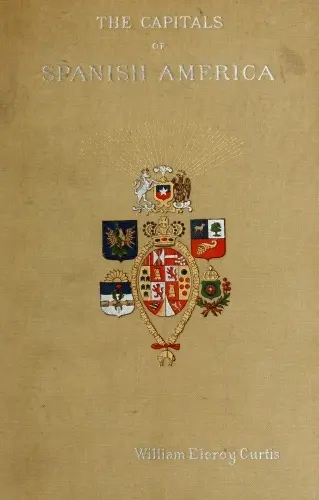
THE CLASSIC COLLECTION · 1888
"The Capitals of Spanish America" by William Eleroy Curtis is a historical account written in the late 19th century. The work explores various cities that serve as capitals in Spanish America, providing insights into their history, culture, and political climate during that period. The book is particularly focused on Mexico City, contrasting its ancient traditions and modern influences. At the start of the book, the author delves into the complexities of life in Mexico City, highlighting the stark juxtaposition between ancient customs and modern advancements. He observes how indigenous practices persist amidst the introduction of new technologies and ideas, culminating in a unique social fabric where the old and the new coexist. The narrative paints a vivid picture of the city's landscape, its people, and the political dynamics under President Porfirio Diaz, setting the stage for a deeper exploration of other capitals across Spanish America.
Introduction adapted from the source catalogue; source summaries may be automatically generated.
Free to read · English · 176,291 words · No account needed
MAKE TIME FOR A GOOD BOOK
On by default. Untick to stop anonymous reading totals. Each page counts after 10 seconds in view. How this works.
Anonymous counting is on unless you have switched it off.
The interior of Uruguay is being rapidly developed by the construction of railways under the control of the Government, and representing an investment of about $12,000,000. Besides the lines already in operation, extensions are in progress which, when completed, will give the country a system of about 1500 miles of road, at a cost of something like $50,000,000! Railroad building is cheap in Uruguay, as grades are light and easy, and ties are plenty and accessible. The commerce of the country now amounts to $58,000,000 annually, with $29,500,000 of imports and $28,500,000 of exports. The imports are unusually large of late years, because of the vast amount of railway supplies and other merchandise used by the Government. The bulk of the trade is with England and France, the United States having but a very small share, which consists chiefly of lumber, kerosene-oil, and agricultural implements. Uruguay ships to Europe annually about $4,300,000 worth of hides, $7,000,000 in wool, and $6,000,000 in beef. There are twenty-one lines of steamers connecting Uruguay with Europe, and sending from forty to sixty vessels each way every month, while there is no direct communication with the United States except by occasional sailing-vessels.
The foreign commerce of the country is increasing with great rapidity. In 1875 it was $25,000,000; in 1878, $33,000,000; in 1880, $39,000,000; in 1881, $38,000,000; in 1882, $40,000,000; in 1883, $45,000,000; in 1884, $51,000,000; in 1885, $52,000,000; in 1886, $55,000,000; and in 1887, $58,000,000, having increased $33,000,000 in thirteen years, during which time the exports have run up from $12,000,000 to $28,500,000, and the imports from $12,000,000 to 29,500,000.
The great wealth of Uruguay is at present in cattle and sheep, and its chief exports are wool and beef, but the agricultural resources of the country will be the basis of its future greatness, and it will enter into competition with the United States in supplying the world with breadstuffs and provisions. When a total population of only five hundred thousand, including men, women, and children, carries on a foreign commerce of nearly sixty million dollars annually, it can be inferred that there is energy and industry at work, and a productive field for it to engage in. It is claimed that Uruguay has greater natural resources than any other South American country, and it is probably true. It is also claimed that the profits on labor and capital are greater there than elsewhere on the continent, which the statistics demonstrate.
Your reading position is saved on this browser. Take it to another device with a library code. Reading pages adapt to text, rather than matching a printed edition.
William Eleroy Curtis
William Eleroy Curtis
William Eleroy Curtis
William Eleroy Curtis
BEHIND THE BOOK
This eBook is for the use of anyone anywhere in the United States and most other parts of the world at no cost and with almost no restrictions whatsoever. You may copy it, give it away or re-use it under the terms of the Project Gutenberg License included with this eBook or online at www.gutenberg.org. If you are not located in the United States, you will have to check the laws of the country where you are located before using this eBook. Read the source licence.
The original source file, including credits and licence, is retained by this library. Request an original-format copy at no charge. Please include the book title and Project Gutenberg identifier #50298.
KEEP YOUR CURIOSITY GOING
Wilfrid Scawen Blunt
Wilfrid Scawen Blunt

E. W. (Edgar Watson) Howe
Cécile Tormay

Moritz Busch
John L. Ransom