
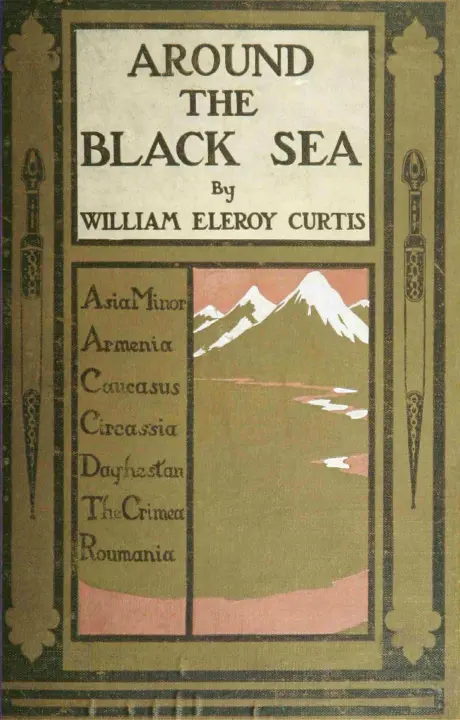
The Turk and his lost provinces
William Eleroy Curtis

THE CLASSIC COLLECTION · 1888
"The Capitals of Spanish America" by William Eleroy Curtis is a historical account written in the late 19th century. The work explores various cities that serve as capitals in Spanish America, providing insights into their history, culture, and political climate during that period. The book is particularly focused on Mexico City, contrasting its ancient traditions and modern influences. At the start of the book, the author delves into the complexities of life in Mexico City, highlighting the stark juxtaposition between ancient customs and modern advancements. He observes how indigenous practices persist amidst the introduction of new technologies and ideas, culminating in a unique social fabric where the old and the new coexist. The narrative paints a vivid picture of the city's landscape, its people, and the political dynamics under President Porfirio Diaz, setting the stage for a deeper exploration of other capitals across Spanish America.
Introduction adapted from the source catalogue; source summaries may be automatically generated.
Free to read · English · 176,291 words · No account needed
MAKE TIME FOR A GOOD BOOK
On by default. Untick to stop anonymous reading totals. Each page counts after 10 seconds in view. How this works.
Anonymous counting is on unless you have switched it off.
He said that when he and his partner were left in charge of the vessel, it was with the understanding that they were to be relieved on the 21st of December, and they were given food enough to last until that time. After the captain and crew had gone, and the two men were alone on the ship, the Indians made their appearance nearly every day, and bits of food were thrown over the side of the vessel into their canoes. Taylor and his companion each carried two revolvers, and were not at all alarmed, as the vessel lay very high on the sand, and it did not seem possible that the Indians could climb up its iron sides. Although several canoes hovered around the place daily, the savages made no unfriendly demonstrations, and no notice was taken of them further than to exchange salutations, and give them meat and bread now and then. One day the Indians traded them a string of fresh fish for a plug of tobacco, and at other times gave them furs for the same consideration. About noon on the 15th of December, while the sailor was cooking dinner in the galley, Taylor, who was at work below, heard several shots fired from a revolver on deck, with shrieks and other sounds, which proved that a fight was going on there. He drew both of his pistols, and rushing up-stairs, saw the bleeding body of his companion lying upon the deck, and one of the savages hacking at it with the cook’s knife. About twenty or twenty-five others were performing a war-dance around one of their number who lay dead, and a single glance at the scene convinced Mr. Taylor that he could find no pleasure in attending the
circus. The Indians did not see him, and he crept quickly below and stowed himself in a large coil of rope in the forward part of the hold. The space in the centre of the coil was large enough to contain his body in a stooping position, and making the hatchway as fast as he could, he piled bags of beans around the sides and on the top of the rope, so as to entirely conceal it. For two days he hid himself here, feeding upon dry uncooked beans and a box of sea-biscuits, which he fortunately found in the hold; but he was entirely without water. The third day, fearing that he would die of thirst, he crept out and drew a bucket of water from a cask on the second deck, which he carried back to his place of concealment. On this excursion he neither heard nor saw signs of the Indians, and after two days more had passed, screwed his courage up to the point of making an exploration. Arranging everything so that he could make a hasty retreat if necessary, and using bean-bags to make a rifle-pit from which he could defend himself if pursued, he crept quietly into the saloon of the vessel, where he found that the Indians had been indulging in “a high old time.” Glasses and crockery were smashed, mattresses were dragged from the cabin, and everything that was movable lay scattered helter-skelter over the dining-tables and floor. It was evident that a search had been made for him, as doors which were locked had been broken open, although no attempt had been made to remove the coverings from the hatchways which led into the hold. Only one deck presented signs of a search, and above all was perfectly quiet. Going up-stairs, Taylor found human bones, picked clean, scattered around the galley. He did not touch them, because to look at them gave him the “shivers,” he said, but he saw enough to convince him that not only had the body of his companion been eaten, but also that of the savage who had been killed in the fray. It was evident that the savages had enjoyed a long and lively picnic, for there were several places on the deck where fires had been built. It was a wonder to him that the vessel had not been burned to the water’s edge. While hunting around for food, he found the head of his companion with the neck chopped off close to the jaws, the eyes punched out, and the fleshy part of the cheeks cut off. The sight of this was so horrible that he abandoned further exploration, and returned to his place of confinement so faint and bewildered that he could scarcely find his way. That night he crept out again, and finding some canned meat and fruit, lowered himself overboard and swam ashore, concluding that the Indians would return to the vessel, and that he would be safer in the rocks and bushes. Here he concealed himself for several days, awaiting the vessel that was to arrive from Valparaiso on the 21st of the month. The 25th passed without any sign of relief, and on the morning of the 26th he started on foot for Punta Arenas, where he arrived two days after. Here he told his story, and instead of being welcomed with hospitality, was arrested and thrown into jail, charged with the murder of his companion. A boat was sent down to the wreck, and such evidence was found there as to convince every one of the truth of his statement; whereupon he was released, and is now at Punta Arenas, in the employment of the Steamship Company, on an old hulk which lies in the harbor and is used for the storage of coal.
Your reading position is saved on this browser. Take it to another device with a library code. Reading pages adapt to text, rather than matching a printed edition.
William Eleroy Curtis
William Eleroy Curtis
William Eleroy Curtis
William Eleroy Curtis
BEHIND THE BOOK
This eBook is for the use of anyone anywhere in the United States and most other parts of the world at no cost and with almost no restrictions whatsoever. You may copy it, give it away or re-use it under the terms of the Project Gutenberg License included with this eBook or online at www.gutenberg.org. If you are not located in the United States, you will have to check the laws of the country where you are located before using this eBook. Read the source licence.
The original source file, including credits and licence, is retained by this library. Request an original-format copy at no charge. Please include the book title and Project Gutenberg identifier #50298.
KEEP YOUR CURIOSITY GOING
Wilfrid Scawen Blunt
Wilfrid Scawen Blunt

E. W. (Edgar Watson) Howe
Cécile Tormay

Moritz Busch
John L. Ransom