THE CLASSIC COLLECTION✦The Spectacle Man: A Story of the Missing BridgeCLASSIC FREE BOOKS
The Spectacle Man: A Story of the Missing Bridge
Mary Finley Leonard
THE CLASSIC COLLECTION · 1901
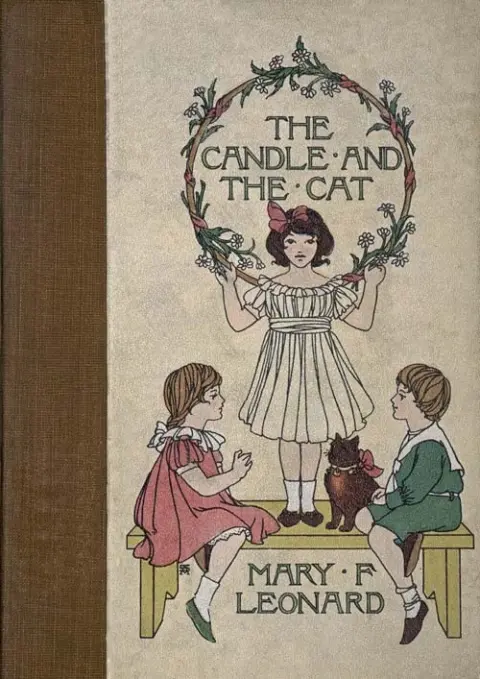
"The Candle and the Cat" by Mary Finley Leonard is a children's novel written in the early 20th century. The story centers around a young girl named Caro and her adventures with her beloved cat, Trolley, in the context of her family's interactions with their neighbors, particularly the reclusive Grayson family. The themes of friendship, kindness, and the importance of light—a metaphor for hope and cheer—are woven throughout the narrative. The plot unfolds as Caro, staying with her grandfather, attempts to bring happiness to her new surroundings and those she meets. Struggling with her fear of the dark, Caro is given a special silver candlestick that belonged to her grandmother, which symbolizes her desire for comfort and warmth amid uncertainties. As she ventures to visit Walter Grayson, the sickly young man unable to walk, she unknowingly helps bridge the gap between the Graysons and her family, thus restoring old friendships and creating new bonds. The story culminates in a heartwarming Christmas celebration that highlights themes of reconciliation, community, and the cherished moments that unite people across differences.
Introduction adapted from the source catalogue; source summaries may be automatically generated.
Free to read · English · 15,587 words · No account needed
MAKE TIME FOR A GOOD BOOK
On by default. Untick to stop anonymous reading totals. Each page counts after 10 seconds in view. How this works.
Anonymous counting is on unless you have switched it off.
Persons who could be angry at her grandfather certainly could not be nice, Caro thought. “But what was the gate for?” she asked.
“A long time ago when Sister Alice and Brother Charlie were little they used to play with the Graysons.”
“Oh, are there children there?”
“No, indeed; that was a long time ago; but Caro--” Marjorie’s voice sank to a whisper--“there’s a man over there who has something the matter with him. He can’t walk, and a servant pushes him around in a chair. Nobody ever sees him, but one day I peeped over the fence and there he was, all wrapped up and--dear! but I was scared!”
“He couldn’t hurt you, could he?”
“No--I suppose not, but he might say something to me.”
“Well that wouldn’t hurt. I’d like to see him,” said Caro.
All this was so interesting she had come near forgetting her candle. Now she thought of it and told Marjorie about it. “Just think,” she added, “my own grandmother’s candlestick--when she was a little girl.”
“I think I’ll ask mamma to give me one,” Marjorie said.
“What did grandpa mean when he said he wanted me to be a candle? Do you
know?”
“He meant you must be good, I ’spect,” Marjorie replied in an offhand manner as she picked some Spanish needles from her dress.
“Candles aren’t good; that’s silly,” said Caro scornfully.
“I don’t care, he meant something like that; you ask him.”
She did ask him that evening. It was just at twilight and Dr. Barrows was sealing a letter to his daughter when Caro seated herself on the arm of his chair. “Can I talk to you grandpa?” she asked; and as if he too wished to join in the conversation, Trolley, with one silent spring was on the study table, close to the president’s elbow.
“He’ll do for a paper weight, won’t he?” laughed Caro, as the cat gravely seated himself on the notes for to-morrow’s lecture. “And he can lick your stamps for you,” she added.
Her grandfather laughed a little at this bright idea. “Well Mischief,” he asked, “what do you wish to talk about?”
“I want to know how I can be a candle?”
“What do candles do?”
“Shine?”
“Yes; they make a little brightness--give a little cheer. Can’t my girl
do that?”
“Marjorie said you meant ‘be good.’”
“Well--yes, only I should say be loving and kind. There are so many sad, lonely, worried people in the world, who need a little cheer. The very best way to be a candle is to love people, Caro.”
Your reading position is saved on this browser. Take it to another device with a library code. Reading pages adapt to text, rather than matching a printed edition.
Mary Finley Leonard
Mary Finley Leonard
Mary Finley Leonard
Mary Finley Leonard
BEHIND THE BOOK
This eBook is for the use of anyone anywhere in the United States and most other parts of the world at no cost and with almost no restrictions whatsoever. You may copy it, give it away or re-use it under the terms of the Project Gutenberg License included with this eBook or online at www.gutenberg.org. If you are not located in the United States, you will have to check the laws of the country where you are located before using this eBook. Read the source licence.
The original source file, including credits and licence, is retained by this library. Request an original-format copy at no charge. Please include the book title and Project Gutenberg identifier #58263.
KEEP YOUR CURIOSITY GOING
Coulson Kernahan

Maurice Baring
Frances Wright
Cécile Tormay

Frederic Jesup Stimson

W. H. P. (William Henry Pope) Jarvis