THE CLASSIC COLLECTION✦The scarab murder caseCLASSIC FREE BOOKS
The scarab murder case
S. S. Van Dine
THE CLASSIC COLLECTION · 1927
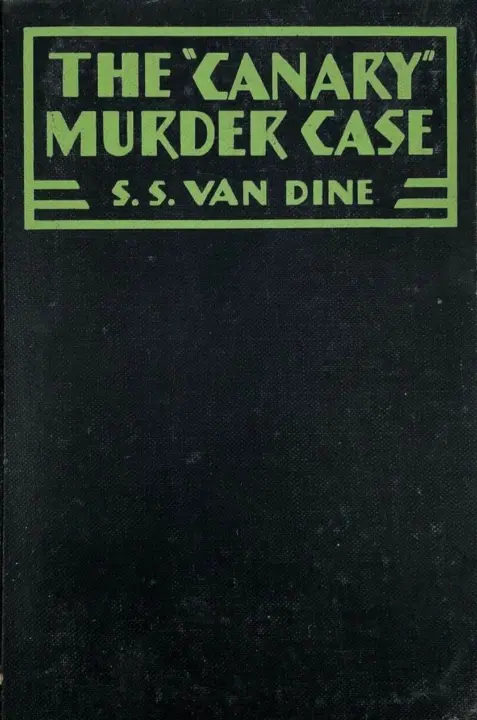
"The 'Canary' Murder Case" by S. S. Van Dine is a murder mystery novel published in 1927. When a beautiful Broadway singer known as "the Canary" is found dead in her apartment, detective Philo Vance must untangle a web of suspects ranging from high society to gangsters. Multiple men visited her the night she died, each with secrets to hide. Only Vance's keen intellect can penetrate a clever alibi and solve one of New York's most baffling cases.
Introduction adapted from the source catalogue; source summaries may be automatically generated.
Free to read · English · 85,708 words · No account needed
MAKE TIME FOR A GOOD BOOK
On by default. Untick to stop anonymous reading totals. Each page counts after 10 seconds in view. How this works.
Anonymous counting is on unless you have switched it off.
When Spively had been dismissed, Markham rose and strode about the room, his head enveloped in a cloud of cigar smoke, while Heath sat stolidly watching him, his brows knit.
Vance stood up and stretched himself.
“The absorbin’ problem, it would seem, remains in statu quo,” he remarked airily. “How, oh how, did the fair Margaret’s executioner get in?”
“You know, Mr. Markham,” rumbled Heath sententiously, “I’ve been thinking that the fellow may have come here earlier in the afternoon—say, before that side door was locked. Odell herself may have let him in and hidden him when the other man came to take her to dinner.”
“It looks that way,” Markham admitted. “Bring the maid in here again, and we’ll see what we can find out.”
When the woman had been brought in, Markham questioned her as to her actions during the afternoon, and learned that she had gone out at about four to do some shopping, and had returned about half past five.
“Did Miss Odell have any visitor with her when you got back?”
“No, sir,” was the prompt answer. “She was alone.”
“Did she mention that any one had called?”
“No, sir.”
“Now,” continued Markham, “could any one have been hidden in this apartment when you went home at seven?”
The maid was frankly astonished, and even a little horrified.
“Where could any one hide?” she asked, looking round the apartment.
“There are several possible places,” Markham suggested: “in the bathroom, in one of the clothes-closets, under the bed, behind the window draperies. . . .”
The woman shook her head decisively. “No one could have been hidden,” she declared. “I was in the bathroom half a dozen times, and I got Miss Odell’s gown out of the clothes-closet in the bedroom. As soon as it began to get dark I drew all the window-shades myself. And as for the bed, it’s built almost down to the floor; no one could squeeze under it.” (I glanced closely at the bed, and realized that this statement was quite true.)
“What about the clothes-closet in this room?” Markham put the question hopefully, but again the maid shook her head.
“Nobody was in there. That’s where I keep my own hat and coat, and I took them out myself when I was getting ready to go. I even put away one of Miss Odell’s old dresses in that closet before I left.”
“And you are absolutely certain,” reiterated Markham, “that no one could have been hidden anywhere in these rooms at the time you went home?”
“Absolutely, sir.”
Your reading position is saved on this browser. Take it to another device with a library code. Reading pages adapt to text, rather than matching a printed edition.
BEHIND THE BOOK
This eBook is for the use of anyone anywhere in the United States and most other parts of the world at no cost and with almost no restrictions whatsoever. You may copy it, give it away or re-use it under the terms of the Project Gutenberg License included with this eBook or online at www.gutenberg.org. If you are not located in the United States, you will have to check the laws of the country where you are located before using this eBook. Read the source licence.
The original source file, including credits and licence, is retained by this library. Request an original-format copy at no charge. Please include the book title and Project Gutenberg identifier #70788.
KEEP YOUR CURIOSITY GOING
Coulson Kernahan

Maurice Baring
Frances Wright
Cécile Tormay

Frederic Jesup Stimson

W. H. P. (William Henry Pope) Jarvis