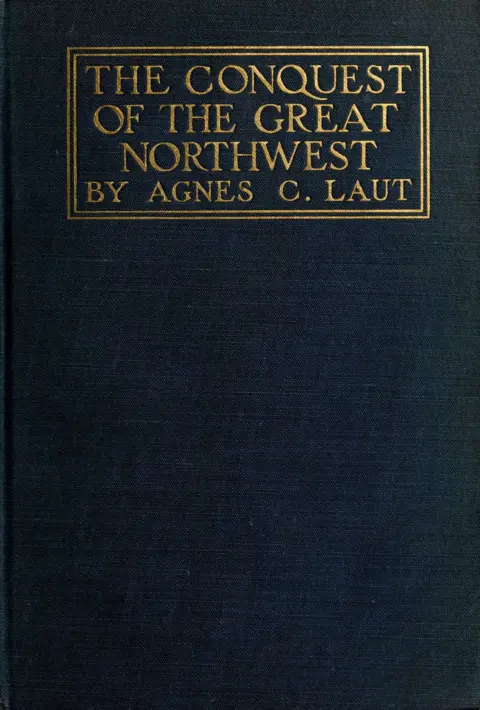
The conquest of the great Northwest, Volume 2 (of 2)
Agnes C. Laut
THE CLASSIC COLLECTION · 1915
"The Canadian Commonwealth" by Agnes C. Laut is a historical account written in the early 20th century. The book focuses on the formation and development of Canadian national consciousness, exploring Canada's unique path to identity and unity compared to other nations, particularly in the context of its diverse cultural roots and political landscape. It discusses the colonial legacies, the impact of immigration, and the tensions between various regional identities, notably among French and English Canadians. The opening portion of the work delves into the concept of national consciousness in Canada, contrasting its development with that of other nations. Laut emphasizes that Canada's identity was forged not through conquest or a desire for dominance, but through unyielding determination and collective ideals stemming from religious, political, and practical pursuits across its various groups. She charts the initial settlement of Canada, the struggles for acknowledgement and governance following the fall of New France, and the persistence of its people to create a system that values law and integrity over mere economic success. This section sets the stage for a nuanced discussion on the roles of different peoples in Canada’s historical journey, suggesting that the nation's consciousness emerged out of challenges and ideals rather than from the chase of material wealth or territorial expansion.
Introduction adapted from the source catalogue; source summaries may be automatically generated.
Free to read · English · 77,046 words · No account needed
MAKE TIME FOR A GOOD BOOK
On by default. Untick to stop anonymous reading totals. Each page counts after 10 seconds in view. How this works.
Anonymous counting is on unless you have switched it off.
So why should Canada become excited over national defense? On the south is a boundary without a fort, without a gun, guarded by a powerful nation with a Monroe Doctrine challenging the world neither to seize nor colonize in the Western Hemisphere. On the east for three thousand miles washes the Atlantic, on the west for five thousand miles the Pacific--what has Canada to fear? "Why," asked the Conservatives, "should we support the Laurier policy of building a tin-pot navy?" "Why," retorted the Liberals when Laurier went out and Borden went in, "should we support the Borden Navy Bill to contribute good Canadian cash to a British navy?"
Besides, in the back of Canada's collective head--as it were--in a sort of unspoken consciousness was the almost religious conviction that the Dominion had contributed her share toward Imperial defense in her transportation system. Had she not granted fifty-five million acres of land for the different transcontinentals and spent far over a billion in loans and subsidies and guarantees? Value that land at ten dollars an acre. That was tantamount to an expenditure of two hundred dollars per capita for a transportation system of use to the empire in Imperial defense. Seventy trainloads of Hindu troops were rushed across Canada in cars with drawn blinds and transported to Europe before the enemy knew such a movement was contemplated. Should Turkey ever cut off Suez, Canada and Panama would be England's route to India. In addition, Canada considers herself the granary of the empire. Should Suez ever cut off the path to India and Australia, what colony could feed England but Canada?
You will note that Canada's thought concerned the empire, not herself. The reason for the navy bills proposed by both parties has been Imperial defense. That Canada might some day be compelled to fight for her own existence--and fight to the death for it--never dawned on her legislators; and their unconsciousness of national peril is the profoundest testimony to the pacific intentions of the United States that could be given. It seems almost treason at this era of world war to call Canada's attention to the fact that the greatest danger is not to Imperial defense. It is to Canada's national defense. Uncle Sam has been Canada's big brother, but what if when the danger came, his arms were tied in a conflict of his own? Whatever comes to menace the United States will menace the safety of Canada; and with swift cruisers, Europe and Asia are nearer Canada to-day than Halifax is near Vancouver. Either city could be attacked by foreign powers before military aid could be transported across the width of Canada. We are nearer Europe to-day than the North was near the South in the Civil War. It takes a shorter time to transport troops across Atlantic or Pacific than it formerly took to send a Minnesota regiment to Maryland. Including Quebec, Montreal, old Port Royal, Annapolis, Louisburg and the forts on Hudson Bay, Canada's chief strongholds of defense have been taken and retaken seven times by European enemies in one hundred and sixty years--between 1629 and 1789. Day was when Quebec fortifications cost so much that the King of France wanted to know if they were laid in gold. Before the fall of Quebec in 1759, Louisburg--a forgotten fortress of Cape Breton--was considered one of France's strongholds. Have Canadians forgotten the frightful wreck of the British fleet in the St. Lawrence in 1711 under Sir Havender Walker; or the defeat of the admiralty ships manned by the Hudson's Bay fur-traders up off Port Nelson in 1697 by Lemoyne d' Iberville? Before La Perouse reduced Churchill it was regarded as a second Gibraltar. Yet Churchill and Nelson and Quebec and Louisburg all fell before a foreign foe, and Europe is nearer to-day than she was in those eras of terrible defeat. What additional fortifications or defenses has Canada to be so cocksure that history can never repeat itself? She is not resting under the Monroe Doctrine. It is a safe wager that many Canadians have never heard of the Monroe Doctrine. Besides, the minute Canada voluntarily enters a European war, does she forfeit American "protection" under that Monroe Doctrine? The idea of being "protected" by any power but her own--and Britain's--right arm Canada would scout to derision. Yet what are her own national defenses?
Your reading position is saved on this browser. Take it to another device with a library code. Reading pages adapt to text, rather than matching a printed edition.
Agnes C. Laut
Agnes C. Laut
Agnes C. Laut
Agnes C. Laut
BEHIND THE BOOK
This eBook is for the use of anyone anywhere in the United States and most other parts of the world at no cost and with almost no restrictions whatsoever. You may copy it, give it away or re-use it under the terms of the Project Gutenberg License included with this eBook or online at www.gutenberg.org. If you are not located in the United States, you will have to check the laws of the country where you are located before using this eBook. Read the source licence.
The original source file, including credits and licence, is retained by this library. Request an original-format copy at no charge. Please include the book title and Project Gutenberg identifier #18032.
KEEP YOUR CURIOSITY GOING
Cécile Tormay

Moritz Busch
John L. Ransom
Frances Wright
Cécile Tormay

Mabel Potter Daggett