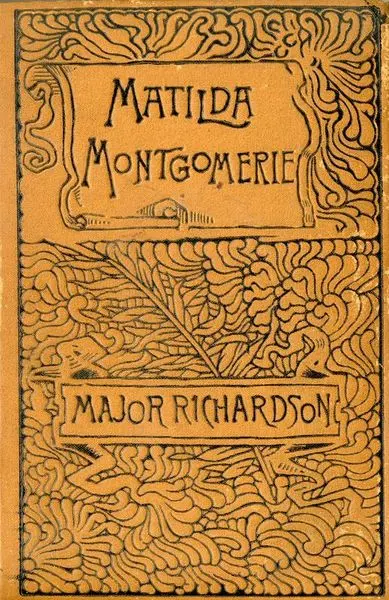
Matilda Montgomerie; Or, The Prophecy Fulfilled
Major (John) Richardson
THE CLASSIC COLLECTION · 1840
"The Canadian Brothers; Or, The Prophecy Fulfilled: A Tale of the Late American War" by John Richardson is a novel published in 1840. This sequel to Richardson's "Wacousta" follows British officers Gerald and Henry Grantham during the War of 1812. When Gerald falls for Matilda Montgomerie, an American woman, he becomes entangled with the villainous Jeremiah Desborough, a descendant of the previous novel's antagonist. Set against battles around Detroit and Lake Erie, the story fulfills a dark prophecy while exploring loyalty, romance, and revenge during wartime.
Introduction adapted from the source catalogue; source summaries may be automatically generated.
Free to read · English · 73,885 words · No account needed
MAKE TIME FOR A GOOD BOOK
On by default. Untick to stop anonymous reading totals. Each page counts after 10 seconds in view. How this works.
Anonymous counting is on unless you have switched it off.
Amid this uproar of the usually placid river, there was but one bark found bold enough to venture upon her angered bosom, and this, although but an epitome of those that have subdued the world of waters, and chained them in subservience to the will of man, now danced gallantly, almost terrifically, from billow to billow, and, with the feathery lightness of her peculiar class, seemed borne onward, less by the leaping waves themselves than by the white and driving spray that fringed their summits. This bark--a canoe evidently of the smallest description --had been watched in its progress, from afar, by the groups assembled on the bank, who had gathered at each other's call, to witness and marvel at the gallant daring of those who had committed it to the boiling element. Two persons composed her crew--the one, seated in the stern, and carefully guiding the bark so as to enable her to breast the threatening waves, which, in quick succession, rose as if to accomplish her overthrow--the other, standing at her bows, the outline of his upper figure designed against the snow-white sail, and, with his arms folded across his chest, apparently gazing without fear on the danger which surrounded him. It was evident, from their manner of conducting the bark, that the adventurers were not Indians, and yet there was nothing to indicate to what class of the white family they belonged. Both were closely wrapped in short, dark coloured pea coats, and their heads were surmounted with glazed hats--a species of costume that more than any thing else, proved their familiarity with the element whose brawling they appeared to brave with an indifference bordering on madness.
Such was the position of the parties, at the moment when Henry Grantham gained the bank. Hitherto the canoe, in the broad reach that divided the island from the American mainland, had had merely the turbulence of the short heavy waves, and a comparatively modified current, to contend against. Overwhelming even as these difficulties would have proved to men less gifted with the power of opposing and vanquishing them, they were but light in comparison with what remained to be overcome. The canoe was now fast gaining the head of the island, and pursuing a direct course for the whirlpool already described. The only means of avoiding this was by closely hugging the shore, between which and the violent eddy without, the water, broken in its impetuosity by the covering head land, presented a more even and less agitated surface. This head land once doubled, the safety of the adventurers was ensured, since, although the tremendous current which swept through the inner channel must have borne them considerably downwards, still the canoe would have accomplished the transit below the town in perfect safety. The fact of this opportunity being neglected, led at once to the inference that the adventurers were total strangers, and distinct voices were now raised by those on the bank, to warn them of their danger--but whether it was that they heard not, or understood not, the warning was unnoticed. Once indeed it seemed as if he who so ably conducted the course of the bark, had comprehended and would have followed the suggestion so earnestly given, for his tiny sail was seen to flutter for the first time in the wind, as with the intention to alter his course. But an impatient gesture from his companion in the bow, who was seen to turn suddenly round, and utter something, (which was however inaudible to those onshore,) again brought the head of the fragile vessel to her original course, and onward she went leaping and bounding, apparently with the design to clear the whirlpool at a higher point of the river. Nothing short of a miracle could now possibly enable them to escape being drawn into the boiling vortex, and, during the moments that succeeded, every heart beat high with fearful expectation as to the result. At length the canoe came with a sudden plunge into the very centre of the current, which, all the skill of the steersman was insufficient to enable him to clear. Her bow yawed, her little sail fluttered--and away she flew, broadside foremost, down the stream with as little power of resistance as a feather or a straw. Scarcely had the eye time to follow her in this peculiar descent, when she was in the very heart of the raging eddy. For a moment she reeled like a top, then rolled two or three times over, and finally disappeared altogether. Various expressions of horror broke from the several groups of whites and Indians, all of whom had anticipated the catastrophe without the power of actively interposing. Beyond the advice that was given, not a word was uttered, but every eye continued fixed on the whirlpool, as though momentarily expecting to see something issue from its bosom. After the lapse of a minute, a dark object suddenly presented itself some twenty yards below, between the island and the town. It was the canoe which, bottom upwards, and deprived of its little mast and sail, had again risen to the surface, and was floating rapidly down with the current. Presently afterwards two heads were seen nearly at the point where the canoe had again emerged. They were the unfortunate adventurers, one of whom appeared to be supporting his companion with one arm, whilst with the other he dashed away the waters that bore them impetuously along. The hats of both had fallen off, and as he who exerted himself so strenuously, rose once or twice in the vigour of his efforts above the element with which he contended, he seemed to present the grisly, woolly hair, and the sable countenance of an aged negro. A vague surmise of the truth now flashed upon the mind, of the excited officer, but when, presently afterwards, he saw the powerful form once more raised, and in a voice that made itself distinctly heard above the howling of the wind, exclaim: "Help a dare," there was no longer a doubt, and he rushed towards the dock yard, to gain which the exertions of the negro were now directed.
Your reading position is saved on this browser. Take it to another device with a library code. Reading pages adapt to text, rather than matching a printed edition.
Major (John) Richardson
Major (John) Richardson
Major (John) Richardson
Major (John) Richardson
BEHIND THE BOOK
This eBook is for the use of anyone anywhere in the United States and most other parts of the world at no cost and with almost no restrictions whatsoever. You may copy it, give it away or re-use it under the terms of the Project Gutenberg License included with this eBook or online at www.gutenberg.org. If you are not located in the United States, you will have to check the laws of the country where you are located before using this eBook. Read the source licence.
The original source file, including credits and licence, is retained by this library. Request an original-format copy at no charge. Please include the book title and Project Gutenberg identifier #5107.
KEEP YOUR CURIOSITY GOING
Cécile Tormay

Moritz Busch
Coulson Kernahan
John L. Ransom

Maurice Baring
Frances Wright