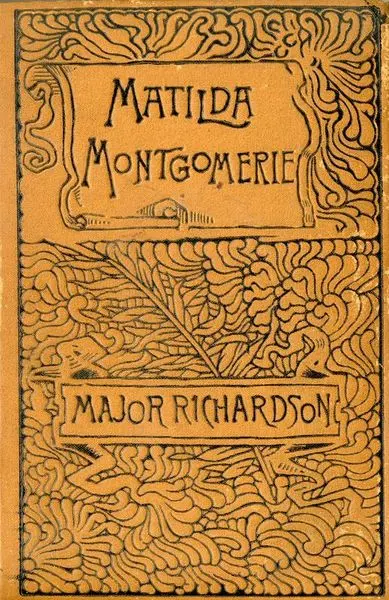
Matilda Montgomerie; Or, The Prophecy Fulfilled
Major (John) Richardson
THE CLASSIC COLLECTION · 1840
"The Canadian Brothers; Or, The Prophecy Fulfilled: A Tale of the Late American War" by John Richardson is a novel published in 1840. This sequel to Richardson's "Wacousta" follows British officers Gerald and Henry Grantham during the War of 1812. When Gerald falls for Matilda Montgomerie, an American woman, he becomes entangled with the villainous Jeremiah Desborough, a descendant of the previous novel's antagonist. Set against battles around Detroit and Lake Erie, the story fulfills a dark prophecy while exploring loyalty, romance, and revenge during wartime.
Introduction adapted from the source catalogue; source summaries may be automatically generated.
Free to read · English · 73,885 words · No account needed
MAKE TIME FOR A GOOD BOOK
On by default. Untick to stop anonymous reading totals. Each page counts after 10 seconds in view. How this works.
Anonymous counting is on unless you have switched it off.
Major Grantham beheld with dismay the effect of this blow upon his beloved wife. Fell consumption had now marked her for his own, and so rapid was the progress of the disease acting on a temperament already too much pre-disposed to its influence, that, in despite of all human preventives, the sensitive Isabella, before six months had elapsed, was summoned to a better world.
And never did human being meet the summons with more perfect resignation to the Divine will. The death-bed scene between that tender mother and her sorrowing family, was one which might have edified even the most pious. Gerald, as we have already said, was in his twelfth year at the period of this afflicting event--his brother Henry, one year younger; both were summoned from school on the morning of her death--both knew that their fond mother was ill--but so far were they from imagining the scene about to be offered to their young observation, that when they reached home it was with the joyous feeling of boys, exulting in a momentary liberation from scholastic restraint, and eagerly turning into holiday, that which they little deemed would so soon become a day of mourning. How rapidly was the deceitful illusion dispelled, when, on entering the sick chamber of their adored parent, they beheld what every surrounding circumstance told them was not the mere bed of sickness, but the bed of death. Propped on pillows that supported her feeble head--her beautiful black hair streaming across her pallid, placid brow, and her countenance wearing a holy and religious calm, Mrs. Grantham presented an image of resignation, so perfect, so superhuman, that the disposition to a violent ebullition of grief, which at first manifested itself in the youths, gave place to a certain mysterious awe, that chained them almost spell-bound at the foot of her bed. A strict observer of the ordinances of her religion, she had had every preparation made for her reception of the sacrament, the administering of which was only deferred until the arrival of her children. This duty being now performed, with the imposing solemnity befitting the occasion, the venerable clergyman, who had known and loved her from her infancy, imprinted a last kiss upon her brow, and left the apartment deeply affected. Then, indeed, for the first time, was a loose given to the grief that pervaded every bosom, even to the lowest of the domestics, who had been summoned to receive her parting blessing. Close to the bed-side, each pressing one of her emaciated hands to his lips, knelt her heart-broken sons, weeping bitterly, while, from the chest of a tall negro, apparently an old and attached servant, burst forth at intervals convulsive sobs. Even the austere Major Grantham, seated at some little distance from the bed, contemplating the serene features of his dying wife, could not restrain the tears that forced themselves forth, and trickled through his fingers, as he half sought to conceal his emotion from his servants. In the midst of the profound sorrow which environed her, Mrs. Grantham alone was unappalled by her approaching end: she spoke calmly and collectedly, gently chiding some and encouraging others; giving advice, and conveying orders, as if she was merely about to undertake a short customary journey instead of that long, and untravelled one, whence there is neither communication nor return. To her unhappy sons she gave it in tender injunction to recompense their father by their love for the loss he was about to sustain in herself; and to her servants she enjoined to be at once dutiful to their master and affectionate to her children. Having made her peace with God, and disposed, of herself, her consideration, was now exclusively for others--and, during the hour which intervened between the departure of the clergyman and her death, the whole tenor of her thoughts was directed to the alleviation of the sorrow which she felt would succeed the flight of her spirit from earth. As she grew fainter, she motioned to her husband to come near her--He did so, and, with a smile of rapt serenity that bespoke the conviction strong at her heart, she said in a low tone, as she clasped his warm hand within her own, already stiffening with the chill of death: "Grieve not, I entreat you, for recollect that, although we part, it is not for ever. Oh, no! my father, my mother, my brothers, and you my husband, and beloved children, we shall all meet again." Exhausted with the energy she had thrown into these last words, she sank back upon the pillow, from which she had partially raised her head. After a short pause, she glanced her eye on a portrait that hung on the opposite wall. It represented an officer habited in the full uniform of her father's regiment. She next looked at the negro, who, amid his unchecked sorrow, had been an attentive observer of her every action, and pointed expressively first to her kneeling children, and then to the portrait. The black seemed to understand her meaning; for he made a sign of acquiescence. She then extended her hand to him, which he kissed, and bedewed with his tears, and retreated sobbing to his position near the foot of the bed. Two minutes afterwards, Mrs. Grantham had breathed her last, but so insensibly that, although every eye was fixed upon her, no one could tell the precise moment at which she had ceased to exist.
Your reading position is saved on this browser. Take it to another device with a library code. Reading pages adapt to text, rather than matching a printed edition.
Major (John) Richardson
Major (John) Richardson
Major (John) Richardson
Major (John) Richardson
BEHIND THE BOOK
This eBook is for the use of anyone anywhere in the United States and most other parts of the world at no cost and with almost no restrictions whatsoever. You may copy it, give it away or re-use it under the terms of the Project Gutenberg License included with this eBook or online at www.gutenberg.org. If you are not located in the United States, you will have to check the laws of the country where you are located before using this eBook. Read the source licence.
The original source file, including credits and licence, is retained by this library. Request an original-format copy at no charge. Please include the book title and Project Gutenberg identifier #5107.
KEEP YOUR CURIOSITY GOING
Cécile Tormay

Moritz Busch
Coulson Kernahan
John L. Ransom

Maurice Baring
Frances Wright