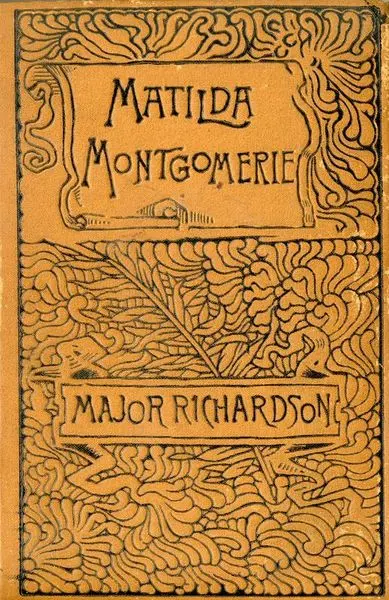
Matilda Montgomerie; Or, The Prophecy Fulfilled
Major (John) Richardson
THE CLASSIC COLLECTION · 1840
"The Canadian Brothers; Or, The Prophecy Fulfilled: A Tale of the Late American War" by John Richardson is a novel published in 1840. This sequel to Richardson's "Wacousta" follows British officers Gerald and Henry Grantham during the War of 1812. When Gerald falls for Matilda Montgomerie, an American woman, he becomes entangled with the villainous Jeremiah Desborough, a descendant of the previous novel's antagonist. Set against battles around Detroit and Lake Erie, the story fulfills a dark prophecy while exploring loyalty, romance, and revenge during wartime.
Introduction adapted from the source catalogue; source summaries may be automatically generated.
Free to read · English · 73,885 words · No account needed
MAKE TIME FOR A GOOD BOOK
On by default. Untick to stop anonymous reading totals. Each page counts after 10 seconds in view. How this works.
Anonymous counting is on unless you have switched it off.
Upwards of a fortnight had elapsed since his arrival, and yet, although Captain Jackson, prior to his return to Sandusky, had personally introduced him to many highly respectable families in Frankfort, he uniformly abstained from cultivating their acquaintance, until at length he was, naturally enough, pronounced to be a most disagreeable specimen of a British officer. Even with the inmates of the hotel, many of whom were officers of his own age, and with whom he constantly sat down to the ordinary, he avoided every thing approaching to intimacy--satisfying himself merely with discharging his share of the commonest courtesies of life. They thought it pride--it was but an effect--an irremediable effect of the utter sinking of his sad and broken spirit. The only distraction in which he eventually took pleasure, or sought to indulge, was rambling through the wild passes of the chain of wooded hills, which almost encircles the Kentuckian capital, and extends for a considerable distance in a westerly direction. The dense gloom of these narrow vallies he had remarked on his entrance by the same route, and feeling them more in unison with his sick mind than the hum and bustle of a city, which offered nothing in common with his sympathies, he now frequently passed a great portion of the day in threading their mazes--returning however, at a certain hour to his hotel, conformably with the terms of his parole.
On one occasion, tempted by the mellow beauty of the season (it was now the beginning of October) he had strayed so far, and through passes so unknown to him, that when the fast advancing evening warned him of the necessity of returning, he found he had utterly lost his way. Abstracted as he usually was, he had yet reflection enough to understand that his parole of honor required he should be at his hotel at an hour, which it would put his speed to the proof to accomplish. Despairing of finding his way by the circuitous route he had originally taken, and the proper clue to which he had moreover lost, he determined, familiar as he was with the general bearings of the capital, to effect his return in a direct line across the chain of hills already alluded to. The deepening shadows of the wild scene, as he proposed to ascend that immediately before him, told that the sun had sunk beneath the horizon, and when he gained its summit, the last faint corruscations of light were passing rapidly away in the west. Still, by the indistinct twilight he could perceive that at his feet lay a small valley, completely hemmed in by the circular ridge on which he stood. This traversed, it was but to ascend the opposite section of the ridge, and his destination would be gained. Unlike the narrow rocky passes, which divided the hills in every other direction, in which he had previously wandered, this valley was covered with a luxuriant verdure, and upon this the feet of Gerald moved inaudibly even to himself. As he advanced more into the centre of the little plain, he thought he could perceive, at its extremity on the right, the dark outline of a building--apparently a dwelling house--and while he yet hesitated, whether he should approach it and inquire his most direct way to the town, a light suddenly appeared at that point of the valley for which he was already making. A few minutes sufficed to bring him to the spot whence the light had issued. It was a small circular building, possibly intended for a summer-house, but more resembling a temple in its construction, and so closely bordering upon the forest ridge, by a portion of the foliage by which it had previously been concealed, as to be almost confounded with it. It was furnished with a single window, the same through which the light now issued, and this narrow, elongated, and studded with iron bars, was so placed as to prevent one even taller than our hero from gazing into the interior, without the aid of some elevation. But Gerald, independently of his anxiety to reach the town in time to prevent comment upon his absence, had no desire to occupy himself with subjects foreign to his object. Curiosity was a feeling dead within his bosom, and he was preparing, without once staying his course, to ascend the ridge at the side of the temple, when he fancied he heard a suppressed groan, as of one suffering from intense agony--Not the groan, but the peculiar tone in which it was uttered, arrested his attention, and excited a vague yet stirring interest in his breast. On approaching closer to the temple, he found that at its immediate basement the earth had been thrown up into a sort of mound, which so elevated the footing as to admit of his reaching the bars of the window with his hands. Active as we have elsewhere shown him to be, he was not long in obtaining a full view of the interior, when a scene met his eye which rivetted him, as well it might, in utter astonishment. Upon the rude uncarpeted floor knelt a female, who, with clasped and uplifted hands, had her eyes fixed upon a portrait that hung suspended from the opposite wall--her figure, clad in a loose robe of black, developing by its attitude a contour of such rich and symmetrical proportion as might be difficult for the imagination to embody. And who was the being upon whom his each excited sense now lingered with an admiration little short of idolatry? One whom, a moment before, he believed to be still far distant, whom he had only a few months previously fled from, as from a pestilence, and whom he had solemnly sworn never to behold again, yet whom he continued to love with a passion that defied every effort of his judgment to subdue, making his life a wilderness--Matilda Montgomerie--And if her beauty had THEN had such surpassing influence over his soul, what was not its effect when he beheld her NOW, every grace of womanhood exhibited in a manner to excite admiration the most intense!
Your reading position is saved on this browser. Take it to another device with a library code. Reading pages adapt to text, rather than matching a printed edition.
Major (John) Richardson
Major (John) Richardson
Major (John) Richardson
Major (John) Richardson
BEHIND THE BOOK
This eBook is for the use of anyone anywhere in the United States and most other parts of the world at no cost and with almost no restrictions whatsoever. You may copy it, give it away or re-use it under the terms of the Project Gutenberg License included with this eBook or online at www.gutenberg.org. If you are not located in the United States, you will have to check the laws of the country where you are located before using this eBook. Read the source licence.
The original source file, including credits and licence, is retained by this library. Request an original-format copy at no charge. Please include the book title and Project Gutenberg identifier #5107.
KEEP YOUR CURIOSITY GOING
Cécile Tormay

Moritz Busch
Coulson Kernahan
John L. Ransom

Maurice Baring
Frances Wright